
Where Are Your Billable Hours Leaking? How AI Agents Recover Lost Time in Professional Services Firms
Billable hour leakage is not a people problem. It is a systems problem — and it is costing professional services firms far more than most partners have ever calculated. Industry data consistently shows that services firms fail to capture between 10% and 28% of their actual billable work. The hours were worked. The value was delivered. The invoice was never sent.
AI agents close that gap. Not by working longer hours, but by capturing the work that already happened — and by eliminating the administrative weight that prevents billable professionals from doing billable work.
At Tenfold, we implement AI agent systems for professional services firms. What we find, consistently, is that the leakage is structural. It lives in your workflows, not your people.
Key Takeaways:
Professional services firms lose 10–28% of billable work to administrative gaps, delayed time entry, and scope creep absorption
Billable utilization has fallen to a 19-year low of 66.4% industry-wide — well below the 75% threshold needed for healthy margins
Median PS teams spend 30–40% of delivery capacity on non-billable administrative work
AI agents recover 6+ hours per knowledge worker per week by automating time capture, admin workflows, and reporting
The fix is not more discipline — it is better systems
Quick Answer: Professional services firms lose billable revenue through delayed time entry, unbilled scope additions, manual admin overhead, and invoice cycle delays. AI agents recover this revenue by capturing work as it happens, automating compliance checks, and eliminating the manual coordination that drains consultant time.
The Scope of the Problem: Utilization at a 19-Year Low
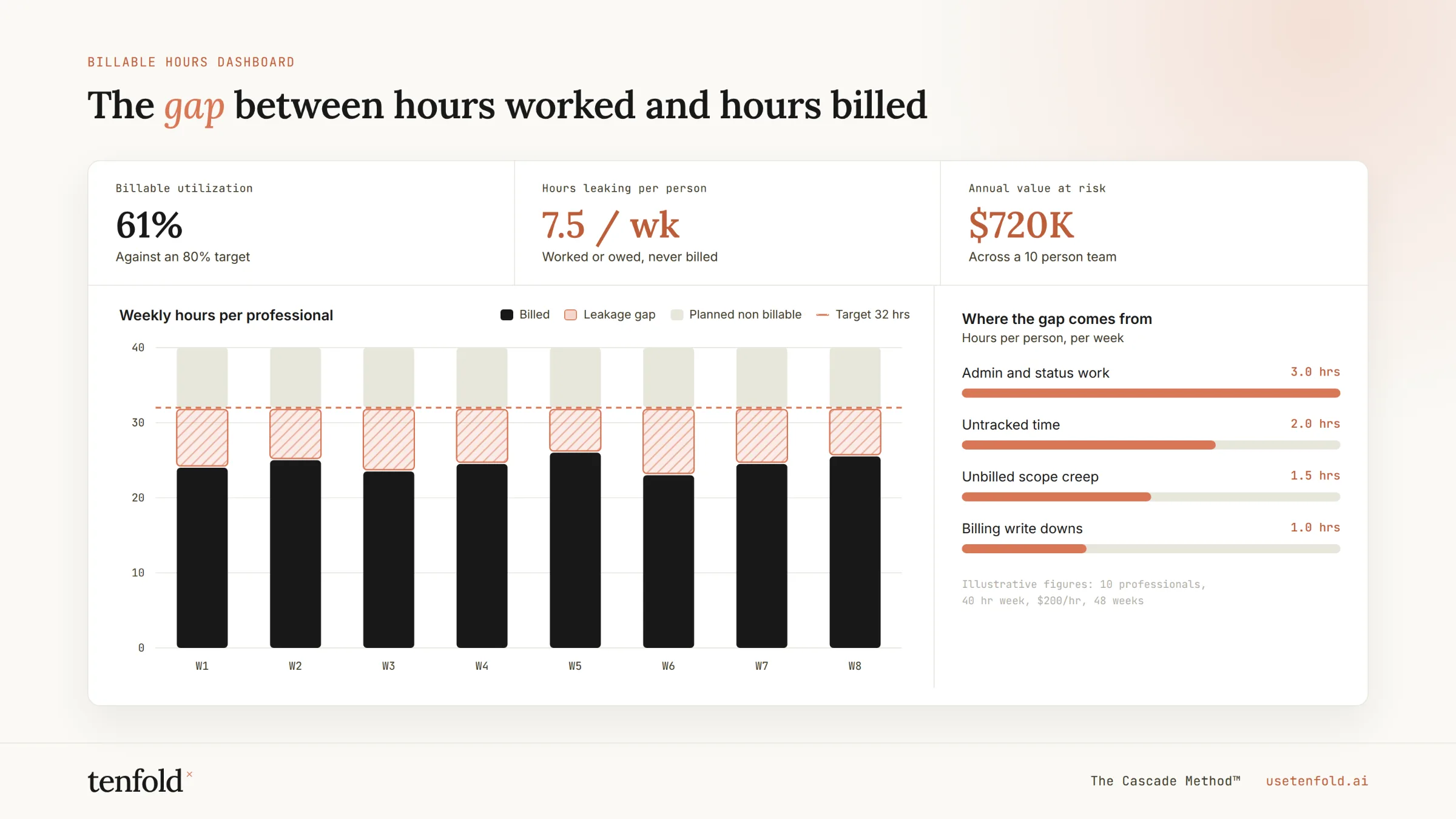
The numbers are worse than most firm leaders realize. According to SPI Research's 19th annual Professional Services Maturity Benchmark — built on survey data from 509 firms representing more than 245,000 employees — billable utilization fell to 66.4%, the lowest reading in the study's 19-year history. That is down from approximately 75% a decade ago.
An earlier wave of the same benchmark, surveying 403 firms globally, recorded billable utilization at 68.9% in 2024 — itself the lowest in five years, and a full 6.1 points below the 75% threshold considered necessary for healthy margins.
The direction is clear. Utilization has been sliding for years, and the average firm now leaves roughly a third of its paid capacity either unbilled or unrecovered.
For a firm billing at $200 per hour, a 1% improvement in utilization across 20 consultants is worth nearly $84,000 per year. The leakage problem is not abstract — it has a dollar value, and it compounds annually.
Where Billable Hours Actually Disappear
The lost hours are not dramatic. Nobody forgets to bill for a two-week engagement. The leakage happens in increments small enough to feel insignificant: a 20-minute client call that never gets logged, a half-hour of email correspondence mentally filed as overhead, a Friday afternoon fixing a deliverable already marked complete.
Those fragments add up fast. According to CarteFi's analysis of industry data, a five-person team where each member loses just 30 minutes of billable time per day generates roughly $97,000 in annual unbilled revenue at $150 per hour.
Here is where leakage concentrates across professional services firms:
1. Delayed Time Entry
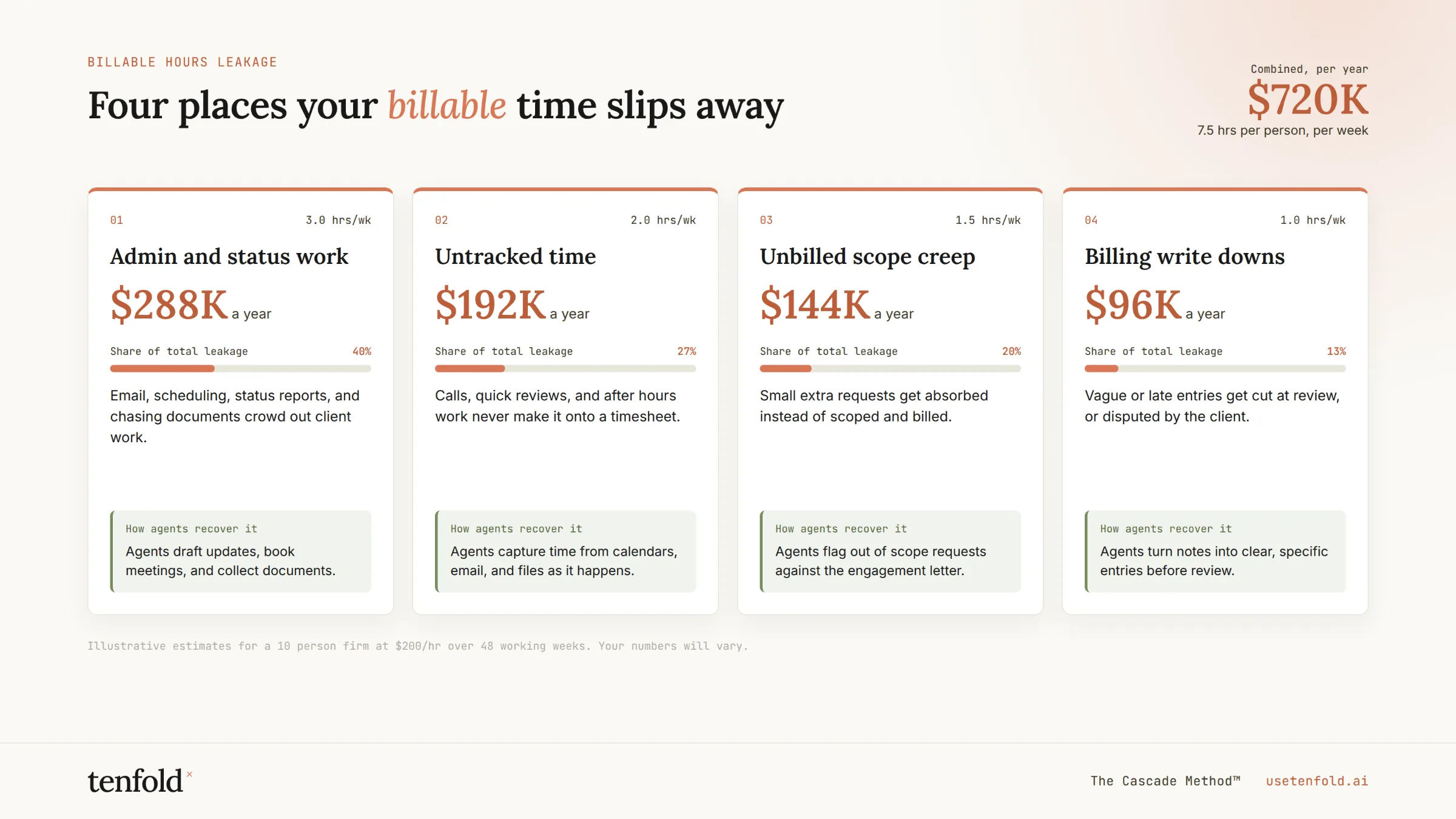
Delayed time entry is the primary culprit. According to a large-scale study of professional services firms, 22% of professionals record less than 70% of the time they spend on client work. When team members reconstruct their day from memory at week's end, they underreport. Short tasks get collapsed. Client emails get categorized as overhead. The work was real. The invoice never reflects it.
According to Clio's Legal Trends Report, the average attorney records just 2.9 hours of billable work in an eight-hour day. That leaves over five hours unbilled — every single day. At $300 per hour, that is roughly $400,000 in annual lost revenue per professional.
2. Non-Billable Task Creep
Time leaks do not look like empty calendars. They look like busywork. Clockify's time tracking data across 2,300 US firms shows that 34.1% of all work hours are non-billable. Status updates, scheduling, internal reporting, proposal prep — these tasks fill the day before any client work begins.
According to the 2025 Forrester Professional Services Automation Study, consulting firms lose 18–28% of billable capacity to manual workflows. That is not edge-case inefficiency. That is structural overhead baked into how these firms operate.
According to SPI Research's 2025 Professional Services Maturity Benchmark, PS teams without intelligent automation spend 30–40% of their delivery capacity on non-billable administrative work. The consultants are present. They are working hard. They are just not working on billable deliverables.
3. Unbilled Scope Additions
Informal scope additions are delivered and never invoiced. A client asks for one more pass on a deliverable. A quick call turns into a strategy session. A consultant absorbs the work because logging a change order feels awkward. Many service firms name scope creep as their top operational threat — and the financial impact hits fixed-fee projects hardest.
4. Invoice Cycle Delays
Even when hours are logged correctly, the billing cycle introduces its own leakage. Industry data shows an average of 12–18 days from billing period close to invoice dispatch. During that window, hours get written down, adjustments get made informally, and revenue quietly shrinks before it ever reaches an invoice.
According to Ruddr, billing leakage typically runs 3–7% of billable revenue — and for a $20M firm, that is $600,000 to $1.4 million per year that never gets invoiced. No client short-pays. No invoice gets disputed. The revenue simply never appears.
How AI Agents Close Each Leak
AI agents are not time-tracking software with better UI. They are autonomous workflow systems that execute multi-step tasks — capturing activity, flagging exceptions, routing approvals, generating documentation — without waiting for a human to remember to log in.
Here is how agent-based systems address each leakage category:
Automated Time Capture
Modern AI systems integrate with email, calendar, documents, and video calls — using activity data to identify billable work and log it automatically, without requiring manual input. When a consultant drafts an email to a client about a contract, the system logs that time and creates a narrative description. The consultant reviews; the system already did the reconstruction.
According to automated capture studies, these tools can recover 1–4 hours per professional per week without changing how the professional actually works. The behavior stays the same. The capture rate improves.
McKinsey Global AI Survey 2026 and Slack Workforce Index Q1 2026 data converge on a median of 6.4 hours saved per knowledge worker per week across AI agent deployments with telemetry — with senior practitioners saving 10–12 hours in measured implementations.
Timesheet Governance Agents
Compliance failures in time entry are usually caught at month-end — after the revenue opportunity has already been damaged. Timesheet governance agents enforce billing rules at the point of submission: billable vs. non-billable categorization, project-specific rules, regional compliance thresholds. Violations get flagged immediately, not retrospectively.
Teams deploying timesheet governance agents consistently report a 40% efficiency improvement on compliance overhead, with finance gaining accurate financial data in real time rather than waiting for end-of-period reconciliation.
Scope and Change Order Automation
AI agents can monitor project activity against contracted scope and flag additions automatically. When work is performed outside the original statement of work, the system surfaces it — making the change order conversation a data-driven prompt rather than an awkward partner conversation. Scope is captured. Revenue is protected.
Resource Allocation Optimization
Senior consultants absorbing non-billable work due to allocation blind spots is a consistent leakage source across firms. AI-powered resource management analyzes skills matrices, availability, utilization rates, and project requirements simultaneously to surface optimal staffing decisions. What takes 15–20 minutes of manual search per project becomes a 2–3 minute agent-generated recommendation.
According to 2025–2026 benchmark data, firms that actively track and optimize utilization see a 15–25% increase in project profitability — primarily by routing the right work to the right consultant before the senior partner absorbs it by default.
Invoice and Collections Automation
The billing cycle itself is a leakage point. According to the 2025 Forrester study, invoicing and collections workflows are 80–95% automatable in professional services contexts. Agent-based invoice generation, approval routing, and dispatch eliminate the 12–18 day lag and reduce the informal write-downs that happen when partners review aged work they no longer remember clearly.
The ROI Case Is Not Complicated
Consider a 20-person professional services firm billing at a blended $200/hour rate:
At 66.4% utilization (current industry average), the firm bills approximately 11,430 hours per year across 20 consultants
At 75% utilization (healthy floor), the same 20 consultants generate 12,900 billable hours
The gap: 1,470 hours — worth $294,000 at $200/hour
That gap is recoverable without a single new hire
According to McKinsey's 2025 Professional Services Automation Report, consulting firms that automate core delivery workflows reduce non-billable time by an average of 23%. For a $5M firm, that is a meaningful six-figure revenue recovery from systems that already run in the background while the team does the work.
The payback period on AI agent implementation for professional services workflows runs 4–9 months in most measured deployments.
The Bottleneck Is Not Technology — It Is System Design
The tools exist. The problem is that most professional services firms deploy AI point solutions — a chatbot here, an auto-fill there — without designing the underlying agent architecture to close the loop.
Capturing time automatically is only useful if it feeds a system that enforces billing rules. Enforcing billing rules is only useful if invoices get dispatched on time. Dispatching invoices on time is only useful if resource allocation was correct to begin with.
AI agents recover billable hours when they are designed as interconnected systems, not isolated tools. That design problem is what Tenfold solves.
Summary
Professional services firms are not losing billable revenue because their people work less. They are losing it because the systems around the work fail to capture, categorize, and convert that work into invoices. Billable utilization at a 19-year low, leakage rates of 10–28%, and 30–40% of consultant time consumed by admin overhead are not industry facts to accept — they are a recoverable margin gap.
AI agents close that gap systematically: capturing time as work happens, enforcing billing rules in real time, flagging unbilled scope, and compressing the invoice cycle. At Tenfold, this is the implementation we build for professional services firms — not AI for AI's sake, but agent infrastructure that converts worked hours into billed revenue.
Ready to see where your firm is leaking? [Talk to Tenfold about an AI agent assessment for your professional services operation.]
Frequently Asked Questions
Q: What is billable hour leakage and how common is it?
A: Billable hour leakage is work that was performed but never invoiced — due to delayed time entry, unbilled scope additions, administrative overhead, or invoice cycle failures. Industry data shows professional services firms fail to capture 10–28% of their actual billable work, making it a near-universal problem at firms of all sizes.
Q: What is causing billable utilization to fall across the industry?
A: SPI Research's benchmark data shows billable utilization declined from 73.2% in 2021 to 66.4% in the most recent survey — driven by slower revenue growth, economic uncertainty affecting client project timelines, and operational inefficiencies in how firms match and deploy consultants. The administrative burden on consultants has grown while systems to capture that work have not kept pace.
Q: Can AI agents really recover lost billable hours without changing how consultants work?
A: Yes. AI agents that integrate with email, calendar, and project tools capture billable activity passively — without requiring consultants to change their workflow. Studies show automated capture tools recover 1–4 hours per professional per week, and McKinsey's 2026 AI Survey data points to a median of 6.4 hours saved per knowledge worker weekly across full agent deployments.
Q: What percentage of consultant time is spent on non-billable administrative work?
A: According to SPI Research's 2025 Professional Services Maturity Benchmark, PS teams without intelligent automation spend 30–40% of their delivery capacity on non-billable administrative work. Clockify's data across 2,300 US firms confirms 34.1% of all work hours are non-billable on average.
Q: How long does it take to see ROI from AI agent implementation in professional services?
A: Payback periods on AI agent implementations for professional services workflows typically run 4–9 months in measured deployments. Firms implementing PSA tools correctly have reported recovering 18–23% of previously lost billable revenue within the first two quarters of go-live.
