
What Tasks Can AI Agents Handle for Your Finance Team? Month-End Close, AP, and More
More than most finance leaders expect. AI agents can process invoices, match them to purchase orders and receipts, chase missing approvals, reconcile accounts, prepare close checklists, draft variance commentary, follow up on overdue receivables, and assemble management reports. Controllers and accountants stay in charge of judgment, approvals, and sign-off. The agents take over the repetitive work that turns every month-end into a scramble.
Quick Answer: AI agents can handle accounts payable intake and matching, invoice exception follow-up, vendor inquiries, bank and account reconciliations, close checklist management, accrual and journal entry preparation for review, variance analysis drafts, collections follow-up, cash application, expense report review, and recurring financial reporting. Finance teams keep human approval over payments, journal entries, and final reporting, while the agents handle data gathering, matching, drafting, and follow-up.
Key Takeaways:
Best-in-class AP teams move an invoice from receipt to payment-ready in 3.1 days, compared with 17.4 days for the industry average, according to Ardent Partners' 2025 research.
Ardent Partners' benchmarks put the average cost to process an invoice at roughly $9 to $13, versus under $3 for best-in-class teams.
In 2025, invoice exceptions overtook cost reduction as the top challenge cited by AP professionals for the first time in Ardent Partners' research.
AI agents go beyond invoice capture: they handle exceptions, follow-ups, reconciliations, and draft close work across systems.
The best deployments keep humans approving payments, journal entries, and anything that hits the financial statements.
The Real Cost of Manual Finance Work
Finance teams are under constant pressure to close faster, report more, and do it with the same headcount. Yet much of the work is still manual: keying invoices, matching documents, chasing approvals, reconciling accounts, and building the same reports every month.
The accounts payable data shows the size of the gap. Ardent Partners' 2025 research found that best-in-class AP teams process an invoice from receipt to payment-ready in 3.1 days, while the average organization takes 17.4 days. Ardent's benchmarks also put average processing cost at roughly $9 to $13 per invoice, compared with under $3 for best-in-class teams.
Exceptions are the biggest drag. In 2025, for the first time in 19 years of Ardent Partners' research, invoice exceptions overtook cost reduction as the top challenge cited by AP professionals. Every mismatched price, missing PO, or unapproved invoice turns into an email thread, and those threads pile up right when the books need to close.
The bottleneck isn't accounting expertise. It's the volume of manual work around it.
Accounts Payable: From Intake to Payment-Ready
AP is usually the first place finance teams deploy AI agents, because the work is high-volume and rules-based.
Invoice intake. The agent reads invoices from email inboxes and portals, extracts the data, and creates records in the ERP or AP system.
Matching. It matches invoices to purchase orders and receipts, and checks pricing, quantities, and terms.
Exception handling. When something doesn't match, the agent identifies the reason, contacts the vendor or the internal requester, and routes the invoice to the right approver with context.
Approval follow-up. It reminds approvers about pending invoices before they become late payments.
Vendor inquiries. It answers routine vendor questions about invoice and payment status.
Humans approve payments. The agent gets every invoice ready to approve.
Month-End Close: Fewer Late Nights
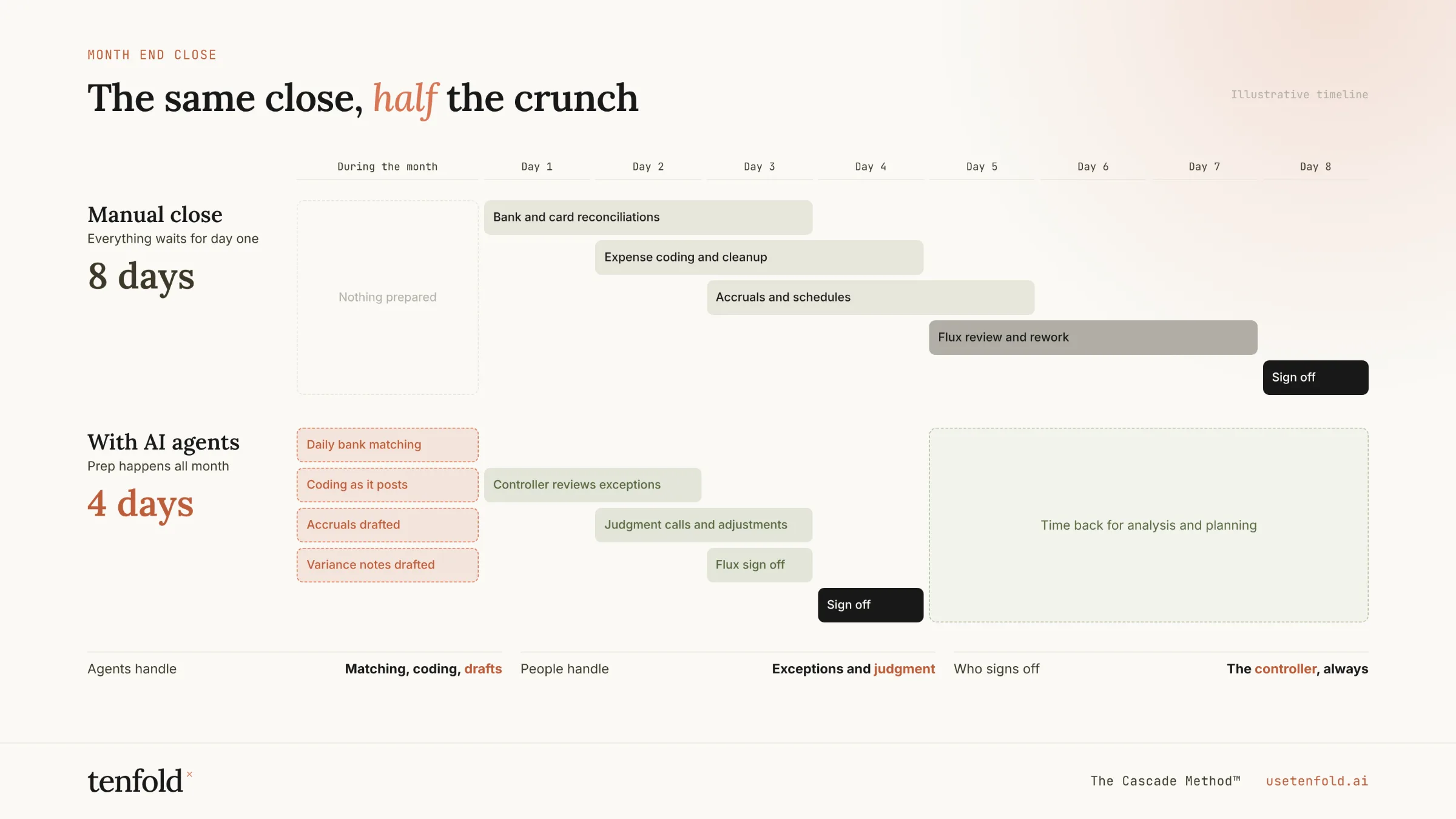
The close is where manual work hurts most, because everything has to happen at once.
Close checklist management. The agent tracks every close task, owner, and deadline, and follows up on anything at risk of slipping.
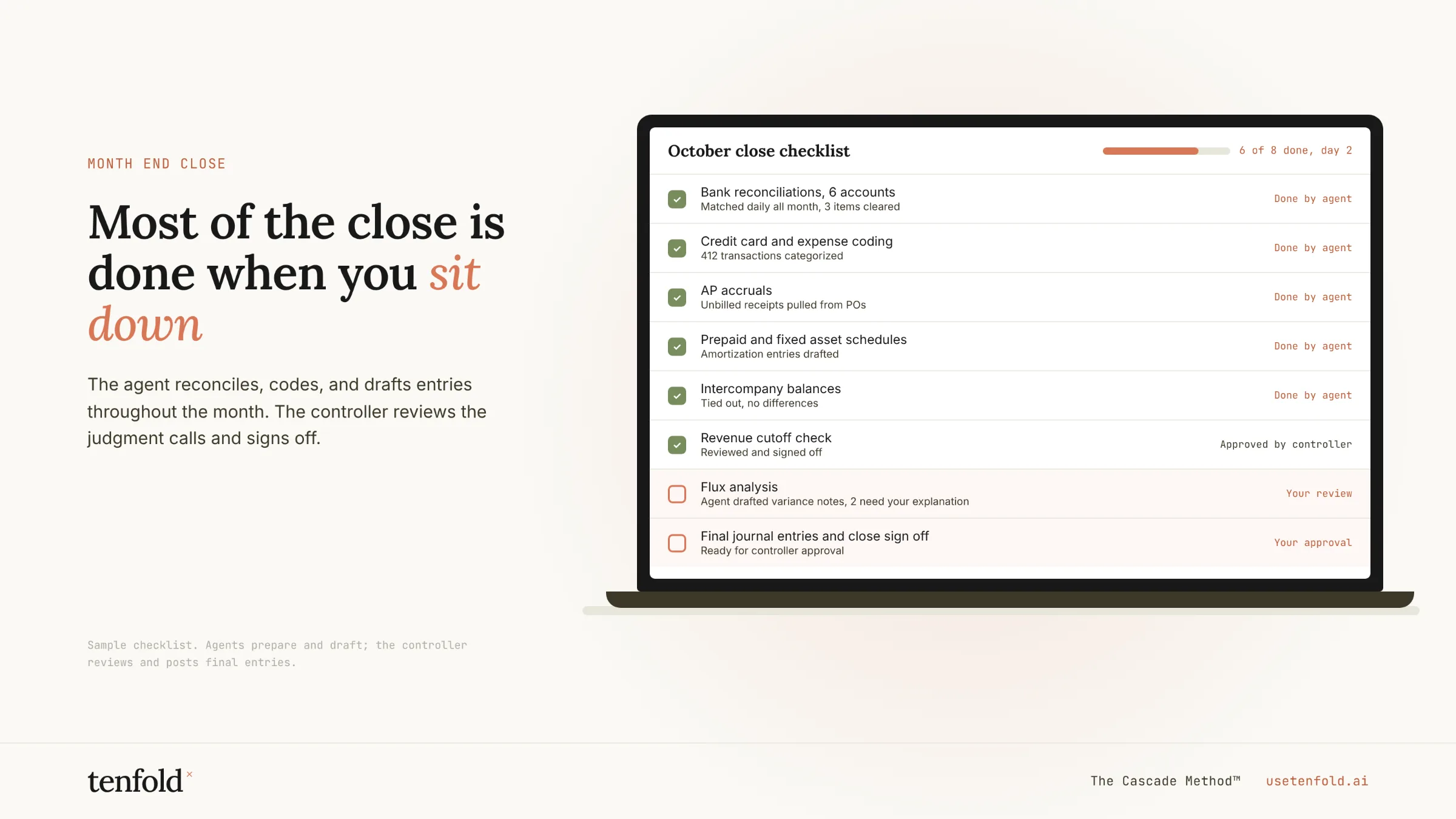
Reconciliations. It reconciles bank accounts, credit cards, intercompany balances, and subledgers to the general ledger, and flags unexplained differences.
Accruals and journal entries. It prepares recurring accruals and draft journal entries with supporting detail for an accountant to review and post.
Variance analysis. It compares actuals to budget and prior periods and drafts plain-language explanations for significant variances.
Close package assembly. It gathers schedules, reconciliations, and supporting documents into a review-ready package.
Accounts Receivable and Cash
Collections follow-up. The agent sends personalized reminders based on customer history and payment terms, escalates overdue accounts, and logs every interaction.
Cash application. It matches incoming payments to open invoices, including partial payments and remittances that arrive by email.
Customer inquiries. It answers routine questions about balances, invoice copies, and payment status.
Credit monitoring. It flags customers whose payment behavior is changing before they become a problem.
Reporting and FP&A Support
Recurring reports. The agent assembles weekly cash reports, monthly management packs, and KPI dashboards from multiple systems.
Commentary drafts. It writes first drafts of performance commentary for finance leaders to refine.
Ad hoc requests. It pulls data and answers routine questions from department leaders, so analysts spend less time on one-off requests.
Expense and Policy Compliance
Expense review. The agent checks expense reports against policy, flags missing receipts and out-of-policy spend, and follows up with employees.
Card reconciliation. It matches corporate card transactions to receipts and coding.
What Separates AI Agents from Traditional Finance Automation
Most finance teams already use some automation: OCR invoice capture, bank feeds, rules-based matching, and workflow approvals. AI agents build on that.
Traditional automation handles the clean cases and stops at the exceptions. AI agents work the exceptions: they read the email thread, understand why the invoice didn't match, contact the right person, and move the item forward. They also work across systems, pulling from the ERP, bank portals, email, and spreadsheets to complete a task end to end.
Automation processes the easy 70%. Agents work the rest.
Guardrails for Finance Teams
Finance is a controlled environment, and AI agents should strengthen controls, not weaken them:
Human approval for payments and postings. Agents prepare; people approve.
Segregation of duties. Agent permissions should respect the same separation of duties as your team.
Complete audit trail. Every action the agent takes should be logged and reviewable by auditors.
Least-privilege access. Agents should only access the systems and data each workflow requires.
Regular review. Sample agent output each month to confirm accuracy.
Where Finance Teams Should Start
AP exception handling and approval follow-up. High volume, clear rules, immediate time savings.
Reconciliations. Recurring, measurable, and a direct path to a faster close.
Collections follow-up. Direct impact on cash flow.
Close management and reporting. The broadest impact once data flows are connected.
At Tenfold, we've found that the finance teams seeing the fastest results aren't the ones with the newest ERP. They're the ones that clearly define which workflows they want to hand off, keep humans approving what matters, and give the agents access to the systems they need to do the work.
Summary
Finance teams spend much of their time on repetitive work: processing invoices, chasing exceptions, reconciling accounts, preparing the close, and building reports. Ardent Partners' 2025 data shows a gap of 3.1 days versus 17.4 days between best-in-class and average invoice processing, and exceptions are now the top AP challenge. AI agents can take over intake, matching, exception follow-up, reconciliations, close prep, collections, and reporting drafts, while finance staff keep approval and sign-off. The constraint isn't what AI can do. It's whether your finance team is ready to delegate.
Tenfold helps finance teams evaluate, implement, and operationalize AI agents across AP, close, receivables, and reporting, with controls and human approvals built in.
Frequently Asked Questions
Q: What finance tasks can AI agents automate?
A: AI agents can handle invoice intake and matching, AP exception follow-up, vendor inquiries, reconciliations, close checklist management, draft journal entries and accruals, variance commentary, collections, cash application, expense review, and recurring reporting.
Q: Can AI agents help with month-end close?
A: Yes. They can track close tasks, perform reconciliations, prepare accruals and draft entries for review, analyze variances, and assemble the close package, which shortens the close and reduces late nights for the team.
Q: Will AI agents replace accountants?
A: No. AI agents handle repetitive preparation, matching, and follow-up so accountants can focus on review, analysis, controls, and advising the business. Approvals and sign-off stay with people.
Q: Are AI agents safe to use in finance?
A: They can be, with the right controls: human approval for payments and postings, segregation of duties, least-privilege access, complete audit trails, and regular review of agent output.
Q: What's the best first AI agent for a finance team?
A: AP exception handling and approval follow-up is usually the fastest win. It's high volume, rules-based, and delivers visible time savings and faster invoice cycle times within weeks.
