
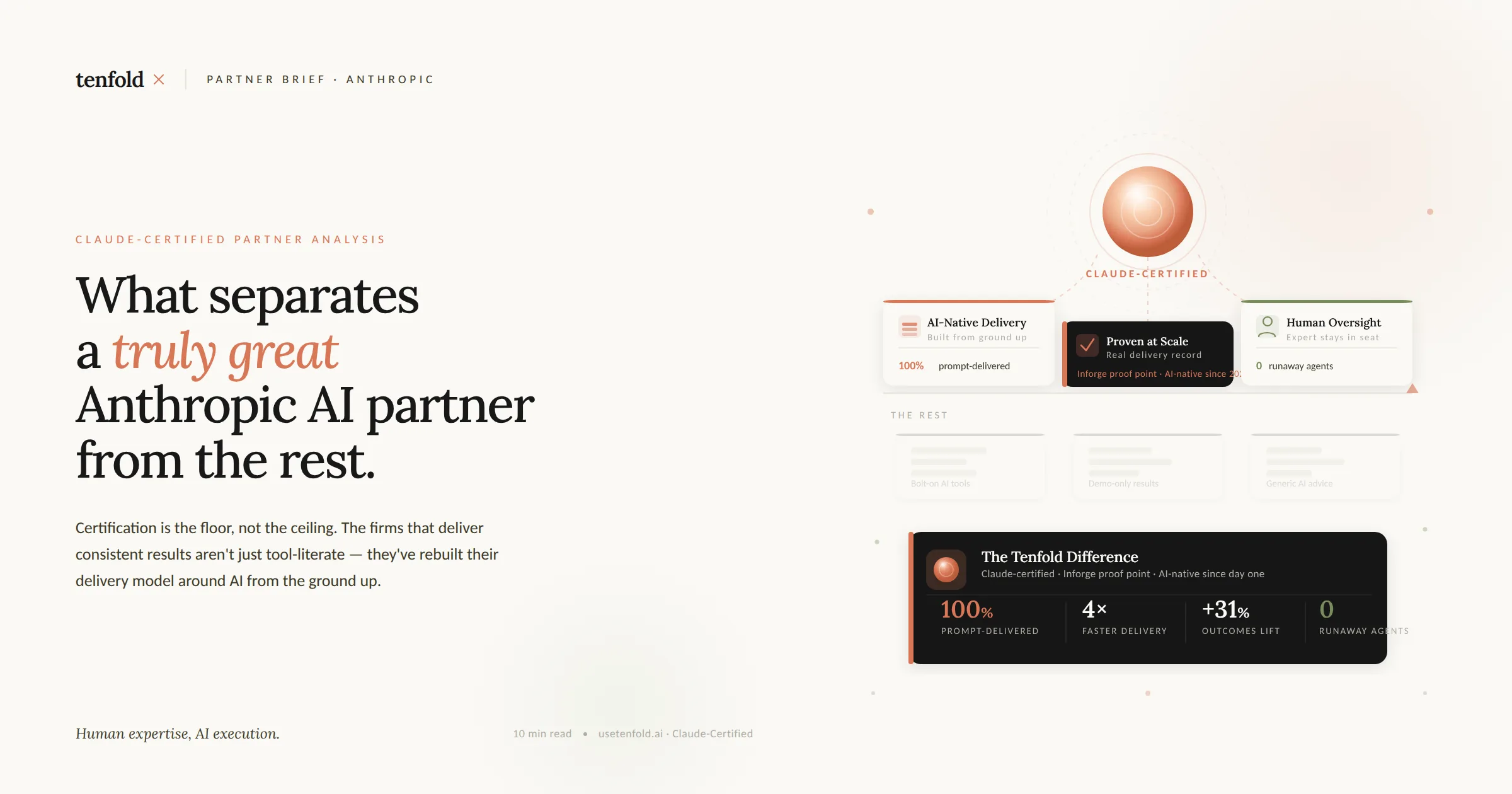
What Separates a Truly Great Anthropic AI Partner from the Rest
Most companies evaluating an Anthropic AI partner ask the wrong first question. They ask: "Do you work with Claude?" The right question is: "Can you show me production deployments — not decks, not pilots — that prove you do?"
The answer to that second question is what separates elite Claude implementation partners from the rest of the market.
Key Takeaways:
Technical certification and Claude-native architecture skills are table stakes — methodology and production track record are the real differentiators.
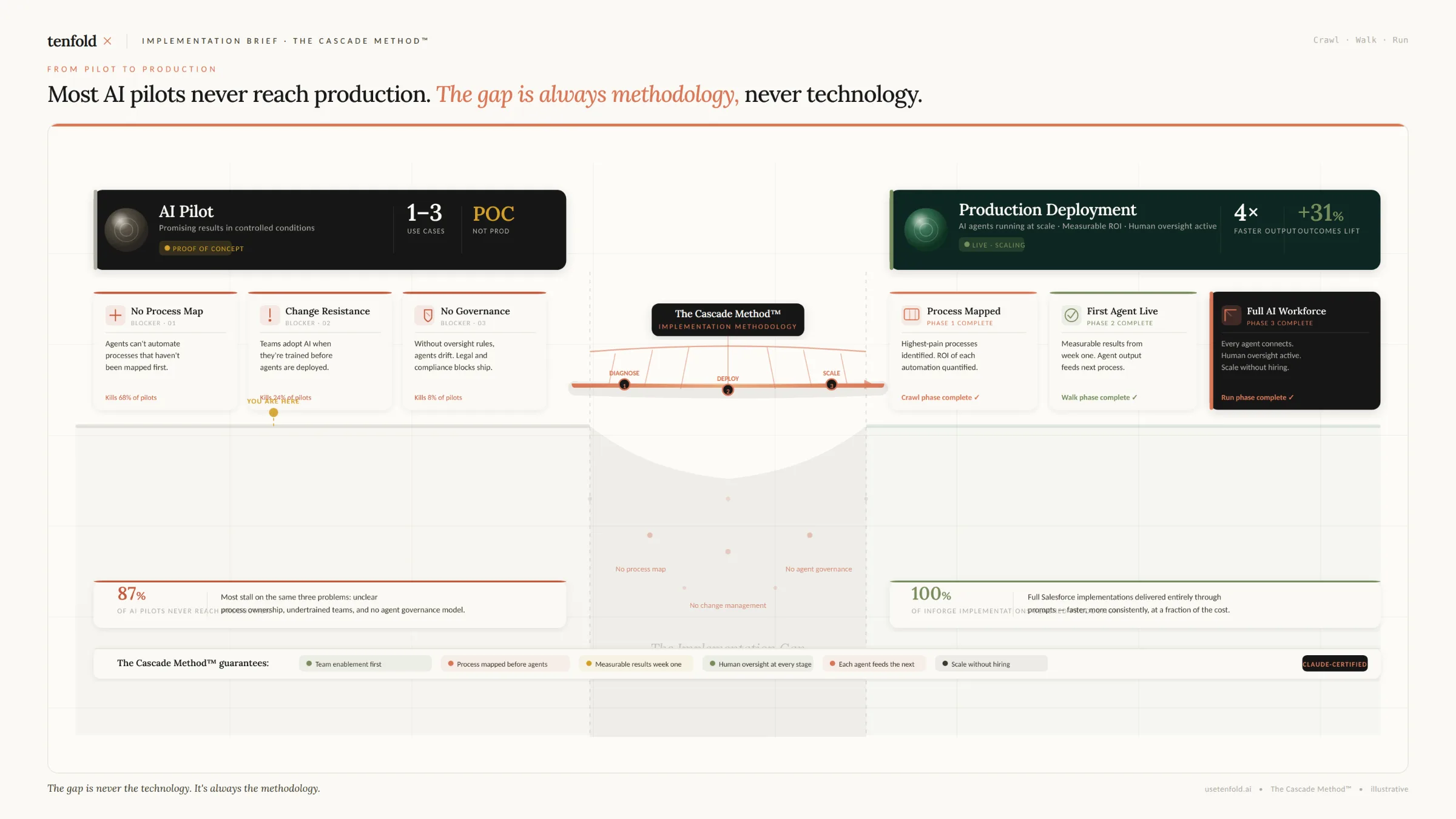
According to a 2025 MIT NANDA study, 95% of generative AI pilot programs fail to produce measurable financial impact — not because of model quality, but poor workflow integration.
The Claude Partner Network, launched March 2026 with a $100M Anthropic commitment, now gives buyers a structured way to vet certified partners.
The best partners don't just consult on AI — they run on it. Proof of internal deployment is the strongest signal available.
At Tenfold, we don't just recommend AI agent workflows. We operate on them. Our sister company Inforge delivers full implementations entirely through AI agents — that's our proof of concept, live in production every day.
Quick Answer: A great Anthropic AI partner combines Claude-native technical depth, a disciplined methodology for moving from pilot to production, and verifiable real-world outcomes. Certification matters. But what matters more is whether they've done it — and whether they can show you.
The Pilot-to-Production Gap Is Where Partners Are Made or Exposed
Deploying Claude in a sandbox is not enterprise AI implementation. It's a science project.
According to a 2025 MIT NANDA study cited in the Stanford Enterprise AI Playbook, 95% of generative AI pilot programs fail to produce measurable financial impact — and the failures stem not from model quality but from poor workflow integration and misaligned organizational incentives.
The same research, drawn from 51 successful enterprise AI deployments, found that across identical use cases and identical models, outcomes varied from weeks to years. The variable was never the AI. It was always the implementing organization — its readiness, its processes, and the methodology it applied.
This is the first thing to stress-test in any Claude implementation partner: not whether they know the model, but whether they know how to integrate it into workflows that actually change how work gets done.
What Claude-Native Technical Depth Actually Looks Like
Claude-native technical depth is specific. It's not generic "AI expertise" or familiarity with LLMs.
Anthropics' Claude Partner Network, launched in March 2026 with an initial $100 million investment, introduced the first formal certification for this: the Claude Certified Architect — Foundations (CCA-F). According to Anthropic, the certification covers tool use and integration, implementing MCP connectors and external system integrations, safety and responsible AI guardrails, and performance optimization including prompt engineering and caching strategies.
Certification is the baseline. But the partners who actually move enterprise clients to production are the ones with dedicated Applied AI engineers working on live customer deals — not generalists who've completed a training module.
Anthropics is scaling its partner-facing team fivefold to provide exactly this kind of support: dedicated Applied AI engineers assigned to partners on live deals, and technical architects scoping complex implementations. The best partners use that resource aggressively. The rest don't know it exists.
For enterprise buyers, the question isn't "Are you certified?" It's "Who on your team has shipped a Claude-based system into production, and what did it do?"
Methodology Is the Product, Not the AI Model
The consultancies with the longest Claude track records don't sell Claude. They sell a repeatable method for deploying it at enterprise scale — and Claude is the engine inside.
According to Deloitte's 2026 State of AI in the Enterprise report, as AI moves from experimentation to deployment, governance is the difference between scaling successfully and stalling out. Enterprises where senior leadership actively shapes AI governance achieve significantly greater business value than those delegating the work to technical teams alone.
What this means in practice: a great Claude implementation partner arrives with more than implementation skills. They arrive with:
A framework to quantify real productivity gains and ROI before the first line of code ships
Workflow redesign capability — because AI doesn't plug into broken processes, it exposes them
Change management that keeps pace as the model evolves
Governance embedded from day one, not retrofitted after a compliance flag
Accenture's partnership with Anthropic, which will train approximately 30,000 professionals on Claude, structures this around "reinvention deployed engineers" — practitioners who embed Claude within client environments specifically to scale adoption, not just to complete an implementation.
Size isn't the point. The structure is. A boutique partner with a disciplined methodology and a track record of production deployments will outperform a large firm that's still building its Claude practice.
Real-World Impact: What Proof Actually Looks Like
Every AI partner will tell you they drive outcomes. The ones worth hiring can tell you which outcomes, how they measured them, and what broke along the way.
According to BCG, AI can help professionals reclaim 26% to 36% of their time in areas that are routine, content-heavy, and data-driven. IBM's research found companies realize an average return of $3.50 for every $1 invested in AI. These numbers are real — but they require implementation discipline to capture. They don't materialize from a proof of concept.
The market for AI systems integration services is expected to surpass $1 trillion as organizations race to move from pilot projects to production deployments. Yet according to a survey of enterprise leaders, only 38% of large enterprises report achieving measurable success with their chosen AI partner programs.
That gap — between the volume of AI investment and the fraction of organizations capturing real value — is exactly what a great Anthropic AI partner closes.
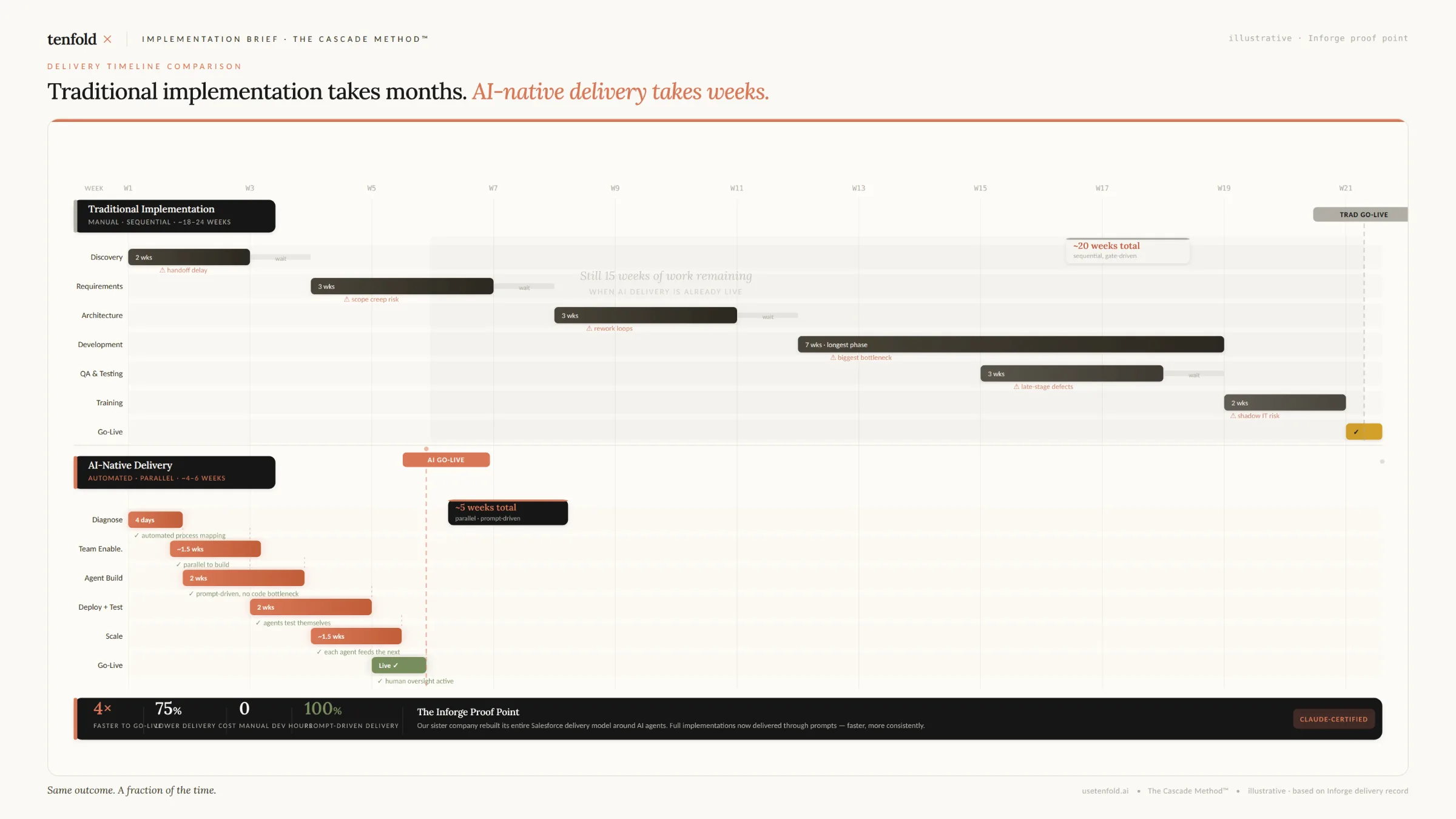
At Tenfold, our benchmark for impact isn't a client testimonial. It's Inforge: our sister company that replaced its entire traditional delivery model with AI agents and now delivers full implementations through prompts, not headcount. Faster timelines. More consistent quality. A fraction of the cost. That's not a case study. That's how we operate, every day.
When evaluating any Claude implementation partner, ask for the equivalent. Ask what they've shipped internally on Claude. If the answer is a shrug, keep looking.
The Questions That Separate Great Partners from Expensive Vendors
Before signing with any Anthropic AI partner, put these five questions on the table:
1. Do you run Claude internally — not just for clients?
The strongest signal of a genuine AI partner is internal dogfooding. If they're not building on the tools they sell, their methodology is theoretical.
2. Can you show a production deployment with measurable outcomes?
Pilots are not proof. Production deployments with before/after metrics are.
3. What breaks after go-live, and how do you handle it?
Every real implementation hits edge cases, model drift, and adoption friction. Partners who can't answer this have never shipped anything real.
4. How do you handle AI governance and compliance in regulated environments?
According to BCG, 74% of companies struggle to scale AI value because of data governance and accessibility issues. Your partner needs a governance framework, not just a disclaimer.
5. What's your Claude certification and technical architecture background?
Anthropics' Claude Certified Architect program, launched March 2026, gives buyers a concrete credential to check. Require it.
Summary
The Claude Partner Network has raised the floor for what it means to be an Anthropic AI partner — certification, dedicated engineering support, and formal vetting are now table stakes. But the ceiling is determined by something harder to certify: whether a partner has the methodology, the governance discipline, and the production track record to take your organization from AI curiosity to AI-native operation. At Tenfold, we built that proof first — inside Inforge — before we took it to market. That's the standard we hold ourselves to, and the standard you should hold every partner to.
Frequently Asked Questions
Q: What is the Claude Partner Network and does my implementation partner need to be in it?
A: The Claude Partner Network is Anthropic's official partner ecosystem, launched March 2026 with a $100 million investment, designed to certify and support consulting firms, professional services organizations, and AI specialists that help enterprises deploy Claude. Membership is not legally required, but certified partners have access to Anthropic's engineering team, technical architects, and proven deployment playbooks — advantages that matter in complex enterprise rollouts.
Q: How do I evaluate an Anthropic AI partner if I'm not technical?
A: Ask for production deployments with documented outcomes — not case studies, but systems live in production with measurable before/after metrics. Ask who on their team holds the Claude Certified Architect credential. And ask what they run internally on Claude. You don't need to evaluate the code. You need to evaluate the proof.
Q: What separates a Claude implementation partner from a general AI consultant?
A: A Claude implementation partner has model-specific technical depth — MCP integration, tool-calling, prompt optimization, safety guardrails — that a general AI consultant typically lacks. The best ones also have a production methodology built specifically around Claude's architecture and Anthropic's responsible AI principles, not a generic LLM playbook rebadged for Claude.
Q: Why do most enterprise AI implementations fail to produce ROI?
A: According to a 2025 MIT NANDA study, 95% of generative AI pilot programs fail to produce measurable financial impact. The failures stem not from model quality but from poor workflow integration and misaligned organizational incentives. The right implementation partner addresses both — not just the technical deployment, but the workflow redesign and governance structures that make AI stick.
Q: What makes Tenfold different as an Anthropic AI partner?
A: Tenfold's differentiation is operational, not theoretical. Our sister company Inforge replaced its entire delivery model with AI agents and runs full enterprise implementations through prompts, not headcount. That internal proof is the foundation of every engagement we take on — and it's the benchmark we use when we say a deployment is ready for production.
