
The Factory Floor Doesn't Sleep: How AI Agents Are Reshaping Manufacturing Operations
AI agents in manufacturing are delivering measurable, production-level results right now — not in a lab, not in a roadmap presentation. Autonomous agents are cutting unplanned downtime by up to 40%, reducing maintenance costs by 25%, and running quality inspection around the clock without fatigue or variance. The manufacturers who have deployed these systems aren't running experiments. They're running factories.
The question for every Operations Director and COO reading this isn't whether AI agents belong on the factory floor. The question is: how far behind is your operation?
Key Takeaways:
AI-driven predictive maintenance has reduced downtime by 40% in manufacturing sectors, with maintenance costs falling 25–40%.
More than 77% of manufacturers have now implemented AI to some extent — up from 70% in 2023.
Agentic AI adoption in manufacturing is expected to quadruple by 2026, from 6% to 24%, according to Deloitte.
The bottleneck isn't the technology. It's organizational readiness to delegate decisions to autonomous systems.
Quality control AI agents are reporting defect detection rates improving by up to 99.9% in some production environments.
What AI Agents in Manufacturing Actually Do
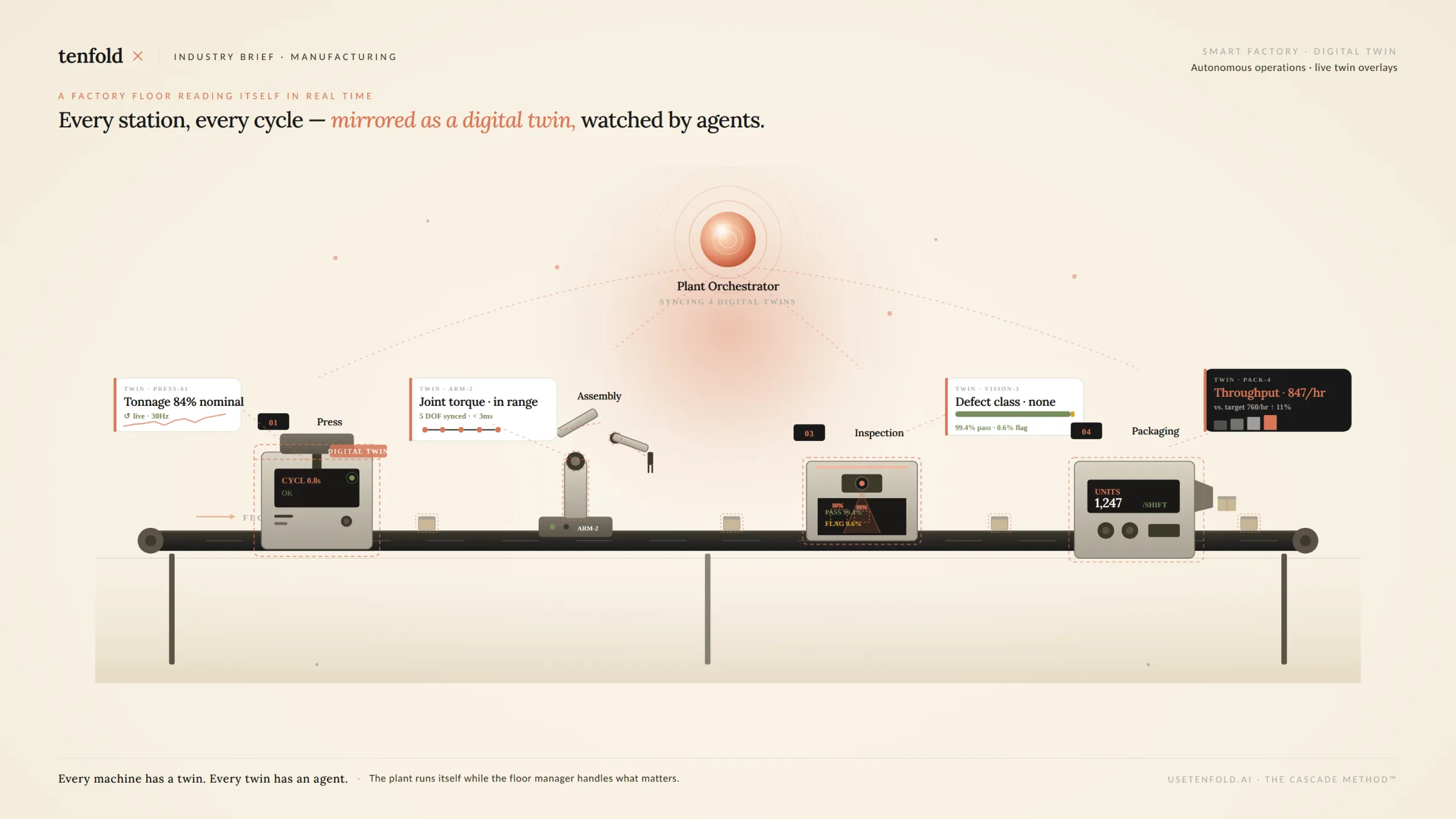
AI agents in manufacturing are autonomous software systems that perceive real-time data from equipment, production lines, and supply chains, make decisions based on that data, and take action — without waiting for a human to issue the next instruction.
This is not automation in the traditional sense. Traditional automation follows a fixed script. An AI agent adapts. It processes vibration patterns from a motor, cross-references maintenance history and production schedule, identifies an anomaly, orders the replacement part, schedules the technician, and generates the work order — all before a human has opened their inbox.
According to OxMaint, while predictive AI tells you a bearing will fail in 22 days, agentic AI drafts the repair plan, checks parts inventory, schedules the technician, and coordinates the work order — all without human intervention.
This is the practical difference between insight and action — and it's why manufacturers deploying AI agents are operating in a different competitive category than those still consuming dashboards.
Predictive Maintenance: Where the ROI Is Most Visible
Predictive maintenance is the most mature and highest-ROI application of AI agents in manufacturing today. The numbers are consistent across sources and sectors.
According to HSO (via AllAboutAI), AI-driven predictive maintenance has reduced downtime by 40% in manufacturing sectors. And according to tech-stack.com, AI can lower manufacturing maintenance costs by 25–40%, while 78% of production facilities utilizing AI reported a waste reduction.
The mechanism is straightforward: AI agents analyze sensor data continuously — vibration, temperature, power consumption, pressure — and detect early failure signatures weeks before a breakdown occurs. The result is a shift from costly unplanned shutdowns to precisely scheduled interventions that keep lines running.
Real-world implementations confirm this pattern. Nestlé has embedded predictive technology into its factory automation strategy to dynamically modify operations and simplify workflows, with results including reduced interruptions and increased production agility at scale.
In one documented case from Coditude, an agentic AI maintenance system was introduced to a factory experiencing recurring false alarms. The digital agent correlated vibration spikes with seasonal humidity changes and learned to shift its internal thresholds in real time. The outcome: an 80% fall in false alarms and a 25% decrease in maintenance costs.
This is the version of AI that sticks — not because it's impressive in a demo, but because it's accurate, adaptive, and measurable.
Quality Control That Never Blinks
Human quality inspection is constrained by shift changes, fatigue, and the limits of the human eye. AI agents have none of these constraints.
Manufacturing facilities implementing quality control AI agents have reported defect detection rates improving by up to 99.9%, significantly reducing costly recalls and customer complaints. The continuous operation capability of these systems means quality control never sleeps, maintaining consistent standards across all shifts and eliminating human fatigue-related errors.
According to SAP's supply chain team, visual inspection tools can already identify defects on a production line in real time, reducing waste and improving throughput — and there is growing interest in expanding these agents into production optimization and formulation decisions.
The architecture enabling this is edge AI: processing data locally on the factory floor, with anomalies detected in milliseconds, not minutes. Edge and cloud systems work in tandem — edge handles immediacy, cloud handles learning and optimization across facilities.
For regulated industries, this matters beyond defect rates. Agentic quality systems maintain immutable records of every inspection decision, reducing manual documentation effort while improving confidence in audit outcomes. Quality agents don't just catch defects — they produce the compliance trail automatically.
Supply Chain Intelligence: From Static Planning to Real-Time Decision-Making
Supply chain disruption has been a defining challenge for manufacturers since 2020. AI agents are the first technology capable of operating at the speed and complexity that modern supply chains demand.
According to IBM's Institute for Business Value, AI agents continuously monitor conditions and adjust plans, reducing reliance on static planning cycles. In practice, agents are applied across demand forecasting, inventory management, production scheduling, and logistics — combining real-time data from enterprise systems, sensors, and IoT devices with predictive analytics to evaluate tradeoffs and run actions.
The results from early deployments are concrete. According to MindStudio, one manufacturer using AI for supply chain management reduced inventory carrying costs by 18% while improving order fulfillment rates. Another cut stockout incidents by 35% through better demand forecasting.
According to Deloitte Insights, agentic AI can offer manufacturers transformative solutions for building more resilient, responsive supply chains — particularly critical given that the UN's 2025 Trade and Development report notes policy unpredictability is at historic highs, raising input costs and disrupting logistics globally.
Gartner predicts that half of all supply chain management solutions will include agentic AI capabilities by 2030. For manufacturers evaluating vendor platforms today, this is not a future feature — it is a procurement criteria.
The Adoption Curve: Where Most Manufacturers Actually Stand
The headline adoption numbers are impressive. The operational reality is more nuanced.
According to the 2025 State of AI in Manufacturing Survey, more than 77% of manufacturers have implemented AI to some extent. According to McKinsey's State of AI 2025 report, 62% of mid-sized and large businesses are experimenting with autonomous multi-step AI — but only 23% of them use and scale agentic AI in at least one business process.
That gap between experimentation and production deployment is the central challenge of the current moment. According to tech-stack.com, despite growing interest and clear ROI potential, many manufacturers still struggle to move AI initiatives from isolated pilots to scalable, factory-wide solutions — and these challenges are rarely technical alone. They stem from gaps in data readiness, organizational alignment, and evolving regulatory expectations.
According to Xometry and Thomas's 2026 Manufacturing Trends Report, 82% of manufacturers cite AI as a primary driver of growth and 44% report significant returns on investment from AI adoption — yet a persistent skills gap in the use of AI tools underscores the need for targeted upskilling to fully realize these benefits.
The manufacturers clearing these hurdles share a common trait: they treat AI not as a standalone technology project but as an integral part of their operational strategy — investing in data infrastructure, connectivity, and organizational capabilities needed to turn AI insights into action at scale.
The Workforce Question: Augmentation, Not Replacement
The most persistent concern among operations leaders isn't ROI — it's workforce impact. It deserves a direct answer.
AI agents are not eliminating the manufacturing workforce. They are restructuring it. According to Gartner, 70% of organizations will implement goal-driven AI to manage core operations — but the direction of travel is augmentation, not removal.
According to the EY Agentic AI Workplace Survey from mid-2025, half of managers doubt their ability to lead AI-augmented teams, and most expect management to become harder, not easier. Among manufacturing-specific respondents, 54% of managers say that addressing job security is a priority concern.
This is a real challenge — and it requires a deliberate response. According to EY, agentic AI demands a cultural transformation, away from a mindset centered on producing the same goods with new tools. Capturing tacit knowledge is essential: the true way of working retained in the minds of experienced workers must be codified and embedded into AI systems before that knowledge walks out the door.
The talent data reinforces urgency. According to data from the AEM's 2025 Annual Conference, the average tenure at a manufacturing company dropped from 20 years in 2019 to just three years in 2023. AI agents that encode institutional knowledge are not just operational assets — they are knowledge retention infrastructure.
For Operations Directors managing this transition: the goal is a workforce that is better supported in the moment — with in-context safety checks, clear work instructions, and built-in quality measures that adapt to changing conditions rather than relying on static processes.
The Market Trajectory: This Is Not a Future Bet
The market numbers confirm that agentic AI in manufacturing is not a speculative technology category — it is an accelerating capital allocation decision.
According to MindStudio, the AI in manufacturing market is projected to grow from $17.44 billion in 2025 to $115.76 billion by 2030 — a 46% annual growth rate. According to Deloitte, agentic AI adoption in manufacturing specifically is expected to quadruple by 2026, from 6% to 24% of facilities.
According to Gartner, by 2028, 33% of enterprise software applications will include agentic AI, up from less than 1% in 2024 — a 33-fold increase in four years. Gartner also identifies agentic AI as one of the top 10 strategic technology trends for 2025, positioning it as fundamental infrastructure rather than a specialized capability.
The implication for COOs and Operations Directors is clear: the competitive gap between early adopters and late movers is not narrowing — it is widening. Manufacturers running agentic systems today are compounding operational advantage every quarter.
Summary
AI agents are restructuring manufacturing operations across every critical function: maintenance, quality, supply chain, and production scheduling. The data is consistent — 40% reductions in downtime, 25% drops in maintenance costs, near-perfect defect detection rates, and supply chains that respond to disruption in real time rather than the next planning cycle. The manufacturers winning are the ones who moved from pilot to production, built the data infrastructure to support agent decision-making, and invested in workforce readiness alongside technology deployment. At Tenfold, we implement AI agent systems for operations leaders who need production-grade results, not proof-of-concept decks. The factory floor doesn't sleep. Your AI strategy shouldn't either.
Frequently Asked Questions
Q: What is an AI agent in manufacturing?
A: An AI agent in manufacturing is an autonomous software system that continuously ingests real-time data from equipment, sensors, and enterprise systems, makes decisions based on that data, and takes action — such as scheduling maintenance, flagging defects, or rerouting supply chain logistics — without human input for each step. Unlike traditional automation, AI agents adapt to changing conditions rather than following a fixed script.
Q: How much can AI agents reduce downtime in manufacturing?
A: AI-driven predictive maintenance has reduced downtime by up to 40% in manufacturing sectors, according to HSO. Beyond downtime, manufacturers report maintenance cost reductions of 25–40%, and some facilities have achieved up to 70% fewer breakdowns after deploying AI-powered predictive systems.
Q: What is the difference between predictive AI and agentic AI in manufacturing?
A: Predictive AI tells you a problem is coming. Agentic AI acts on it. A predictive model might flag that a bearing will fail in 22 days. An agentic system drafts the repair plan, checks parts inventory, schedules the technician, and generates the work order — all autonomously. The human reviews and approves; the AI handles the execution chain.
Q: Are AI agents replacing manufacturing workers?
A: Not at the scale the concern implies. AI agents are restructuring roles, not eliminating the workforce wholesale. The World Economic Forum projects AI will create more than 12 million job opportunities in manufacturing, outweighing positions it replaces. The more immediate challenge is skills readiness — manufacturers need workers who can oversee, interpret, and course-correct AI agent decisions, which requires targeted upskilling programs.
Q: How do manufacturers start implementing AI agents without disrupting operations?
A: The highest-ROI entry point is predictive maintenance, where payback periods are shortest and results are measurable. Start with a focused pilot on a single production line or asset class, validate ROI, then scale. Ensure your data infrastructure — sensors, MES integration, historian data — is in place before deploying agents. Partner with implementation specialists who have deployed production-grade systems, not just prototypes.
*Ready to move from pilot to production? [Tenfold](https://tenfold.ai) implements AI agent systems for operations leaders who need results at scale — not another proof of concept. Talk to our team about what's possible in your facility.*
