
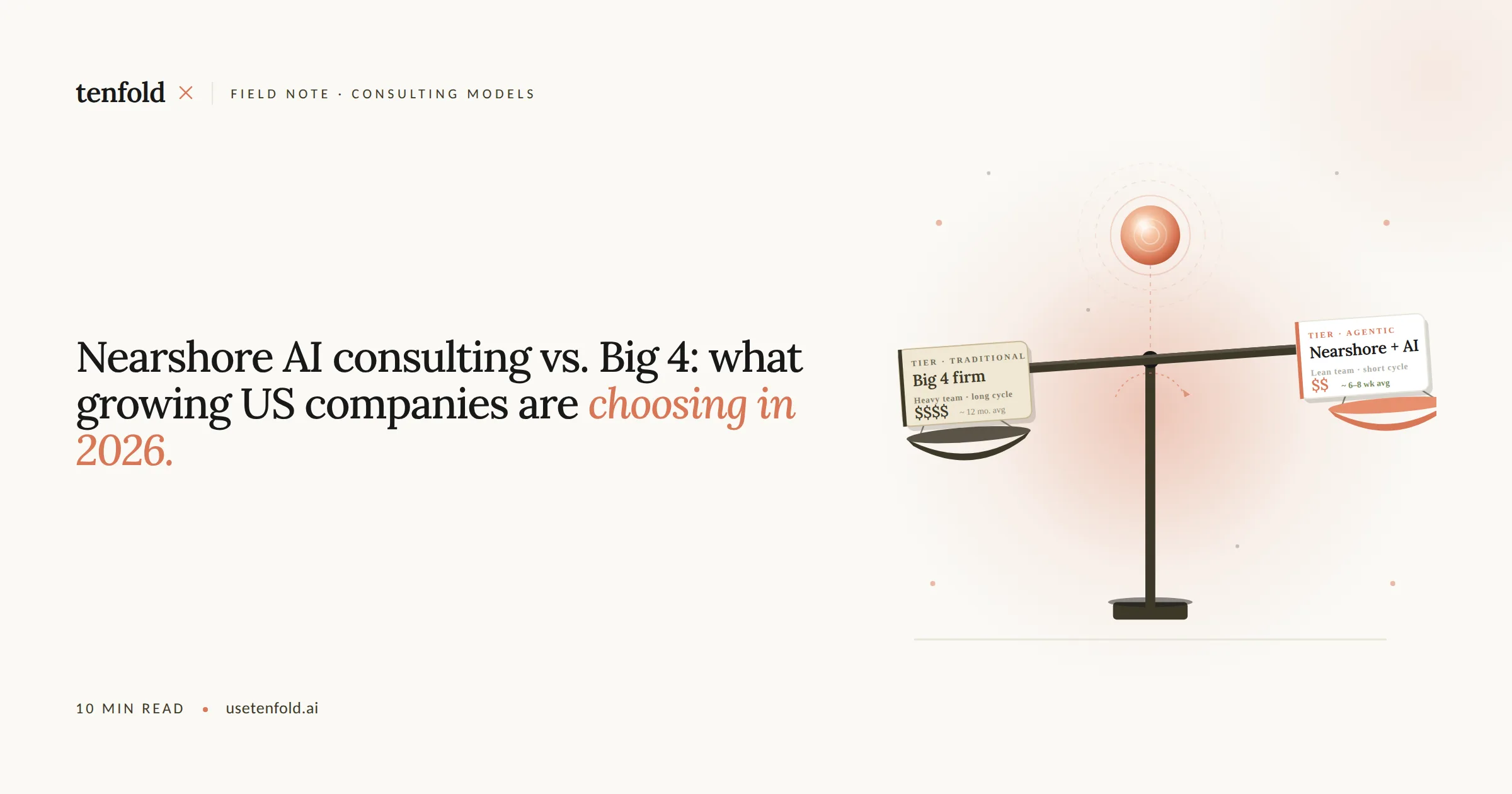
Nearshore AI Consulting vs. Big 4: What Growing US Companies Are Choosing in 2026
Growing US companies don't have a shortage of AI consulting options in 2026. They have a different problem: too many options, with very little transparency about what each one actually costs, delivers, and is designed for. The Big 4 have scale and credibility. Nearshore AI specialists have speed and cost efficiency. But the choice isn't about who is "better" — it's about which model was built for your company's reality right now.
The honest answer: most growing US companies are choosing nearshore AI consulting — and the data in 2026 makes that shift hard to argue with.
Quick Answer: Growing US companies in 2026 are choosing nearshore AI consulting over Big 4 firms primarily because of cost, speed, and fit. Big 4 engagements are built for Fortune 500 scale and multi-year transformation budgets. Nearshore specialists deliver comparable technical execution at 40–60% lower cost, with timezone alignment, direct access to senior practitioners, and faster time to production.
Key Takeaways:
Big 4 AI consulting blended rates run $150–$500/hr; nearshore LatAm specialists run 40–60% below US onshore benchmarks — the cost gap is structural, not marginal.
According to BCG's 2026 AI Radar survey, companies expect to double AI spending this year, from 0.8% to 1.7% of revenues — but most mid-market budgets simply can't support Big 4 engagement minimums.
The Big 4 delivery model relies on a staffing pyramid: senior partners pitch, junior analysts execute. Growing companies need the opposite — senior practitioners doing the actual work.
Nearshore AI consulting from Latin America offers real-time timezone overlap, cultural alignment, and production-grade delivery — without the offshore coordination tax.
At Tenfold, we operate an agent-first delivery model. The same model that powers Inforge's Salesforce implementations is now available to organizations that want AI outcomes, not AI roadmaps.
The Real Cost Gap Between Big 4 and Nearshore AI Consulting
The cost difference between Big 4 firms and nearshore AI specialists is not a rounding error — it's a structural feature of how these firms are built.
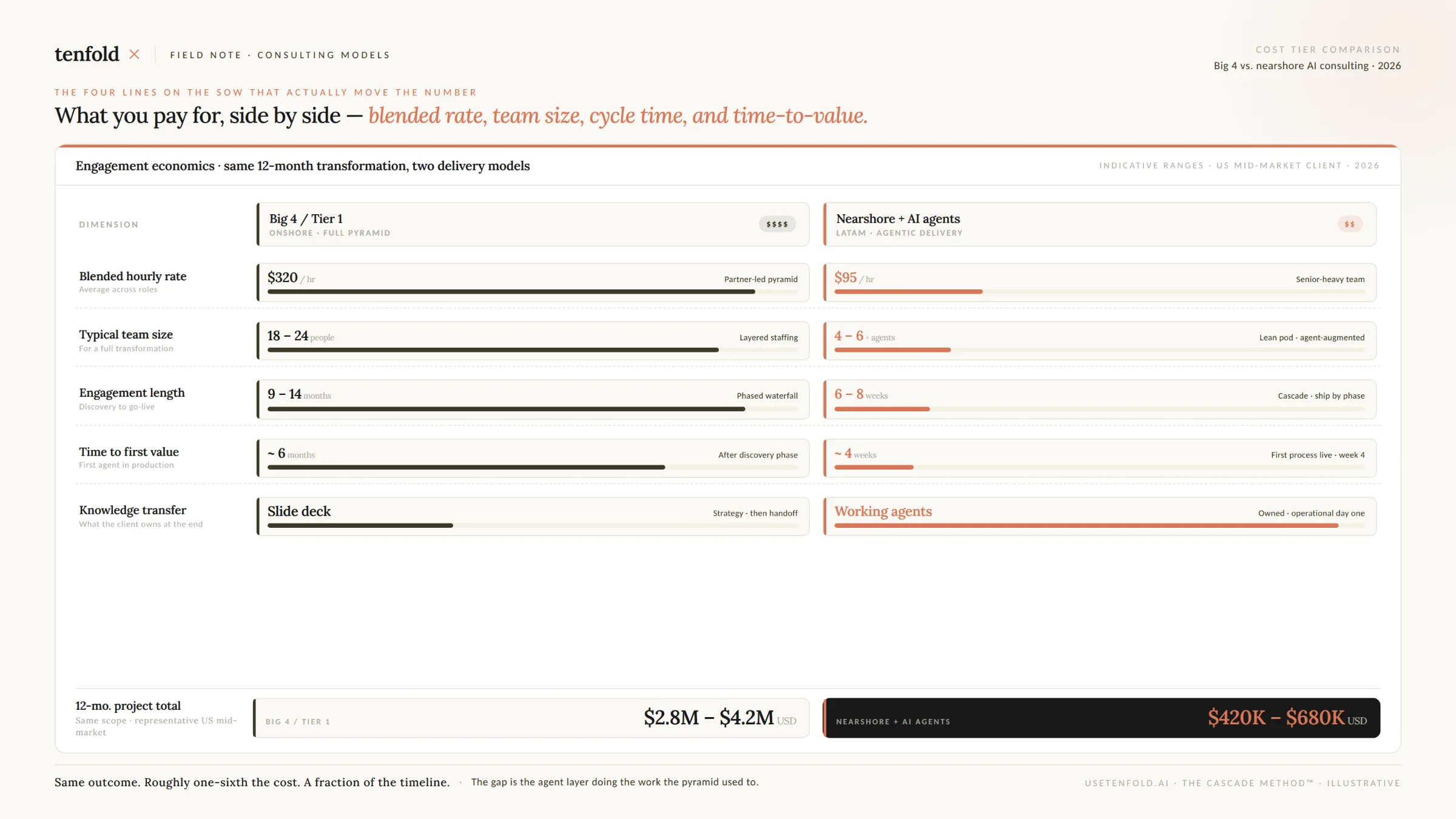
According to DCF Research's 2026 market analysis, blended rates by firm tier break down sharply: elite strategy firms like McKinsey, BCG, and Bain bill $300–$500/hr blended; mid-market implementers like Accenture, Deloitte, and Cognizant bill $150–$300/hr blended; specialist boutiques bill $100–$200/hr blended. Meanwhile, nearshore and offshore talent commands a 40–60% discount versus US onshore benchmarks at every role level.
At the partner level inside Big 4 AI engagements, billing rates run $400–$600 per hour. Director and senior manager rates sit at $250–$400. A typical AI strategy engagement — six to ten people running four to six months — can compound to $1.44 million before firm-specific IP licensing, travel costs, or accelerator tools. Enterprise AI consulting engagements from Big 4 firms typically range from $500,000 to $5 million depending on scope and team composition.
For mid-market companies, the math doesn't close. According to Bosio Digital's 2026 mid-market AI guide, companies can expect to invest $75,000–$500,000 with a boutique AI consulting firm for a full strategy-through-implementation engagement — roughly 40–60% less than comparable Big 4 engagements.
Nearshore Latin America specifically has become a compelling middle ground. According to Leanware's 2026 AI consulting cost research, senior AI consultants in Colombia with US market experience typically charge $35–$70/hour, compared to $300–$500+ for similar services in the US — without the communication lag or cultural misalignment common with offshore alternatives.
One case in the manufacturing sector illustrates the shift clearly: by leveraging nearshore expertise, a mid-market company accessed the same AI specialization they'd find at Big 4 firms — including consultants with previous experience at major US manufacturing systems — at approximately 45% lower cost.
Why the Big 4 Model Wasn't Built for Growing Companies
The Big 4 are not doing anything wrong. Their methodologies are sophisticated, their research is thorough, and their deliverables are polished. If you need a comprehensive AI transformation roadmap spanning multiple business units and geographies, they can mobilize at a scale that smaller firms simply cannot match.
But their entire model — the pricing structures, team sizes, timelines, and governance frameworks — assumes you have dedicated innovation departments, multi-year transformation budgets, and the organizational bandwidth to manage a 20-person consulting engagement alongside running your actual business.
Growing companies operate in a fundamentally different reality.
The staffing pyramid is the most visible structural problem. According to Groovy Web's 2026 AI consulting rate analysis, at $300–$600/hr inside the Big 4, you get brand credibility, exhaustive documentation, and a team of 8–15 people — but the partner has genuine strategic insight while spending only about 10% of their time on your project. Junior analysts who graduated 18 months ago do the actual work. You pay $500/hr for a team whose average experience level is roughly three years.
Boutique AI consulting at $150–$300/hr flips that model. The person who pitches is the person who delivers. For a growing company that needs to move from AI strategy to production AI systems without creating operational risk or burning a multi-year budget, this matters more than the brand on the proposal.
There's another signal worth tracking: a DDN report published in January 2026 found that 54% of organizations have delayed or canceled AI initiatives in the past two years — not because AI doesn't work, but because the approach, and often the consulting partner, was wrong for the company.
Nearshore AI Consulting: What the Model Actually Delivers in 2026
Nearshore AI consulting from Latin America has matured significantly. This is not staff augmentation dressed up as strategy. The best nearshore partners in 2026 deliver end-to-end AI implementation with production-grade engineering, SOC-aligned security, and real-time collaboration — inside US timezone overlap.
According to Leanware, Latin American AI consultants typically charge 40–60% less than US equivalents while working in aligned timezones. The timezone alignment is operational, not cosmetic. Nearshore teams operate with 4–6 hours of time zone overlap, making it easier to resolve blockers in real time — a significant advantage over offshore development, where delays regularly slow down decision cycles.
According to DCF Research's 2026 analysis, the most common pattern among enterprises running successful GenAI programs is a two-tier model: a specialist boutique for design and initial build (3–6 months), followed by an ongoing operations phase. The nearshore model maps cleanly to this — specialist-tier execution at boutique rates, without the management overhead of traditional offshore delivery.
Nearshore LatAm (Colombia, Mexico, Brazil, Argentina) has seen rates rise approximately 18% year-over-year as US demand intensifies — a market signal, not a warning sign. The increase reflects demand from buyers who want rate efficiency without the timezone penalty of offshore alternatives.
For growing US companies, the value equation is straightforward: competitive pricing 40–60% below US rates, specialized domain expertise, and cultural-timezone alignment that enables collaboration that actually works at speed.
The AI Agent Shift Changes the Equation Further
The 2026 AI consulting landscape isn't just a cost comparison. The emergence of AI agents as a production-grade delivery mechanism changes what implementation even means — and which consulting model is positioned to execute it.
According to Gartner's analysis cited by GoGloby, AI agents are one of the fastest advancing technologies in 2026. Agents have matured and can now handle tool use and approvals with built-in guardrails. The shift means buyers should treat agent design as enterprise architecture — not a side project.
According to BCG's 2026 AI Radar survey of approximately 2,400 executives, companies expect to double AI spending this year — from around 0.8% of revenues to roughly 1.7%. A large majority of CEOs now say they own AI decisions directly, nearly double the share from the prior year. This isn't experimentation anymore. It's execution.
But most Big 4 firms are still primarily structured around advisory and transformation strategy — with implementation managed through lengthy sub-contracting arrangements. The agent-first delivery model disrupts this. When implementation itself can be driven through AI agents — handling multi-step workflows, executing decisions, and integrating into existing systems without the headcount overhead — the consulting cost model changes structurally.
At Tenfold, this is precisely where we operate. We built our delivery model around AI agents — not as a future aspiration, but as the current operating reality. The proof is Inforge, our sister company, which delivers full Salesforce implementations entirely through prompts. Faster timelines, more consistent quality, a fraction of the traditional cost. That's not a positioning statement. That's the production model we run every day.
For growing US companies evaluating AI consulting partners, the question to ask is not "Big 4 or nearshore?" It's: "Which partner is actually built to deliver outcomes at my company's scale and timeline?"
What Growing US Companies Are Actually Choosing
The market signals in 2026 are clear.
According to Grant Thornton's Q1 2026 CFO survey, 68% of CFOs expect IT and digital transformation spending to increase over the next year — the highest level recorded in 21 quarters of the survey. More organizations are now evaluating nearshore locations for future operations (17%) than offshoring (13%). Nearshoring is also experiencing less pullback: only 2% reducing nearshore operations compared with 7% scaling back offshore activity.
Organizations are placing greater emphasis on delivery models that provide real-time collaboration and the ability to support complex processes — exactly what the nearshore model delivers.
According to KPMG's 2026 CEO survey, nearly 80% of CEOs plan to allocate at least 5% of their capital budgets to AI in 2026. But 61% worry they won't be able to recruit workers with the technical expertise required. The talent constraint is a significant driver toward consulting partnerships — and toward models that can deliver senior practitioners quickly, not junior analysts behind a premium billing rate.
According to Foundry's AI Priorities Study 2026, nearly two-thirds of ITDMs (65%) now report having a dedicated technology budget for AI — up from 49% last year and 36% the year prior. The shift from planning to production is accelerating. Companies that haven't moved from strategy to live AI systems are falling behind.
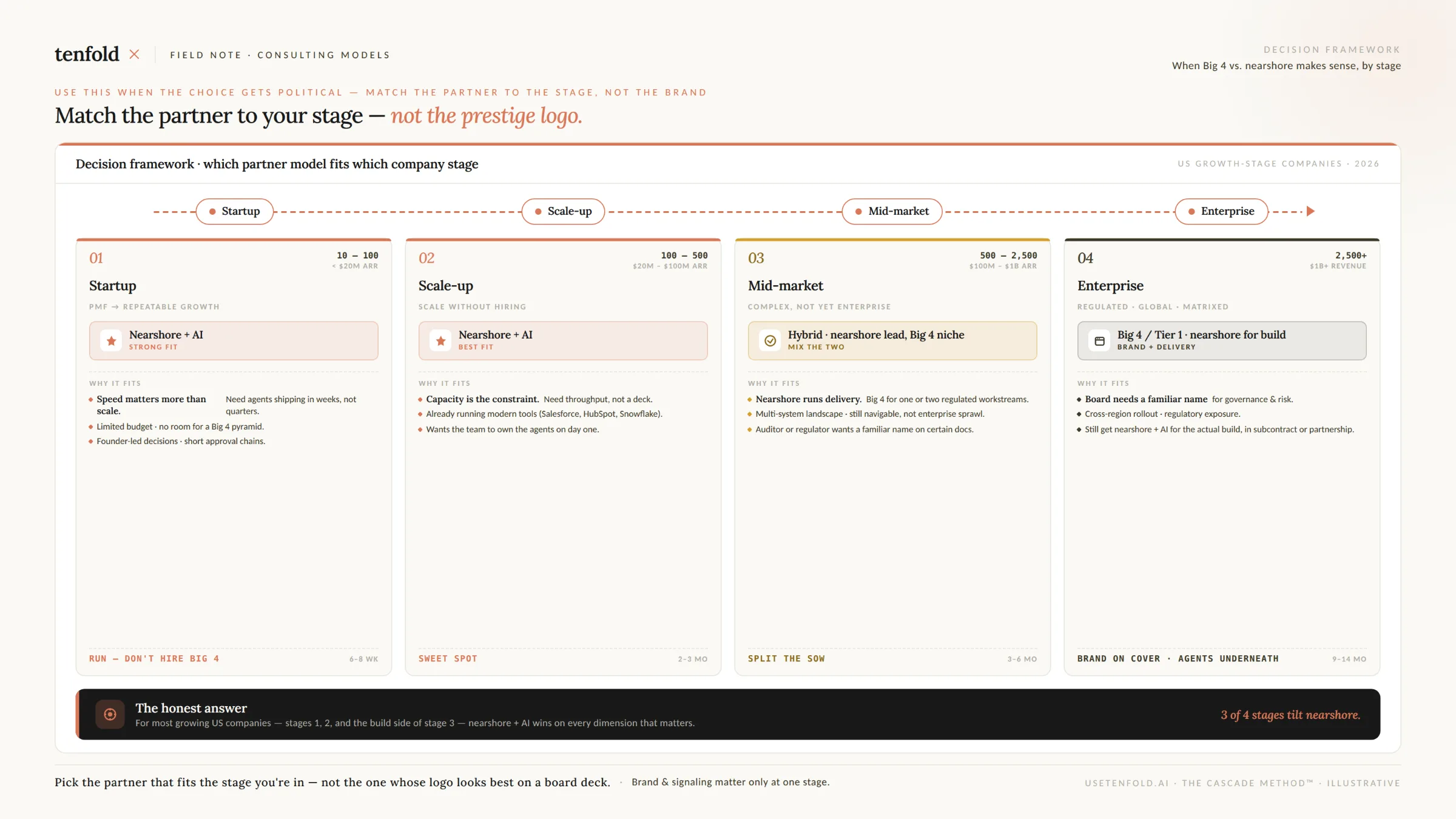
The practical implication: if your company is between $10M and $500M in revenue, pursuing AI implementation in 2026, and evaluating consulting partners — the Big 4 model has real structural misalignment with your timeline, budget, and need for direct practitioner access. Nearshore AI consulting, particularly from the LatAm corridor, is where the value equation closes.
Summary
In 2026, the choice between nearshore AI consulting and the Big 4 is less ambiguous than it looks. The Big 4 are purpose-built for Fortune 500 transformation programs with multi-year budgets and dedicated innovation departments. Nearshore AI specialists — particularly from Latin America — deliver comparable technical execution at 40–60% lower cost, with real-time timezone collaboration and direct senior practitioner access. For growing US companies, the structural fit is clear. At Tenfold, we've built our delivery model around exactly this reality: AI agent-first implementation, production-grade outcomes, and zero overhead from consulting theater. If your company is ready to move from AI roadmap to AI reality, that's the conversation we're built for.
Frequently Asked Questions
Q: What is the real cost difference between Big 4 and nearshore AI consulting in 2026?
A: The gap is 40–60% on comparable engagements. Big 4 blended rates run $150–$500/hr depending on firm tier, with full AI strategy-plus-implementation engagements ranging from $500,000 to $5M+. Nearshore LatAm specialists deliver comparable technical execution at $35–$120/hr depending on role, with full engagements typically ranging from $75,000 to $500,000 for mid-market scope.
Q: What does a nearshore AI consulting firm actually deliver that the Big 4 can't?
A: Senior practitioners doing the actual work — not partners who pitch and junior analysts who execute. The best nearshore AI firms in 2026 deliver end-to-end production AI systems: architecture, build, deployment, and ongoing optimization. They work in your timezone, integrate directly into your team, and move faster because they're not managing a 15-person engagement pyramid behind your project.
Q: Is nearshore AI consulting right for regulated industries like healthcare or financial services?
A: It depends on the scope. Big 4 firms carry institutional credibility that simplifies board-level and regulatory approvals in some regulated contexts — that's a real advantage for specific use cases. For implementation work in regulated industries, the right nearshore partner will have compliance depth, SOC alignment, and governance frameworks. Vet this specifically before signing anything.
Q: When should a growing US company choose the Big 4 for AI consulting?
A: When you need a multi-business-unit transformation spanning geographies, have a $2M+ consulting budget, require the Big 4 brand for internal political or regulatory reasons, or are undertaking M&A-adjacent AI work where institutional credibility carries real procurement weight. For most growing companies, none of these conditions apply.
Q: How does Tenfold approach AI consulting differently?
A: Tenfold is an AI agent specialist and implementation partner — not an advisory firm that hands you a roadmap. We deliver production AI systems using an agent-first delivery model, validated by Inforge's operating track record of delivering full Salesforce implementations entirely through prompts. We don't bill for strategy theater. We build systems that run.
*Ready to move from AI roadmap to production AI? [Talk to Tenfold about your implementation.]*
