
How Wealth Management Firms Use AI Agents for Client Reporting and Compliance
They use them to take over the work that happens around the client meeting: pulling data from custodians and portfolio systems, building client reports, preparing meeting materials, documenting conversations, and running compliance checks before anything goes out the door. Advisors stay in charge of the advice and the relationship. AI agents handle the hours of assembly, review, and recordkeeping that currently crowd out client time.
Quick Answer: Wealth management firms use AI agents to automate quarterly and ad hoc client reporting, prepare meeting briefs, draft meeting notes and follow-ups, pre-review client communications and marketing for compliance, monitor accounts for exceptions, and keep an organized audit trail. Advisors and compliance staff review and approve the output, so firms gain capacity without giving up supervision.
Key Takeaways:
Less than 20% of a typical lead advisor's time is spent actually meeting with clients, according to Kitces Research.
Advisors spend an average of nine hours a week on administrative tasks, per a 2025 Cerulli Associates report cited by PlanAdviser.
In a J.D. Power survey of more than 4,000 advisors, 28% said they don't have enough time with clients, and those advisors spent 41% more time on non-value-added tasks like compliance and admin.
AI agents handle the full reporting and compliance workflow, from data gathering to draft to review queue, rather than a single step.
In a regulated industry, the right design keeps humans approving every client-facing output and logs every action the agent takes.
The Real Cost of Reporting and Compliance Work in Wealth Management
Clients hire advisors for advice. But most of an advisor's week isn't spent giving it.
Kitces Research found that only about half of a typical lead advisor's time goes to client-related activities at all, and less than 20% is spent actually meeting with current clients. The rest goes to meeting preparation, planning analysis, client servicing, investment management, business development, and administration.
A 2025 Cerulli Associates report, cited by PlanAdviser, put advisor administrative work at an average of nine hours every week. And a J.D. Power survey of more than 4,000 advisors found that 28% feel they don't have enough time with clients. Those advisors reported spending 41% more time each month on non-value-added work like compliance and administrative duties, and their satisfaction scores were significantly lower than their peers'.
The pattern holds outside the US too. Fidelity's 2025 IFA DNA study of UK advisers found that preparing client reports and plans takes 20% of the working day, and compliance and admin takes another 18%. Advisers said that ideally, compliance and admin would take just 6%.
Client reporting and compliance aren't optional. They're how firms demonstrate value and stay on the right side of regulators. The problem is that they're built on manual work: exporting data, reconciling accounts, formatting reports, writing commentary, checking communications, and filing records.
The bottleneck isn't advisor talent. It's the hours wrapped around every client interaction.
How AI Agents Handle Client Reporting
Reporting is one of the most natural fits for AI agents in wealth management because it's high-volume, recurring, and follows a consistent structure.
Gathering and reconciling data
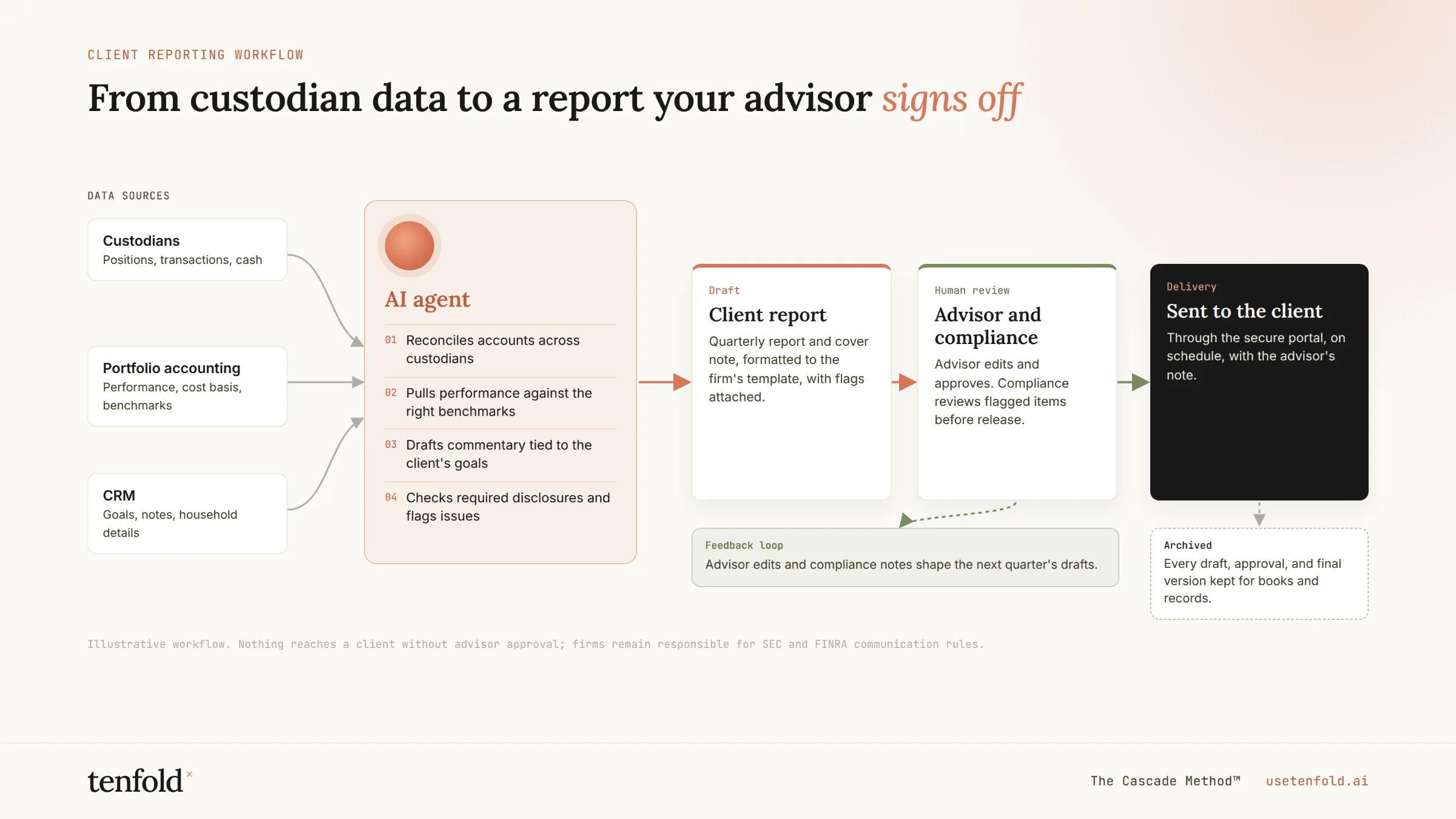
The agent pulls positions, transactions, and performance data from custodians, portfolio management systems, financial planning software, and the CRM. It flags gaps and mismatches, like a missing account, an unreconciled transaction, or a held-away asset that wasn't updated, before a report is built on bad data.
Building the report
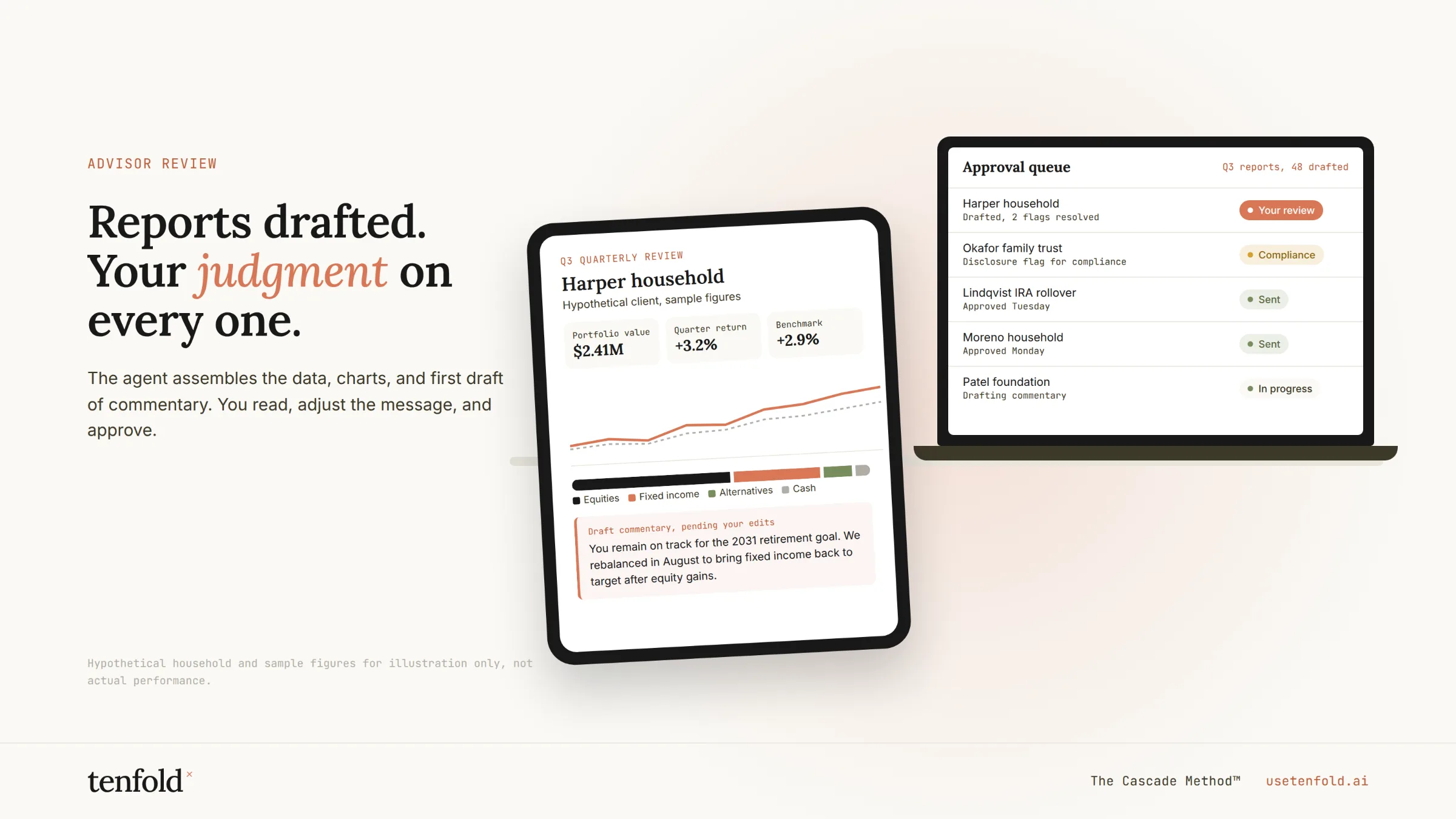
Using the firm's templates, the agent assembles quarterly reports, performance summaries, and household views for each client, and drafts plain-language commentary on performance, allocation changes, and progress toward goals. Reports are personalized to the client's household, accounts, and plan, not just a generic market recap.
Preparing the meeting
Before a review meeting, the agent builds a one-page brief: recent activity, open action items from the last meeting, upcoming life events, required minimum distributions, cash needs, and topics the advisor may want to raise. The advisor walks in prepared without spending an hour assembling it.
Closing the loop after the meeting
After the meeting, the agent drafts the meeting summary, logs notes in the CRM, creates follow-up tasks for the team, and drafts the client follow-up email for the advisor to review and send.
How AI Agents Support Compliance
Compliance is where wealth management firms are most cautious about AI, and rightly so. The good news is that AI agents can make supervision stronger, not weaker, when they're designed correctly.
Pre-review of communications and marketing
Before client emails, reports, social posts, or marketing materials reach compliance, the agent checks them against firm policies and flags issues like performance claims without required context, promissory language, or missing disclosures. Compliance staff review a cleaner first draft and focus their time on judgment calls.
Documentation and recordkeeping
The agent logs meeting notes, client communications, and follow-ups to the right records automatically, so the firm's books and records stay complete. Recordkeeping has been a costly area for the industry: the SEC has fined firms well over $1 billion in recent years over failures to preserve off-channel communications.
Monitoring and exceptions
The agent can monitor accounts for exceptions that need attention: allocations drifting outside a client's stated risk profile, concentrated positions, unusual activity, or overdue suitability and KYC updates. It routes each exception to the right person with context, rather than leaving it in a report nobody reads.
Audit readiness
Because every agent action is logged, firms have a clear trail of what was generated, who reviewed it, and when it was approved. That makes exam preparation faster and supervision easier to demonstrate.
What Separates AI Agents from Basic Reporting Software
Most firms already use portfolio reporting tools and compliance software. So what's different about AI agents?
Traditional reporting software produces the report you configured. It doesn't notice that an account is missing, write commentary specific to a client's goals, or prepare a meeting brief. Traditional compliance tools flag keywords. They don't understand context or route issues with an explanation.
AI agents work across systems and own the workflow. Instead of an advisor or associate stitching together exports, templates, and checklists, the agent gathers the data, builds the draft, runs the checks, and delivers a finished package to a human for approval.
Automation produces outputs. Agents own the process that produces them.
Guardrails That Matter in a Regulated Industry
Firms deploying AI agents for reporting and compliance should build in a few non-negotiables:
Human approval on every client-facing output. Agents draft. Advisors and compliance approve.
Complete logging. Every action, input, and output the agent produces should be recorded and retained according to the firm's recordkeeping obligations.
Data security and access controls. Agents should only access the client data needed for the task, within the firm's existing security and vendor due diligence standards.
Clear supervision policies. Written procedures should cover how AI-generated content is reviewed, approved, and monitored.
Ongoing testing. Outputs should be sampled and checked regularly to catch errors before they reach clients.
Firms should involve their compliance team and legal counsel early to make sure the design fits their specific regulatory obligations.
Where Firms Should Start
Meeting prep and follow-up. Fast to deploy, immediately visible to advisors, and low regulatory risk because outputs stay internal until the advisor approves them.
Quarterly client reporting. High-volume and recurring, with clear time savings every quarter.
Communications pre-review. Reduces compliance queue time and improves first-pass quality.
Account monitoring and exceptions. The broadest impact, but it requires clean data and well-defined rules.
At Tenfold, we've found that the wealth management firms seeing the fastest results aren't the ones with the most technology. They're the ones that clearly define which workflows to hand off, keep humans in the approval loop, and give the agents access to the systems they need to do the work.
Summary
Wealth management advisors spend less than 20% of their time meeting with clients, while reporting, meeting prep, and compliance work consume much of the rest. AI agents can take over the assembly work behind client reporting, prepare meetings and follow-ups, pre-review communications, monitor accounts, and keep a complete audit trail, while advisors and compliance staff keep final approval. The result is more client time, faster reporting cycles, and stronger supervision. The constraint isn't what AI can do. It's whether your firm is ready to delegate.
Tenfold helps wealth management firms evaluate, implement, and operationalize AI agents for client reporting and compliance workflows, with human oversight built in from day one.
Frequently Asked Questions
Q: How do wealth management firms use AI agents?
A: The most common uses are client reporting, meeting preparation, meeting notes and follow-ups, compliance pre-review of communications and marketing, account monitoring, and recordkeeping. Advisors and compliance staff review and approve the agent's output.
Q: Can AI agents be used in a regulated advisory firm?
A: Yes, with the right guardrails. Firms should keep human approval on client-facing content, log every agent action, retain records according to their obligations, apply strict data access controls, and document supervision procedures. Involve compliance and legal counsel early in the design.
Q: Will AI agents replace financial advisors or client service associates?
A: No. AI agents handle repetitive assembly and documentation work so advisors can spend more time with clients and associates can focus on higher-value service. The goal is capacity, not headcount reduction.
Q: How much time can AI agents save advisors?
A: It depends on the firm's workflows, but the opportunity is large. Cerulli data puts advisor administrative work at about nine hours a week, and Kitces Research shows most advisor time goes to work outside client meetings. Reporting and meeting prep are typically the fastest areas to recover time.
Q: What's the first AI agent a wealth management firm should deploy?
A: Meeting preparation and follow-up is usually the best starting point. It delivers visible time savings for advisors right away and keeps outputs internal until the advisor approves them, which keeps regulatory risk low.
Sources used (for fact checking, not for publishing): Kitces Research on advisor time · Cerulli 2025 via PlanAdviser · J.D. Power survey via Kitces · Fidelity IFA DNA 2025 · SEC off-channel communications fines, cited from memory, verify the current total before publishing
