How to Implement AI in Sales: A Step-by-Step Playbook with Real ROI Examples
Implementing AI in sales is not a technology problem. It's an execution problem. Most teams already have access to capable tools — they stall on where to start, what to automate first, and how to prove value before scaling. This playbook gives you a step-by-step path that works, backed by real performance data from teams that have already done it.
Quick Answer: To implement AI in sales, start by auditing where your reps lose time, then deploy AI in the highest-volume, lowest-complexity workflows first — lead scoring and CRM data entry — before expanding to pipeline management, forecasting, and personalized outreach. Measure ROI at each stage before advancing.
Key Takeaways:
Sales reps currently spend 70% of their time on non-selling tasks — AI directly attacks that number.
83% of sales teams using AI reported revenue growth versus 66% without it.
The teams that fail at AI implementation invest in technology first and ignore process. The teams that win do the opposite.
Median ROI on AI sales investments arrives within 5.2 months, with sustained annual returns averaging 317% after that.
You don't need to automate everything at once. Start with one workflow, prove it, then scale.
Why Most Sales Teams Still Aren't Winning with AI
The gap is not capability — it's readiness. According to the Salesforce State of Sales Report (6th Edition), sales reps spend 70% of their time on non-selling tasks, making it structurally hard to connect with prospects. AI can eliminate a significant share of that load — but only if the underlying workflows are mapped and the data is clean.
Here's the other number that matters: according to Salesforce's sixth State of Sales report, 83% of sales teams using AI saw revenue growth, compared to 66% without it. That 17-point gap is not noise. It's a consistent, repeatable edge.
The bottleneck isn't AI capability. It's that most orgs aren't yet set up to delegate to it.
Step 1: Audit Where Your Reps Actually Spend Their Time
Before touching a single tool, document your current state. Map every repeatable task your reps do in a week — CRM updates, lead research, follow-up emails, meeting prep, forecasting submissions — and estimate time spent per task.
You're looking for three categories:
High volume, low complexity — CRM data entry, lead routing, call logging. These are your first automation targets.
High volume, high complexity — Outreach personalization, deal coaching. These come after your foundation is built.
Low volume, high value — Enterprise negotiation, executive relationships. These stay human. Always.
According to McKinsey, approximately one-third of all sales activities can be automated with today's AI and process automation technologies. Your audit will show you exactly which third.
Do not skip this step. Teams that implement AI without an activity audit end up automating the wrong things and generate internal resistance within 60 days.
Step 2: Clean Your CRM Data Before You Flip the Switch
AI is only as accurate as the data it runs on. Dirty CRM data — duplicate records, missing fields, inconsistent naming — produces misleading lead scores, broken forecasts, and AI outputs your reps will stop trusting fast.
According to Salesforce, 53% of sales teams that have fully implemented AI first consolidated their tech stack to streamline data. Nearly 51% also implemented additional data security measures before going live.
Practical minimum before launch:
Deduplicate contact and account records
Enforce required fields for deal stage progression
Standardize lead source, industry, and region values
Connect your CRM to your email and calendar (activity capture)
This is not glamorous work. It is the difference between AI that your team trusts and AI that your team ignores.
Step 3: Deploy AI in Lead Scoring and Qualification First
Lead scoring is the highest-ROI starting point for most B2B sales teams. It's high volume, data-driven, and directly connected to rep time — the three conditions where AI delivers fastest.
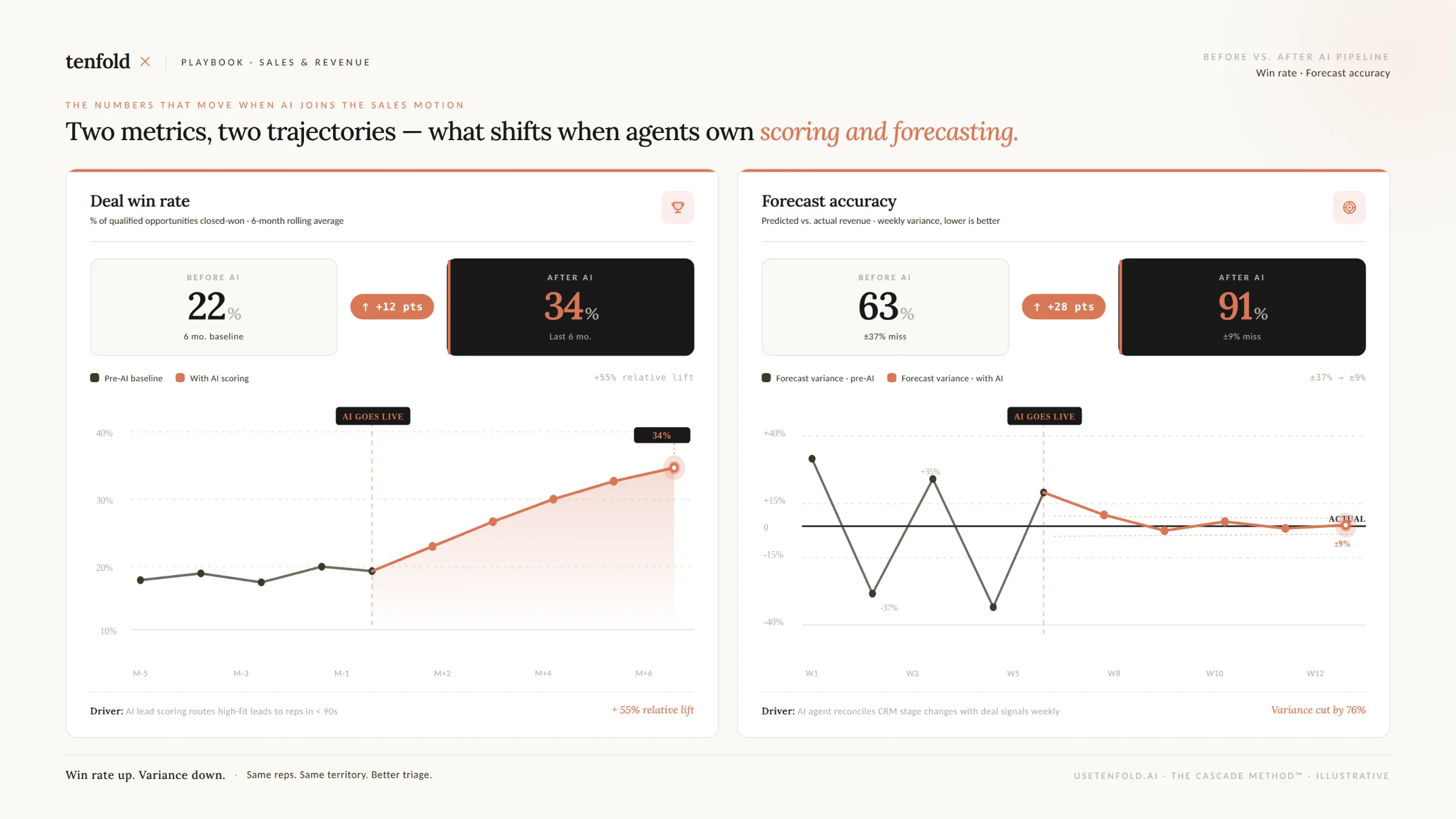
According to ROM Sales Efficiency research, predictive lead scoring driven by AI enhances lead-to-customer conversion rates by as much as 28%. According to McKinsey (2025), AI sales tools can increase leads by 50% and reduce acquisition costs by up to 60% through enhanced targeting and scoring.
What this looks like in practice:
AI scores inbound leads in real time based on firmographic, behavioral, and intent data
Reps receive a prioritized queue instead of a raw list
Low-scoring leads enter automated nurture sequences without rep involvement
High-scoring leads trigger immediate outreach alerts
This alone can produce a measurable shift in pipeline conversion within 30–45 days. That's your proof-of-concept moment.
Step 4: Automate CRM Updates and Admin Workflows
Once lead scoring is running, turn AI loose on the tasks that drain rep time every single day: CRM data entry, call logging, meeting summaries, and follow-up task creation.
According to Salesforce, 43% of sales professionals report administrative work occupying 10–20 hours per week. That's nearly half a workweek lost to non-revenue-generating activity. According to ZoomInfo's State of AI in Sales & Marketing 2025, AI users report cutting low-value manual tasks by an average of 12 hours per week.
The practical implementation here:
Deploy AI call recording and transcription with auto-generated CRM notes
Use AI to auto-populate deal fields after meetings
Automate follow-up task creation based on conversation triggers (e.g., "send pricing" → creates task)
Set AI to flag deals with no activity after a defined period
According to Bain & Company (2025), AI could effectively double active selling time by eliminating routine tasks. Sellers currently spend only about 25% of their working hours actively selling. Fixing that ratio is where the compounding ROI lives.
Step 5: Expand to Pipeline Management and Forecasting
With clean data, automated admin, and AI-scored leads in place, you're ready for the higher-complexity layer: pipeline health monitoring and revenue forecasting.
This is where AI moves from efficiency tool to strategic asset.
AI flags deals at risk based on engagement patterns, deal age, and competitive signals
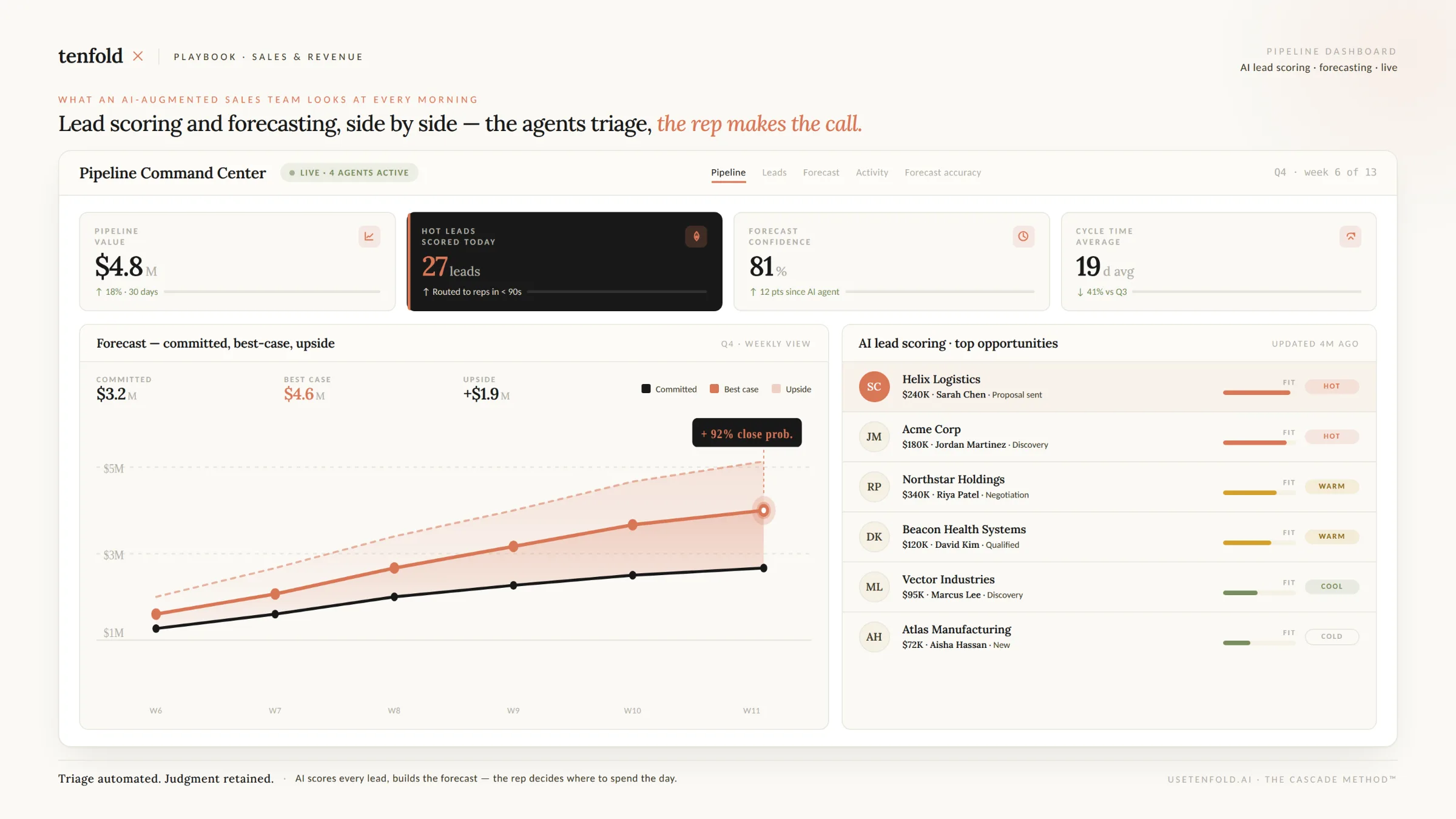
Forecast accuracy improves because AI pulls from actual activity data, not rep self-reporting
Sales managers get real-time visibility into pipeline gaps without running manual reports
According to ROM Sales Efficiency research, AI-driven CRM analytics result in a 20% increase in sales forecasting accuracy. According to IBM's AI-Powered Sales research, by 2026, 83% of executives anticipate AI agents will autonomously execute actions based on operational metrics and transaction histories.
At Tenfold, we've found that pipeline management is where most teams see their second major ROI signal — after lead scoring — because it directly reduces revenue leakage from deals that stall without intervention.
Step 6: Scale to Personalized Outreach and Sales Enablement
By this stage, your team has clean data, automated workflows, and AI-informed forecasting. Now you can apply AI to outreach quality and rep coaching — the highest-leverage applications, and the ones most often deployed too early by teams that skip the foundation.
According to Gartner (2025), by 2027, 95% of seller research workflows will begin with AI, up from less than 20% in 2024. Teams that are already here have a compounding advantage.
Practical applications at this stage:
AI-generated outreach drafts personalized by account, industry, and buying stage
Real-time call coaching that surfaces objection responses during live conversations
AI-driven sales training that identifies rep skill gaps and delivers targeted playbooks
Automated deal reviews that prep reps for renewal and expansion conversations
According to Gartner, sellers who effectively partner with AI tools are 3.7 times more likely to meet quota than those who do not.
Real ROI: What the Data Actually Shows
Implementation skeptics always want numbers. Here they are.
According to Gong's State of Revenue Growth 2025, organizations using AI reported 29% higher revenue growth than peers not using AI.
According to ROM Sales Efficiency research, businesses typically see a median ROI on AI investments within 5.2 months, achieving sustained annual returns averaging 317% thereafter. On average, sales teams see returns of $4.81 for every dollar invested in AI sales technology.
According to Sopro's 2026 AI in Sales & Marketing research, 86% of sales teams using AI report positive ROI within their first year.
According to Datagrid's AI Agents for Sales research, the 26% of companies generating tangible AI value achieve 1.5x higher revenue growth and 1.6x greater shareholder returns — and those companies invest 70% of their AI resources in people and process, not technology alone.
The ROI is not theoretical. The teams not capturing it are the ones that treat AI as a product launch instead of an operational redesign.
Common Pitfalls That Kill AI Sales Implementations
Know these before you start:
1. Deploying AI before cleaning your data. The output quality of every AI layer depends on input data quality. Skipping the data cleanup step produces outputs your reps will dismiss — correctly.
2. Piloting in the wrong workflow. Starting with AI coaching or outreach generation before automating admin is backwards. Your reps will engage more with AI when it first removes their most hated tasks.
3. No change management plan. According to Cirrus Insight's 2025 AI in Sales research, many sales teams resist new systems because they fear AI will monitor or replace them. Adoption requires education, transparency, and management buy-in before rollout.
4. Measuring the wrong thing. Track selling time recovered, conversion rate lift, and forecast accuracy improvement — not just tool login rates. Login rates measure adoption. The other three measure value.
5. Scaling before proving. Every step in this playbook has a proof point. Don't move to the next step until you can document what the current step changed.
Summary
Implementing AI in sales is an execution discipline, not a technology bet. The playbook is sequenced deliberately: audit first, clean your data, prove ROI on lead scoring, then expand to admin automation, forecasting, and outreach. Teams that follow this sequence see measurable returns within months, not years. At Tenfold, we work with operations leaders who are done with pilots and ready to implement — the kind of AI deployment that changes how the revenue org operates, not just how it reports.
Frequently Asked Questions
Q: How long does it take to see ROI from AI in sales?
A: Most teams see an initial ROI signal within 30–45 days from lead scoring alone. Full-stack AI implementations typically reach positive ROI within 5.2 months, according to sales technology benchmarks, with sustained annual returns of 317% after that point.
Q: What's the first thing a sales team should automate with AI?
A: Lead scoring and CRM data entry. These are high-volume, low-complexity workflows with clear before/after measurement. Start here, prove the value, then expand. Teams that start with outreach generation or forecasting before the data layer is clean usually stall.
Q: Do we need to replace our CRM to implement AI in sales?
A: No. Most AI sales capabilities layer on top of your existing CRM — Salesforce, HubSpot, or otherwise. The prerequisite is not a new platform; it's clean, structured data inside your current one. Consolidating your tech stack before AI deployment is what 53% of fully implemented teams did first.
Q: Will AI replace our sales reps?
A: The data says no. According to Gong's 2025 research, companies using AI actually report more aggressive hiring plans than those not using it. AI removes low-value tasks so reps can spend more time on the work that only humans can do — building trust, navigating complex deals, and managing key relationships.
Q: How do we get sales rep buy-in for AI tools?
A: Start by deploying AI against the tasks reps hate most — manual CRM entry, meeting notes, follow-up logging. When AI removes that friction first, reps become advocates. Resistance builds when AI is deployed as surveillance or when it adds steps instead of removing them.