
How to Deploy AI Agents Safely in Your Company
Most companies are deploying AI agents faster than they're building the controls to govern them. According to a SailPoint Technologies global survey, 80% of organizations have already encountered risky behaviors from AI agents — including improper data exposure and unauthorized system access. The agents are live. The governance isn't.
This guide gives Operations leaders and IT Directors a step-by-step framework for deploying AI agents safely — without slowing the business to a crawl.
Quick Answer: Safe AI agent deployment requires four things done in sequence: scoped use-case selection, identity and access controls specific to agents (not inherited from human roles), runtime monitoring, and defined human-in-the-loop checkpoints. Bolt-on governance after launch doesn't work.
Key Takeaways:
80% of organizations have already encountered risky agent behavior — this is a production problem, not a future one.
The dominant risk is identity and access, not AI accuracy. Treat agents as independent, identity-bearing entities.
Gartner projects 40% of enterprise applications will embed task-specific agents by end of 2026 — your governance window is now.
Start contained. Expand only once monitoring and controls are proven.
Autonomy without guardrails isn't innovation. It's incident creation.
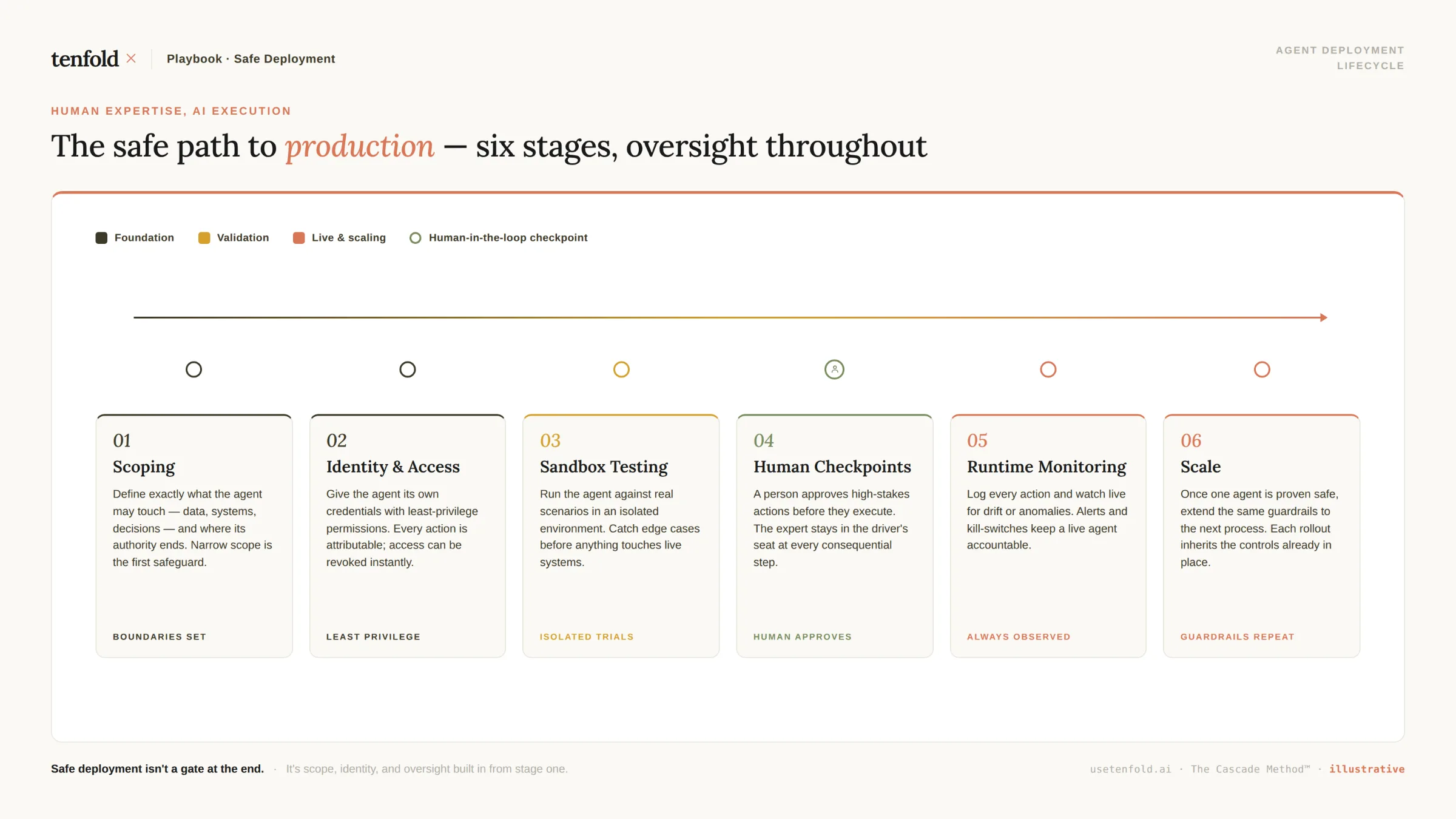
At Tenfold, we've deployed AI agents across complex enterprise environments — and the failures we've seen aren't from bad AI. They're from good AI running without a governance layer. Here's the framework that changes that.
Step 1: Choose the Right Use Case Before Anything Else
Start contained. The fastest path to a major incident is deploying an agent into a high-sensitivity environment before you understand how it behaves in a lower-stakes one.
When evaluating your first — or next — agent use case, apply a simple three-factor test. According to Gartner, any use case that combines the ability to access sensitive data, ingest untrusted content, *and* communicate externally in the same workflow should be treated as a no-go zone due to heightened exfiltration risk. Separate those factors. Start with one.
Good starting points:
Internal knowledge retrieval (no write access, no PII)
Structured data summarization from internal reports
Low-stakes workflow routing where human review follows
Avoid at the outset:
Agents with direct database write permissions
Any agent touching financial transactions, healthcare records, or regulated data
Multi-agent pipelines where one agent instructs another
The goal is to learn how your agents behave in production — because pre-deployment testing cannot anticipate the full range of behaviors that emerge when AI encounters actual business data and unexpected input combinations.
Step 2: Treat Every Agent as an Independent Identity
This is where most enterprise deployments break down immediately.
Only 21.9% of organizations currently treat AI agents as independent, identity-bearing entities within their security model, according to Gravitee's State of AI Agent Security Report. Most still treat agents as extensions of human users or generic service accounts — which creates gaps in auditability and granular access control that attackers actively exploit.
Agents often operate with excessive privileges and weak authentication mechanisms. When compromised, they become a lateral movement vector inside your environment.
What correct agent identity governance looks like:
Unique credentials per agent. Never share accounts or personal credentials across agents. This is already happening in production — and it's a documented security risk.
Ephemeral, scoped tokens. Agents should receive time-bound permissions for each task. Privilege drift — where agents accumulate permissions beyond what any single task requires — is a structural problem, not an edge case.
Least-privilege access by default. Transition from broad access grants to scoped, task-specific permissions. Review and remediate excessive permissions before go-live, not after an incident.
Agent-specific IAM policies. Do not inherit access rules from human user roles. Agents reason and act differently from humans — and their access controls need to reflect that.
Step 3: Build Runtime Monitoring Before You Launch
Security teams consistently underestimate runtime risk. According to Acuvity's 2025 State of AI Security, 38% of organizations identify the runtime phase as their most vulnerable — and an additional 27% view risks as spanning the entire AI lifecycle. That means two-thirds of organizations see runtime as at least partially exposed.
The problem: traditional monitoring tools were designed for static applications. They cannot detect the subtle behavioral changes that indicate an agent operating outside its intended scope.
Runtime monitoring for AI agents requires:
End-to-end traffic logging. Log every prompt, every tool call, every output. According to the State of Agentic AI Security 2025 Report, only 38% of enterprises currently monitor AI traffic end-to-end. The remaining 62% are operating with structural blindspots.
Agent-to-agent visibility. Only 24.4% of organizations have full visibility into which agents are communicating with others, per Gravitee's research. Multi-agent pipelines where 25.5% of deployed agents can create or instruct other agents introduce autonomous chains of command that bypass traditional authorization gates.
Behavioral anomaly detection. Set baseline behavior patterns at deployment. Flag deviations — not just errors. An agent doing exactly what it's told but with manipulated instructions (prompt injection) will look clean to a log scanner but is actively compromised.
Prompt injection resilience. According to Help Net Security, multi-turn attacks across extended conversations achieved success rates as high as 92% in testing across open-weight models. Single-turn protections are insufficient for agents operating over longer sessions with memory and tool access.
Only 41% of enterprises have runtime guardrails in place. Build yours before go-live — retrofitting governance into a running agent is significantly harder than designing it in.
Step 4: Define Human-in-the-Loop Checkpoints
Full autonomy is not the goal for most enterprise deployments. Supervised autonomy — where agents execute within defined parameters and escalate when they hit boundaries — is both safer and more reliable.
Human-in-the-loop (HITL) checkpoints serve three functions:
1. Catch edge cases that pre-deployment testing didn't surface
2. Limit blast radius when an agent is manipulated or behaves unexpectedly
3. Build organizational trust in the agent's outputs before expanding scope
Define HITL triggers explicitly before deployment:
Any action above a specified financial or data impact threshold
Any write operation to a production system during the first 30 days
Any agent decision that a human couldn't explain from the logs alone
Prompt engineering enables threat actors to manipulate agents into carrying out malicious actions — which makes layered security controls and human-in-the-loop checkpoints a structural requirement, not a fallback. According to Recorded Future, zero-trust principles and HITL validation are the primary mitigations against agent-driven threats.
Step 5: Map Your Compliance Obligations Now
The regulatory window is closing. The EU AI Act's high-risk AI obligations take effect in August 2026. The Colorado AI Act becomes enforceable in June 2026. GDPR already requires explicit consent, data minimization, and the right to explanation for automated decisions affecting individuals.
For enterprise AI agent deployments, the minimum compliance baseline includes:
ISO 42001: International AI management system standard — requires supplementary controls for agent-specific risks including tool authorization, delegation chain integrity, and prompt injection
NIST AI RMF: Structured approach to identifying, assessing, and mitigating AI risks across the agent lifecycle
SOC 2: Requires demonstrable controls over third-party access, including AI agents touching customer data
GDPR: Any agent processing personal data of EU residents requires documented lawful basis, data minimization controls, and explainability mechanisms
Compliance and security are not separate workstreams here. The governance infrastructure that satisfies NIST and ISO 42001 is the same infrastructure that prevents prompt injection and privilege escalation. Build it once. Document it properly.
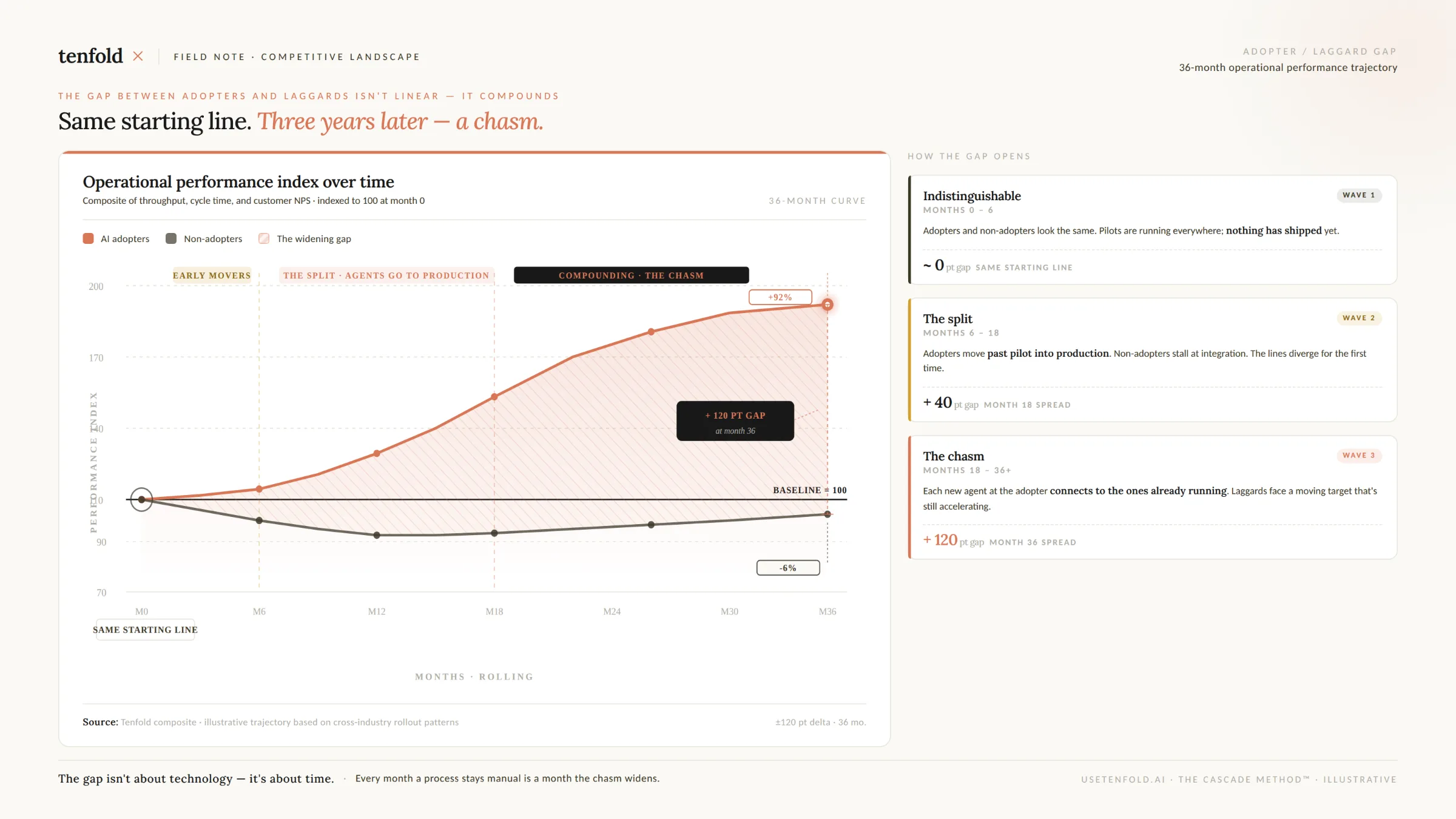
Common Mistakes to Avoid
Inheriting human access controls for agents. Agents require their own identity and access model. Reusing human IAM policies leaves gaps that attackers exploit through impersonation, session smuggling, and unauthorized capability escalation.
Treating security as a pre-deployment activity only. Pre-deployment testing cannot anticipate production behavior. Runtime monitoring is not optional.
Deploying into multi-agent pipelines before single-agent governance is proven. Multi-agent systems introduce cascading failure risks. A compromised upstream agent can inject hidden instructions into output consumed by a downstream agent — including one handling financial transactions.
Assuming compliance means security. According to Gravitee's State of AI Agent Security Report, 69.2% of executives believe existing regulations are already sufficient — while technical teams report agents sharing passwords and using personal credentials in production. The gap between compliance confidence and actual implementation is a documented risk.
Waiting for governance to be "finished" before deploying. Security maturity builds progressively. Start with basic controls — monitoring agent actions, setting data access boundaries, implementing approval workflows for high-risk tasks. Layer in sophistication as you learn.
Summary
Deploying AI agents safely isn't about slowing down. It's about deploying with the right architecture from the start — so you can move fast without creating incidents that force you to stop entirely. The five steps above — scoped use-case selection, agent-specific identity controls, runtime monitoring, human-in-the-loop checkpoints, and compliance mapping — form the minimum viable governance layer for any enterprise agent deployment.
At Tenfold, we've built and governed AI agent deployments across complex enterprise environments. The proof of what safe, fast, agent-first delivery looks like is Inforge — a full Salesforce consultancy operating entirely via AI agents, every day. If you're evaluating how to deploy agents safely in your own org, that's where we start every conversation.
Frequently Asked Questions
Q: What is the biggest security risk when deploying AI agents in an enterprise?
A: Identity and access management is the dominant risk — not AI accuracy. Most organizations still treat agents as extensions of human users or generic service accounts, which creates exploitable gaps in auditability and access control. Agents need their own identity, scoped credentials, and time-bound permissions.
Q: How do I know if my organization is ready to deploy AI agents?
A: You don't need to solve every challenge before starting. What readiness means in practice is: one or two well-scoped use cases, real-time visibility into agent behavior, defined guardrails for task execution, and an explicit escalation path for edge cases. Start contained, then scale.
Q: What is prompt injection and why does it matter for AI agents?
A: Prompt injection is when a malicious actor embeds hidden instructions in content an agent reads — causing the agent to execute unintended actions. It's the leading attack vector against agentic systems. Multi-turn attacks have achieved success rates as high as 92% in testing, making runtime monitoring and input validation non-negotiable.
Q: Do AI agents need to comply with GDPR and other regulations?
A: Yes. Any agent processing personal data of EU residents is subject to GDPR requirements including lawful basis, data minimization, and explainability for automated decisions. The EU AI Act's high-risk AI obligations also take effect in August 2026. Compliance mapping should happen before deployment, not after.
Q: How is governing AI agents different from governing traditional software?
A: Traditional software follows rigid scripts. AI agents reason, plan, and act autonomously — their behavior can vary across executions even when starting conditions are identical. That variability means static, pre-deployment controls are insufficient. Governance requires continuous runtime monitoring, behavioral anomaly detection, and dynamic access controls that adapt as agent behavior evolves.
