
How Real Estate Brokerages Use AI Agents to Follow Up with Every Lead
Brokerages don't have a lead generation problem. They have a lead follow-up problem. The inquiries are coming in through portals, websites, open houses, and phone calls. What's breaking is the response. AI agents fix that by replying to every lead in seconds, qualifying intent, booking showings, and nurturing long-cycle prospects for months without a single one slipping through the cracks.
Quick Answer: Real estate brokerages use AI agents to respond to every inbound lead instantly across text, email, and phone, qualify buyers and sellers with a short conversation, book showings and listing appointments directly on agent calendars, and run long-term nurture sequences until the lead is ready. The result is faster speed to lead, fewer lost inquiries, and agents spending their time on conversations that are ready to convert.
Key Takeaways:
In Pied Piper's 2026 Lead Handling Effectiveness Study, 73% of phone inquiries to real estate offices received no follow-up of any kind within 24 hours.
68% of website inquiries got no response within 24 hours, and only 10% reached an agent within the first hour.
76% of repeat buyers and 67% of first-time buyers interviewed only one agent, per NAR's 2025 Profile of Home Buyers and Sellers. The first agent to respond often becomes the only agent.
AI agents close the speed gap by responding in seconds, 24/7, and they close the persistence gap by following up for as long as a lead stays warm.
The brokerages getting the most out of AI agents connect them directly to their CRM and calendars, so the agent can act, not just reply.
The Real Cost of Slow Lead Follow-Up in Real Estate
The numbers on lead response in real estate are hard to look at.
Pied Piper's 2026 Real Estate Lead Handling Effectiveness Study submitted 2,198 consumer inquiries by phone and website to local offices of 21 major real estate brands. Only 33% of callers were able to speak with an agent during their call. 73% received no follow-up by phone, text, or email within 24 hours.
Website inquiries fared even worse. About 1 in 10 website inquiry forms didn't work at all. 68% of web inquiries received no response within 24 hours, and only 10% resulted in contact from an agent within the first hour.
Now layer on how buyers and sellers actually choose agents. According to NAR's 2025 Profile of Home Buyers and Sellers, 76% of repeat buyers and 67% of first-time buyers interviewed only one agent before deciding who to work with. On the listing side, 80% of sellers contacted only one agent before hiring.
Put those two facts together and the math is simple. Most consumers talk to one agent. Most inquiries don't get a timely answer. The brokerage that responds first usually wins, and most brokerages aren't responding at all.
This isn't new. Harvard Business Review's landmark research on online sales leads found that companies contacting a lead within an hour were nearly 7 times as likely to qualify that lead as those who waited even one hour longer. In real estate, where leads shop multiple portals at once, that window is even tighter.
The bottleneck isn't agent effort. It's that one agent can't answer a text from a showing, a closing table, or a family dinner.
Why Agents Can't Solve This Manually
Most agents already know speed to lead matters. Every coaching program teaches it. The problem is structural.
Agents are the product. When they're with a client, they're not answering new inquiries. Lead flow is also uneven: portal leads spike on weekend evenings, open houses generate a burst of sign-ins on Sunday afternoon, and seller inquiries often arrive late at night after someone has been browsing comps.
Then there's the long tail. Real estate has one of the longest buying cycles of any consumer purchase. A lead who says "just looking" today may be ready in six or nine months. Manual follow-up over that timeframe rarely survives a busy season.
ISAs and call centers help, but they're expensive, they work shifts, and they still hand off leads with inconsistent notes. That's the gap AI agents are built to fill.
How AI Agents Follow Up with Every Lead: The Four-Stage Model
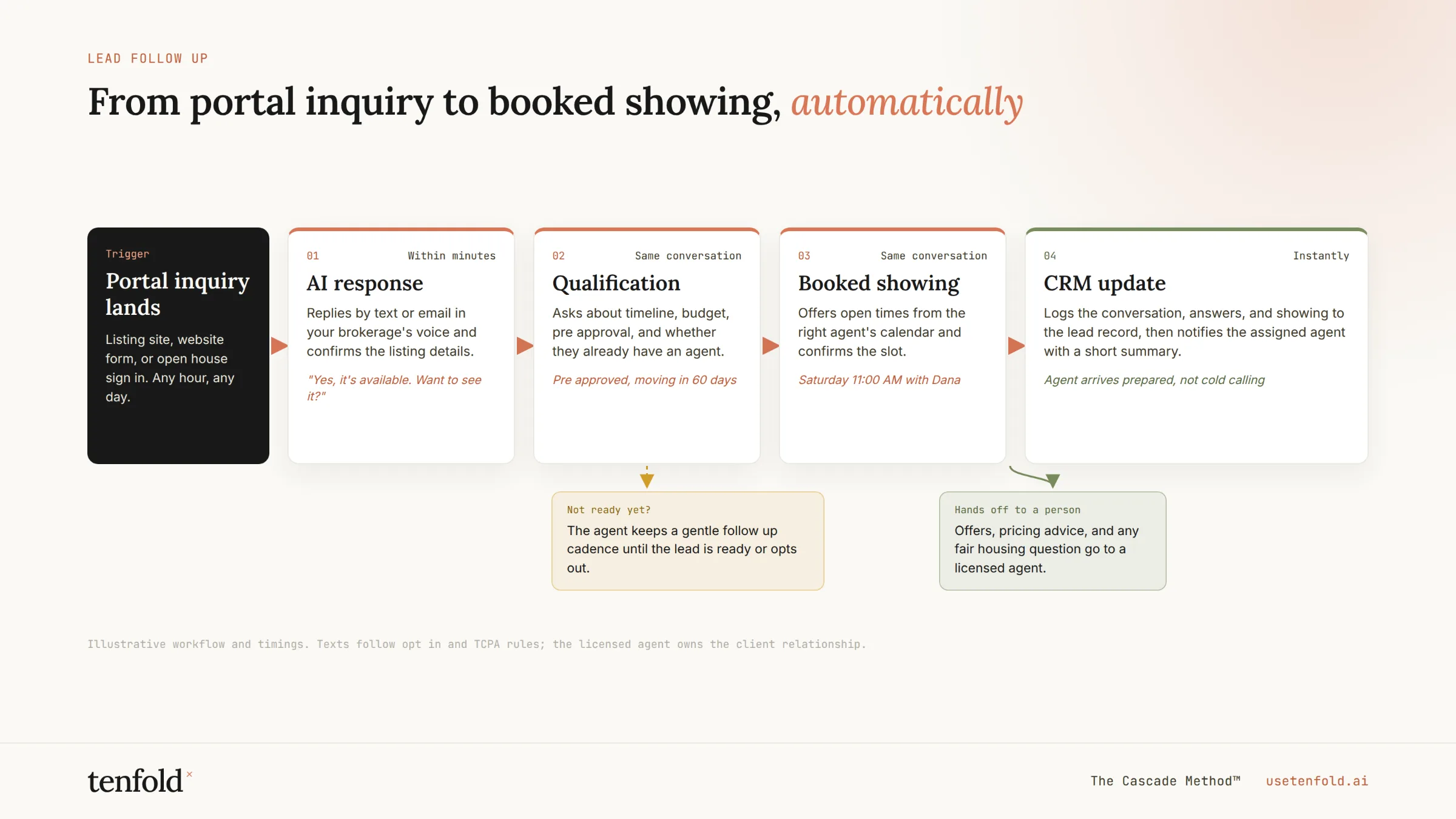
AI agents handle lead follow-up as a complete workflow, not a single auto-reply. The best brokerage deployments cover four stages.
Stage 1: Instant response on every channel
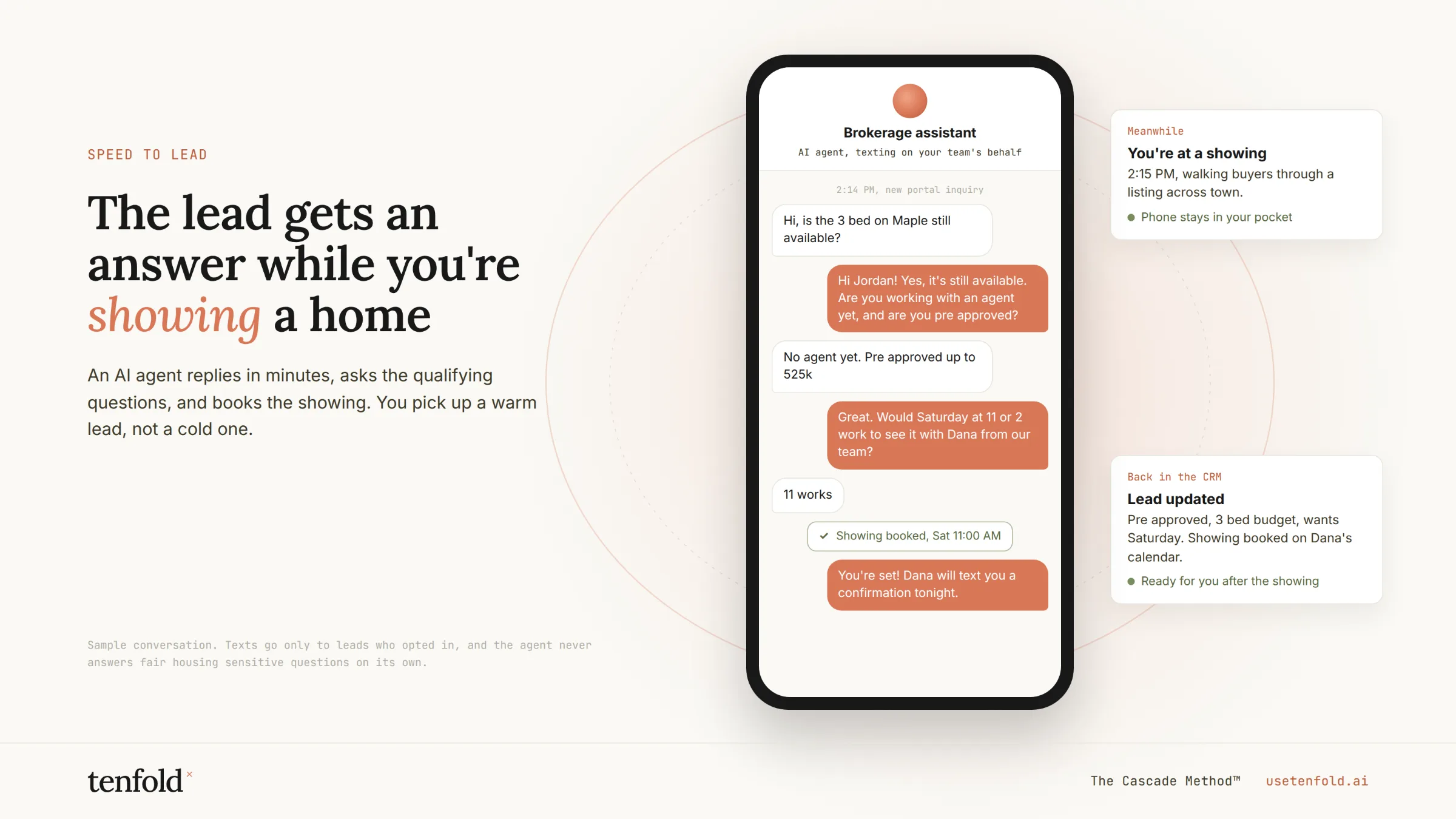
The moment a lead submits a form on Zillow, Realtor.com, a brokerage website, or a Facebook ad, the AI agent replies by text and email within seconds. If the lead calls and no one picks up, a voice agent answers, captures the request, and keeps the conversation going. Every inquiry gets a real, relevant response, at 2 PM on a Tuesday or 11 PM on a Saturday.
Stage 2: Conversational qualification
Instead of a generic "thanks, an agent will reach out," the AI agent asks the questions a good ISA would: timeline, price range, preapproval status, target neighborhoods, whether they need to sell first. It adapts based on the answers. A seller asking for a home value gets a different path than a buyer asking about a specific listing.
Stage 3: Booking and handoff
Once a lead is qualified, the agent books the showing or listing consultation directly on the right agent's calendar, applies routing rules (by territory, price point, language, or round robin), and logs a clean summary in the CRM. The human agent walks into the first conversation already knowing what the client wants.
Stage 4: Long-term nurture
Leads that aren't ready yet don't go cold. The AI agent keeps checking in with new listings that match their criteria, market updates for their neighborhood, and timely nudges when rates shift or inventory changes. When a lead re-engages, it alerts the assigned agent immediately.
What Separates AI Agents from Basic Real Estate Automation
Most brokerages already have some automation in place: drip campaigns in the CRM, a portal auto-responder, maybe a chatbot on the website. So what's different?
Traditional automation is rule-based: if a lead comes in, send email template 3. It sends the same message to everyone and stops when the template runs out. AI agents are goal-directed. They read what the lead actually said, respond to the specific question, decide whether to text or call, and take the next action needed to book an appointment.
In practice, that means:
A drip campaign sends a generic "new listings" email. An AI agent tells the buyer that the 3-bedroom they asked about just had a price drop and offers two showing times.
A chatbot answers FAQs on the website. An AI agent checks the agent's calendar and books the showing in the same conversation.
An auto-responder confirms receipt. An AI agent qualifies the lead, routes it, and writes the CRM note so the human agent never starts from zero.
Automation sends messages. Agents own the follow-up.
Where Brokerages Should Start
Not every brokerage needs to automate the entire lead lifecycle on day one. Based on where leads are lost most often, the highest-ROI starting points are:
Instant response on web and portal leads. This is where the Pied Piper data shows the biggest failure rate, and it's the fastest workflow to deploy.
After-hours and missed-call coverage. A voice agent that answers when agents can't recovers inquiries that would otherwise go to the next office on the list.
Database reactivation. Most brokerages are sitting on thousands of old leads in their CRM. An AI agent can work that list systematically and surface the people who are ready now.
Long-term nurture. The broadest impact, but it works best once lead data and routing rules are clean.
The infrastructure question matters here too. An AI agent is only as useful as the systems it can reach. If it can't read your CRM, see agent calendars, or pull listing data from your MLS feed, it can only send messages, not run the workflow.
At Tenfold, we've found that the brokerages seeing the fastest results aren't the ones with the biggest tech stacks. They're the ones that have clearly defined the follow-up workflow they want to hand off, and given the agent the access and authority to actually run it.
Summary
Real estate brokerages are paying to generate leads and then losing most of them to slow or missing follow-up. The 2026 Pied Piper study shows the scale of the problem: 73% of phone inquiries and 68% of web inquiries go unanswered for a full day. Meanwhile, most buyers and sellers only ever talk to one agent. AI agents solve both halves of the problem by responding instantly on every channel and following up persistently for as long as a lead takes to convert. The constraint isn't what AI can do. It's whether your brokerage is ready to let it run the workflow.
Tenfold helps brokerages and real estate teams evaluate, implement, and operationalize AI agents for lead response, qualification, and nurture, so every lead gets a fast answer and a real follow-up plan.
Frequently Asked Questions
Q: How fast should a real estate brokerage respond to a new lead?
A: Within minutes, and ideally within seconds. Harvard Business Review research found that contacting a lead within an hour makes it nearly 7 times more likely to qualify than waiting longer, and NAR data shows most buyers and sellers only interview one agent. AI agents make an instant response possible 24/7 without adding staff.
Q: Will AI agents replace real estate agents or ISAs?
A: No. AI agents handle the first response, qualification, scheduling, and long-term nurture so that agents spend their time on showings, negotiations, and client relationships. Many teams redeploy ISAs to higher-value work like working hot leads and past-client outreach.
Q: Can AI agents work with my existing CRM?
A: Yes, in most cases. AI agents can connect to popular real estate CRMs like Follow Up Boss, kvCORE, Lofty, and Salesforce through standard APIs to read lead data, update records, log conversations, and trigger handoffs to agents.
Q: How do AI agents handle leads that aren't ready to buy or sell yet?
A: They keep nurturing them. The AI agent sends relevant listings, neighborhood updates, and personalized check-ins on a cadence that matches the lead's timeline, and alerts the assigned agent the moment the lead shows renewed intent.
Q: What's the first AI agent a brokerage should deploy?
A: For most brokerages, an instant-response agent for web and portal leads delivers the fastest, most measurable impact. That's where industry data shows the most leads are lost, and it requires only CRM and calendar access to start.
Sources used (for fact checking, not for publishing): Pied Piper 2026 study via Real Estate News · NAR 2025 Profile buyer data via BAM · NAR 2025 Profile seller data via BAM · HBR, "The Short Life of Online Sales Leads" (2011)
