
How Much Does It Cost to Build an AI Agent in 2026? A Realistic Pricing Guide
Building an AI agent in 2026 costs between $10,000 and $500,000+, depending on agent type, autonomy level, integration complexity, and compliance requirements. That range is real — and it's not vague. A rule-based FAQ bot sits at the low end. A multi-agent orchestration system that touches your CRM, ERP, and compliance stack sits at the high end. Most mid-market enterprise projects land between $80,000 and $350,000 for development alone — before you factor in Year 1 operational costs.
At Tenfold, we've priced and scoped dozens of these builds. The number one mistake we see isn't overspending — it's under-scoping. Vendors quote the build. Nobody quotes what running it actually costs.
This guide gives you both.
Quick Answer: A production AI agent that does something useful in 2026 typically costs $40,000–$300,000 to develop. Add 40–60% for Year 1 infrastructure, LLM API fees, integration work, and maintenance — and your true total cost of ownership is materially higher than the headline build number.
Key Takeaways:
AI agent build costs range from $10K (simple chatbot) to $500K+ (enterprise multi-agent system) depending on complexity and autonomy.
Year 1 all-in cost is typically 1.4x–1.8x the headline build quote — most vendor proposals don't model infrastructure, LLM tokens, or ongoing maintenance.
Most enterprise AI agent projects carry $3,200–$13,000/month in operational spend post-launch.
Build vs. buy has a clear crossover point: below ~1 million agent interactions per year, buying is almost always cheaper.
The median payback period for well-scoped AI agent deployments is now 6.7 months — down from 11.4 months in 2025.
AI Agent Costs by Type: The Definitive 2026 Range
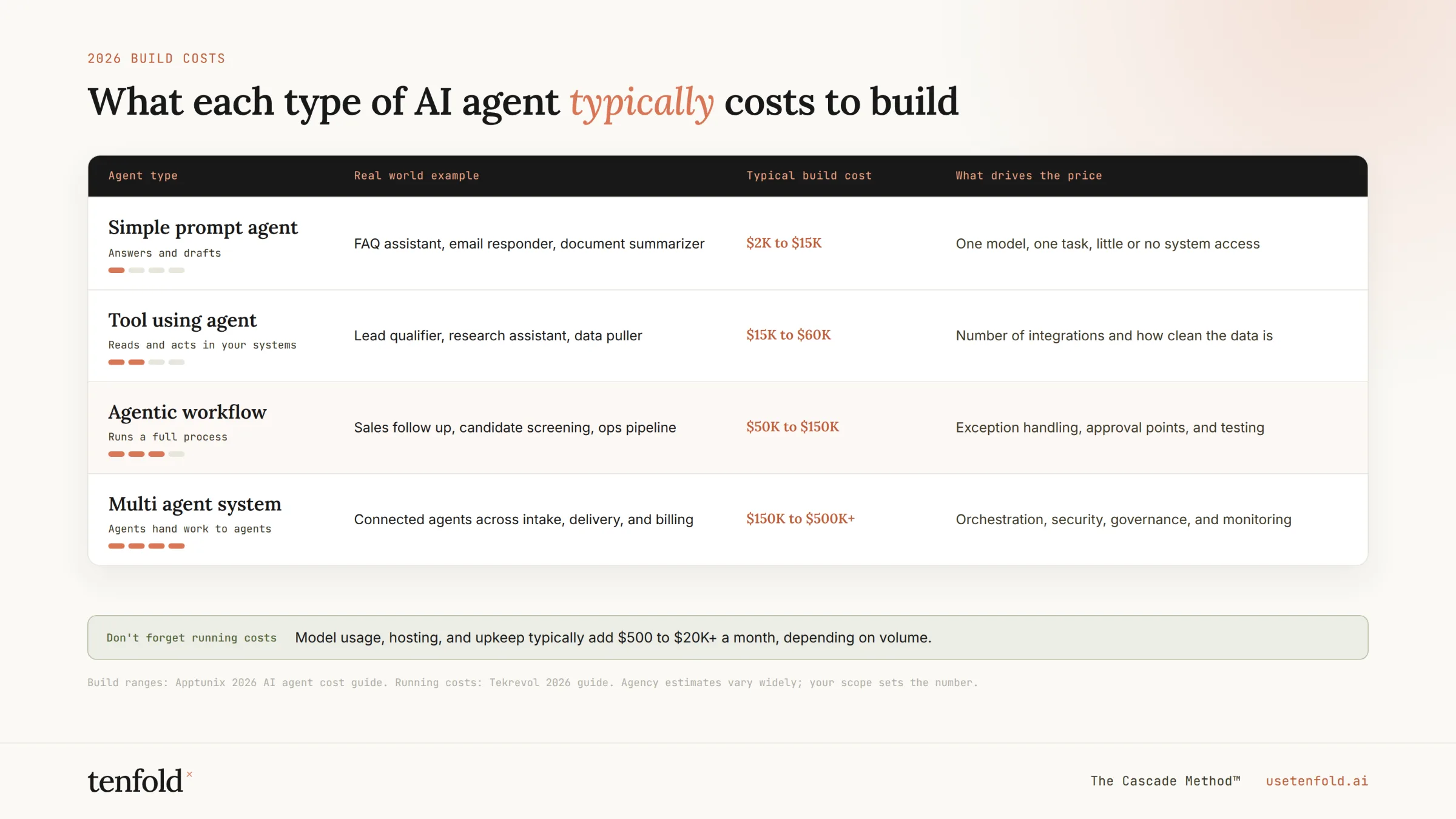
The most important variable in your budget isn't your industry or your team size. It's the type of agent you're building. Complexity and autonomy determine cost more than any other single factor.
Here's how the market breaks down in 2026:
| Agent Type | Build Cost | Monthly OpEx | Typical Timeline |
|---|---|---|---|
| Rule-based / Simple Chatbot | $8,000 – $30,000 | $500 – $2,000 | 4–8 weeks |
| LLM-Powered Task Agent | $50,000 – $120,000 | $2,000 – $6,000 | 8–14 weeks |
| RAG-Based Knowledge Agent | $50,000 – $150,000 | $3,000 – $9,000 | 12–20 weeks |
| Goal-Based / Autonomous Agent | $80,000 – $200,000 | $3,500 – $10,000 | 12–22 weeks |
| Multi-Agent Orchestration System | $150,000 – $400,000+ | $8,000 – $20,000 | 16–28 weeks |
| Enterprise Agentic Platform | $300,000 – $500,000+ | $10,000 – $25,000+ | 24–40+ weeks |
According to Hudasoft's 2026 AI Agent Pricing Analysis, these ranges reflect the current market for custom development — not no-code tools or off-the-shelf platforms. The gap between tiers is driven primarily by orchestration complexity, the number of tool integrations, and the depth of memory and reasoning required.
If you're building for a specific business function, the cost picture looks like this:
| Business Function | Build Cost | Monthly Run Cost | Timeline |
|---|---|---|---|
| Customer Support | $40,000 – $120,000 | $2,500 – $5,000 | 8–16 weeks |
| Sales Qualification | $70,000 – $180,000 | $3,000 – $6,000 | 12–20 weeks |
| Legal Document Review | $100,000 – $200,000 | $3,000 – $10,000 | 16–24 weeks |
| Data Analysis & Reporting | $80,000 – $180,000 | $3,000 – $7,000 | 12–20 weeks |
| HR Onboarding | $50,000 – $100,000 | $2,000 – $5,000 | 10–16 weeks |
[INTERNAL LINK: anchor — "AI agents for Salesforce CRM" — link to Tenfold's Salesforce AI agent implementation page]
What You're Actually Paying For: Cost by Development Phase
Every AI agent project runs through the same phases. Most budget overruns happen because teams underestimate the back half of the build — integration, QA, and deployment — not the core agent development.
| Phase | Typical Cost | Share of Budget | Where Teams Go Wrong |
|---|---|---|---|
| Discovery & Scoping | $5,000 – $20,000 | 8–15% | Skipping it to save money — every dollar cut here costs three in development |
| Data Preparation | $5,000 – $40,000 | 10–25% | Assuming data is ready. It almost never is |
| Core Agent Development | $15,000 – $100,000 | 25–40% | Building custom orchestration when LangChain or LangGraph would do the same job faster |
| Integration & API Work | $8,000 – $80,000 | 15–35% | Treating integration as a small task — on complex projects, it regularly exceeds core development cost |
| QA & Safety Testing | $5,000 – $50,000 | 10–15% | Testing only happy paths, not adversarial inputs or hallucination edge cases |
| Deployment & Monitoring Setup | $10,000 – $30,000 | 8–12% | Launching without observability — you won't know when it breaks |
According to Decipherzone's 2026 AI Agent Cost Guide, the integration phase is consistently the most underbudgeted line item. On complex projects connecting agents to CRM, ERP, and proprietary databases, integration work regularly exceeds the core agent development cost.
The Hidden Costs Nobody Quotes You
This is where most enterprise AI agent budgets go wrong. The build cost is the visible number. The operational cost is what kills the business case.
According to Hypersense Software's TCO Guide for 2026, most enterprise budgets underestimate the true total cost of ownership by 40–60%. That gap is where AI projects fail.
Here's what's hiding in that gap:
LLM API Token Costs
Every time your agent reasons, retrieves, or responds, you're paying per token. At production scale, this compounds fast. A mid-size customer service agent handling 10,000 conversations per month at approximately 2,000 tokens each runs roughly $3,000/month in API fees at current GPT-4o pricing, according to Oometa AI's 2026 Enterprise Cost Framework. Enterprise usage can easily reach $1,000–$5,000/month just in API calls.
There's also a non-linearity problem: because LLM APIs are stateless, agent frameworks resend the entire cumulative context log at each reasoning step. Token use grows quadratically with longer reasoning chains — a 20-step loop costs far more than twice a 10-step run.
Cloud Infrastructure
Ongoing API usage and cloud hosting adds $200–$5,000/month on top of token costs, depending on scale, redundancy requirements, and whether you're self-hosting any components.
Prompt Engineering and Maintenance
The most underestimated ongoing cost. As underlying models update, edge cases surface in production, and business requirements evolve, your agent's behavior requires continuous tuning. Expect $1,000–$2,500/month in ongoing prompt maintenance for a mid-complexity agent.
Security and Access Control
If the agent touches real business data — and it will — you need access controls, logging, role-based permissions, and API gating. This adds $500–$2,000/month depending on compliance scope.
Combined, Azilen's 2026 pricing analysis reports that mid-tier enterprise agents carry $3,200–$13,000/month in operational spend post-launch, covering LLM API tokens, vector database hosting, monitoring, prompt tuning, and security upkeep.
Annual Maintenance
After Year 1, expect recurring expenses of 15–25% of your original development cost annually in maintenance and model retraining, plus $12,000–$24,000/year in dedicated maintenance developer hours for a stable production agent, per GettIA's real-cost breakdown.
The True Year 1 All-In Cost
When you model it correctly, Year 1 all-in cost is typically 1.4x–1.8x the headline build cost. Here's what that looks like across tiers:
| Tier | Build Cost | Year 1 Infra + LLM | Year 1 Maintenance | Year 1 All-In Total |
|---|---|---|---|---|
| Lean MVP (Simple Agent) | $15K – $40K | $3.5K – $10K | $3K – $6K | $21.5K – $56K |
| Mid-Tier RAG Agent | $30K – $80K | $10K – $30K | $6K – $16K | $46K – $126K |
| Autonomous Tool-Using Agent | $60K – $150K | $22K – $72K | $12K – $30K | $94K – $252K |
| Multi-Agent System | $120K – $400K+ | $60K – $240K+ | $24K – $80K+ | $204K – $720K+ |
*Source: Decipherzone AI Agent Cost Guide 2026*
Vendor quotes that lead with "$80,000 to build your AI agent" rarely model the $30,000–$50,000 in infrastructure, token usage, and maintenance you will spend in the same 12 months.
Build vs. Buy vs. Hybrid: Which Path Fits Your Budget?
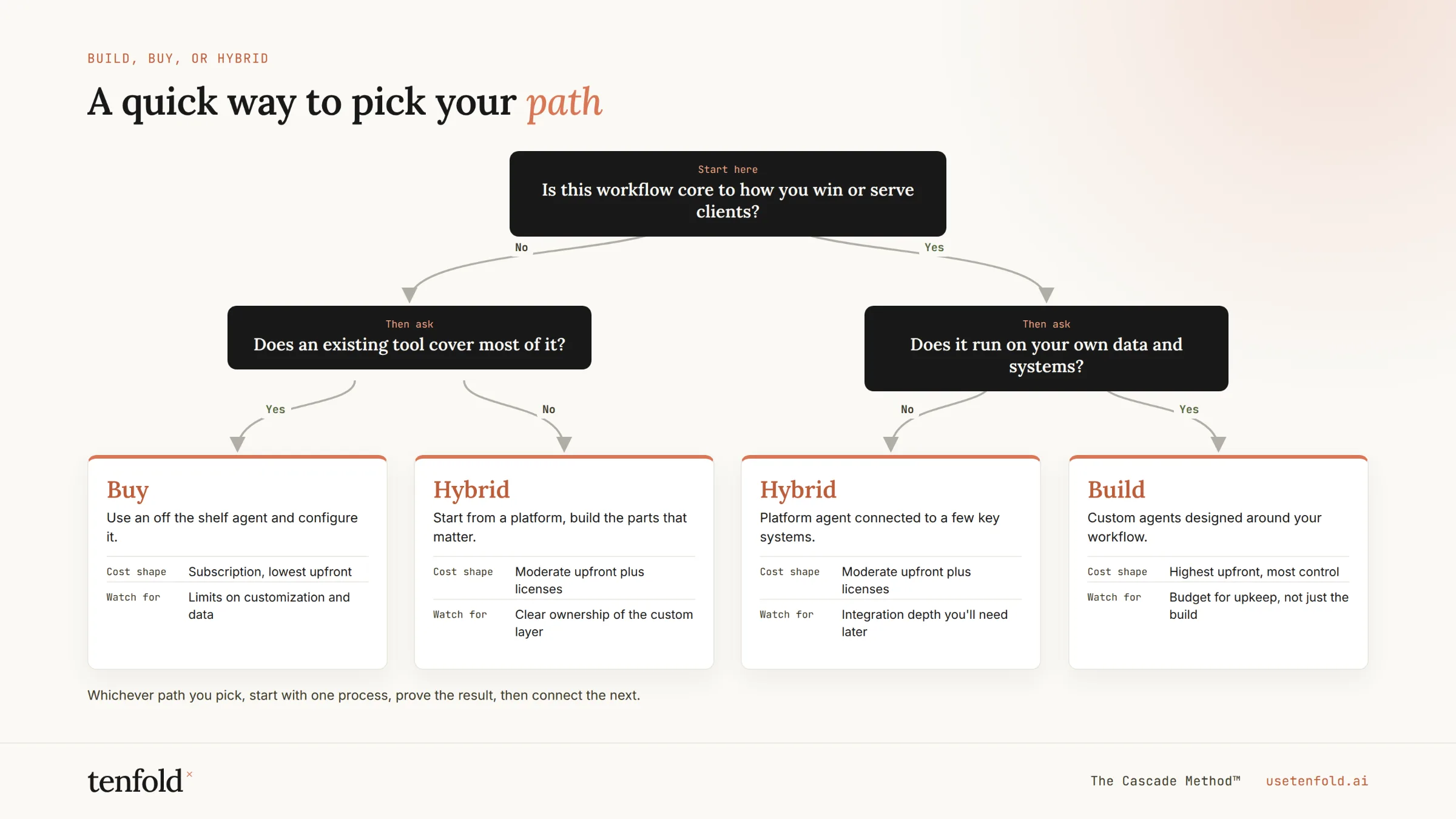
The build-vs-buy question has a clearer answer in 2026 than it did a year ago — but it still depends on your volume and use case specificity.
According to analysis from Digital Applied, the total cost of ownership crossover point sits at approximately one million agent conversations per year. Below that, buying a SaaS platform is almost always cheaper. Above it, a custom build starts to win on unit economics — sometimes significantly.
Here's the practical comparison:
| Factor | Buy (SaaS Platform) | Hybrid | Custom Build |
|---|---|---|---|
| Speed to production | Days to weeks | 4–8 weeks | 12–24 weeks |
| Year 1 cost | Lower | Medium | Higher |
| 3-year ROI | Moderate | Strong | Strongest (at scale) |
| Proprietary data advantage | No | Partial | Full |
| Data control | Vendor's rules | Shared | Yours |
| Best for | Fast deployment, proven use cases | Existing CRM/ERP shops wanting control | High-volume, unique workflows, competitive differentiation |
The practical rule: buy when the workflow is common and speed matters. Build when the agent is a competitive differentiator or your data can't live in a vendor's system.
A SaaS AI agent platform typically runs $500–$5,000/month — dramatically lower upfront than custom development's $50,000–$500,000 first-year cost. But at scale, that monthly subscription compounds, and you're capped by the vendor's roadmap.
The hybrid path — buying a platform layer and building proprietary agent logic on top — is the right call for roughly 25% of teams, and it's consistently the fastest path to meaningful customization without the full custom build price tag.
What the ROI Numbers Actually Say in 2026
The ROI case for AI agents has strengthened materially this year — but the failure rate hasn't disappeared.
On the upside: the average cost of deploying an enterprise AI agent system has fallen 23% year-over-year to $276,000 in 2026, down from $358,000 in 2025 and $512,000 in 2024, driven by more competitive model pricing and the growth of pre-built connector ecosystems. The median payback period has dropped from 11.4 months in 2025 to 6.7 months in 2026.
Real-world production deployments show what's possible when agents are well-scoped:
Klarna's AI agent handled the equivalent workload of 853 employees and saved $60 million by Q3 2025.
Salesforce cut $5 million in legal costs through contract automation agents.
BakerHostetler reduced legal research hours by 60%, cutting time spent on case searches while improving accuracy.
But the other number matters too: 59% of enterprise AI agent programs do not achieve positive ROI in their first year. That's down from 77% failure in 2025, but 6 in 10 enterprise AI investments are still missing their year-one targets — despite two years of hype and billions in deployment spending.
The gap between winners and losers isn't capability. It's scope discipline. The projects that hit ROI are the ones with a clearly defined use case, clean data, and a realistic total cost model built before the first line of code is written.
At Tenfold, we've found that the single most reliable predictor of ROI isn't the technology stack — it's whether the organization scoped the agent around one high-value workflow before trying to scale it to ten.
7 Factors That Actually Determine Your AI Agent Budget
Every cost driver reduces to one of these seven variables. If you can answer all seven before you talk to a vendor, you'll get proposals that reflect reality — not wishful thinking.
1. Agent Type and Autonomy Level
Reactive agents that follow scripted flows cost a fraction of autonomous agents that plan, reason, and execute multi-step tasks independently. Know which one your use case actually requires.
2. Number and Complexity of Integrations
Every system the agent connects to — CRM, ERP, internal databases, third-party APIs — adds $10,000–$40,000 in integration work. On complex enterprise projects, integration regularly exceeds core agent development cost.
3. Data Readiness
Data cleaning, normalization, document preparation for RAG pipelines, and ongoing data pipeline maintenance add $5,000–$25,000 upfront and $1,000–$5,000/month in maintenance. Messy data alone can double a project timeline.
4. Compliance and Regulatory Requirements
Healthcare (HIPAA) and financial services (SOC 2, regulatory audit trails) add significant compliance-specific development costs. These are non-negotiable line items in regulated industries.
5. Build Approach
No-code platforms ($5K–$20K) get you to deployment fast with limited customization. Low-code frameworks ($20K–$50K) balance speed and control. Full custom development ($60K–$250K+) gives you complete architectural ownership.
6. Team Model
In-house teams cost $150,000+/year in loaded personnel costs before a single line of agent code is written. Outsourcing to a specialist partner runs $25,000–$200,000/project with shared governance and faster ramp-up.
7. Ongoing Operational Commitment
Hidden costs include prompt maintenance, human oversight and review, infrastructure, and compliance governance. Plan for annual maintenance at 15–30% of your initial development investment.
Summary
Building an AI agent in 2026 is no longer experimental — it's an operational decision with real, modelable costs. The range is wide because the use cases are wide. A simple FAQ agent is a fundamentally different project from an autonomous multi-agent system that executes across your CRM, finance, and operations stack. What separates the projects that deliver ROI from the ones that don't isn't budget size — it's whether you walked in with a realistic cost model that included the full Year 1 picture.
At Tenfold, we build production AI agents for enterprise organizations — and we model the full TCO before we quote the build. If you're evaluating an AI agent investment, we'll help you scope it accurately, so the business case holds when it hits the CFO's desk.
Frequently Asked Questions
Q: How much does it cost to build an AI agent in 2026?
A: Building an AI agent in 2026 costs between $10,000 and $500,000+, depending on agent type and complexity. A rule-based chatbot sits at $8,000–$30,000. An LLM-powered task agent runs $50,000–$120,000. A full multi-agent orchestration system starts at $150,000 and can exceed $400,000. Most mid-market enterprise projects land between $80,000 and $350,000 for development alone.
Q: What are the ongoing costs of running an AI agent after launch?
A: Mid-tier enterprise agents carry $3,200–$13,000/month in operational costs post-launch, covering LLM API tokens, vector database hosting, monitoring tools, prompt tuning, and security upkeep. Annual maintenance typically runs 15–30% of your initial development investment. Year 1 all-in cost is consistently 1.4x–1.8x the headline build quote.
Q: Should I build a custom AI agent or buy a SaaS platform?
A: Buy when your use case is common, you need it running in weeks, and your data can live in a vendor's system. Build when the agent is a core competitive differentiator, spans multiple proprietary systems, or would be prohibitively expensive at per-interaction SaaS pricing. The TCO crossover point is approximately one million agent interactions per year — below that, buying is usually cheaper.
Q: What is the ROI on an AI agent investment?
A: The median payback period for well-scoped AI agent deployments is now 6.7 months, down from 11.4 months in 2025. However, 59% of enterprise AI agent programs still do not achieve positive ROI in their first year. The gap between winners and losers is almost always scope discipline and data readiness — not the technology itself.
Q: What hidden costs do AI agent vendors typically not disclose?
A: The most commonly underbudgeted categories are LLM token costs at production scale (often 3–5x development-phase estimates), integration drift as external systems update, ongoing prompt engineering and maintenance, human oversight and exception-handling overhead, and compliance and governance costs. EY estimates the full enterprise cost of an AI agent can be roughly three times the token invoice once all of these factors are included.
