

How Manufacturing Companies Are Using AI Agents to Automate Supply Chain and Inventory Workflows
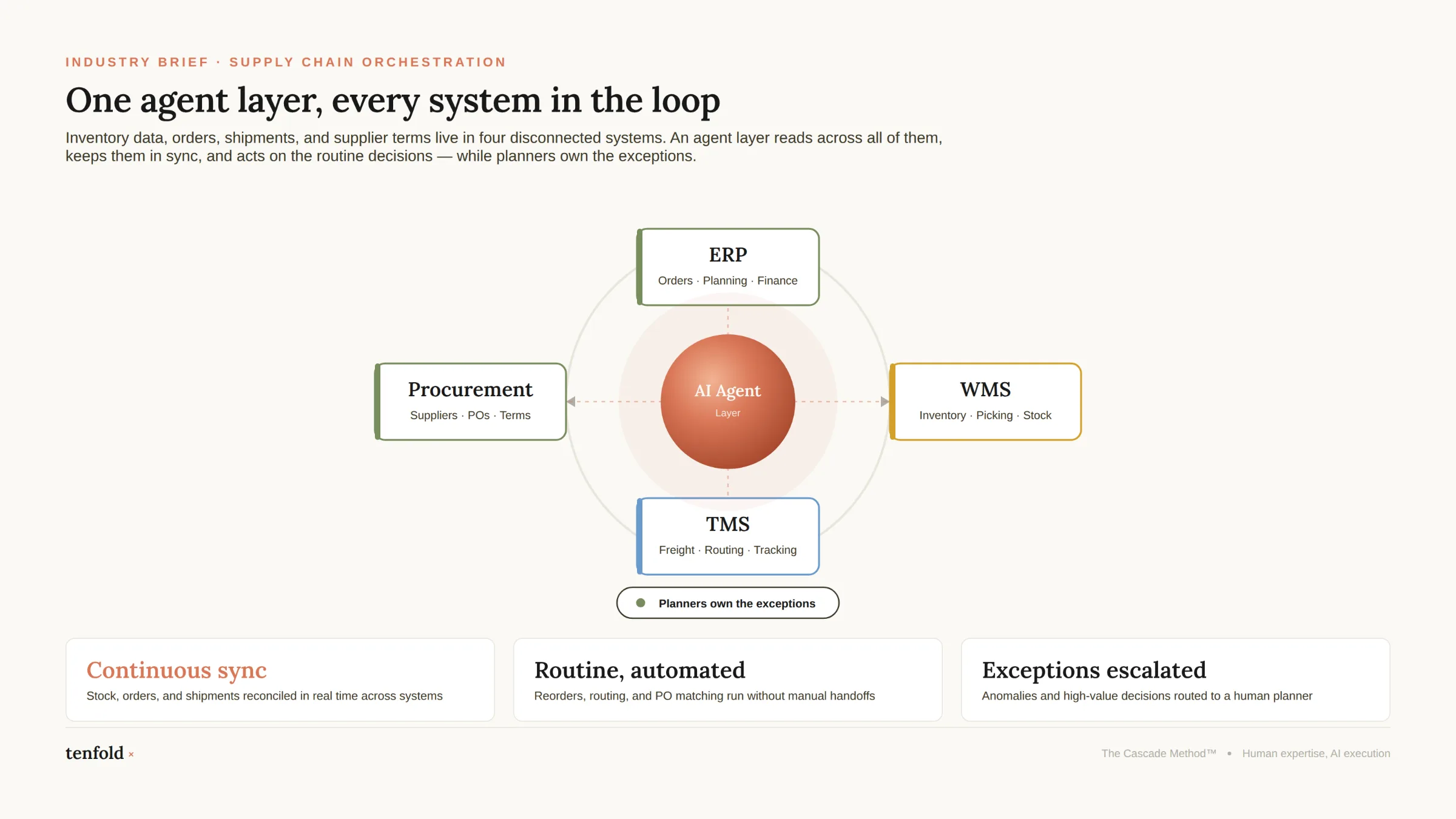
Manufacturing companies are using AI agents to automate supply chain and inventory workflows by deploying autonomous software that monitors operational data, makes goal-directed decisions, and executes actions across ERP, WMS, TMS, and procurement systems — without requiring human approval at every step. The result is a supply chain that doesn't just flag problems. It fixes them.
The shift from dashboards to autonomous execution is already underway. More than half of surveyed supply chain executives now report deploying AI agents to automate workflows — and the organisations that have crossed from pilot to production are posting concrete numbers.
Key Takeaways:
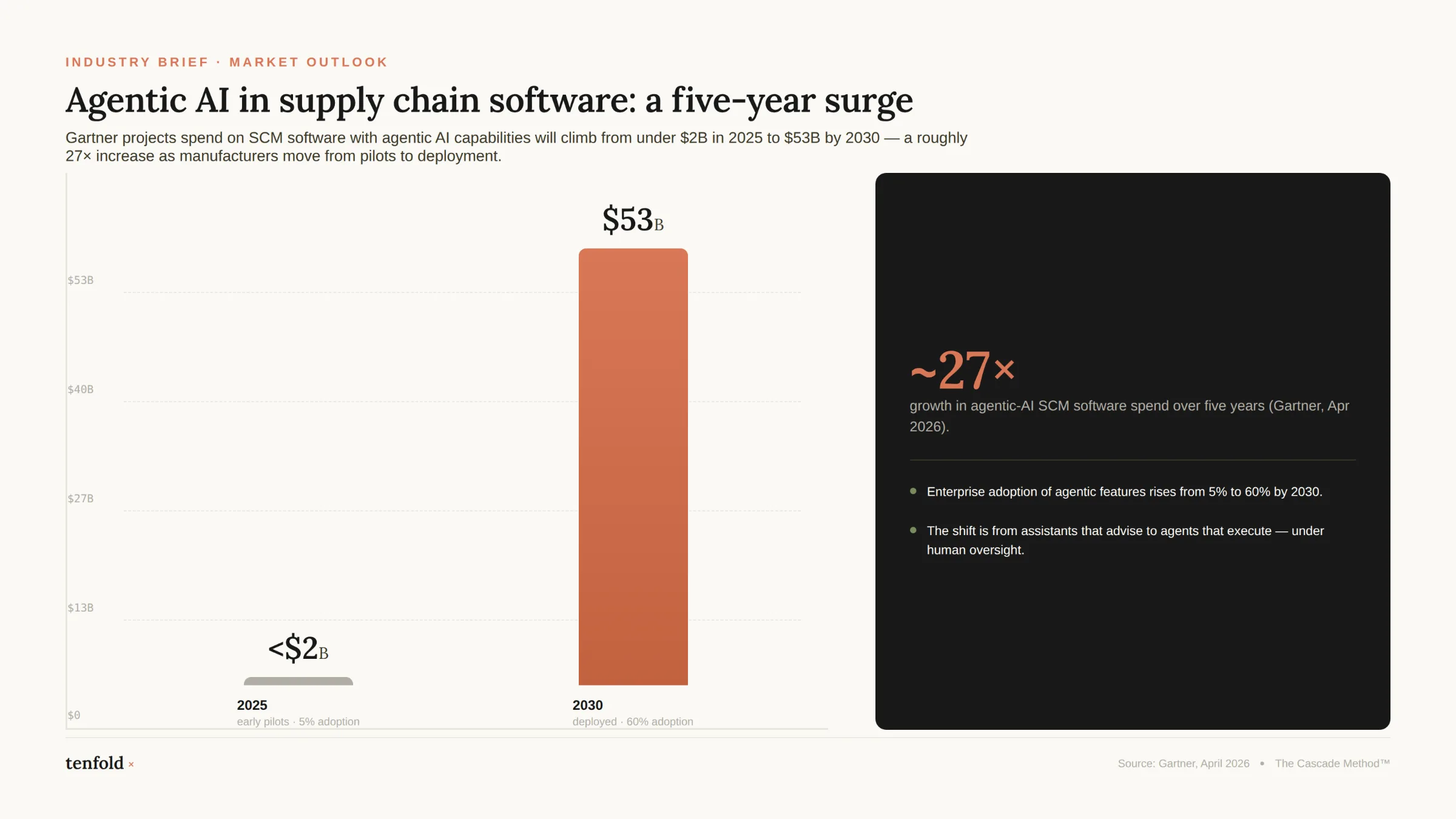
More than half of supply chain executives report active AI agent deployments, and Gartner forecasts 60% of enterprises using SCM software will have adopted agentic AI features by 2030, up from 5% in 2025.
Companies that reach production deployment report a 34% average increase in supply chain efficiency, reduced stockouts, and measurable reductions in carrying costs.
The highest-ROI use cases target high-volume, repeatable workflows: inventory replenishment, procurement automation, demand forecasting, and logistics exception management.
The bottleneck isn't AI capability. It's that most manufacturing orgs aren't yet set up to delegate to it — clean data, write access to ERP systems, and defined authority boundaries are prerequisites, not afterthoughts.
AI agents differ fundamentally from RPA: they handle exceptions as a core capability, adapting to changing inputs rather than failing when conditions deviate from a script.
Quick Answer: Manufacturing companies deploy AI agents across four core workflows — demand forecasting and inventory replenishment, procurement and supplier management, logistics exception handling, and production scheduling optimisation. Each agent connects directly to operational systems and acts within a defined authority boundary, closing the gap between anomaly detection and corrective action in minutes rather than hours.
Why Supply Chains Break — and Why Dashboards Can't Fix It
Supply chains don't fail because of a shortage of data. They fail because the time between an anomaly appearing in the data and a corrective action being taken is measured in hours or days.
A procurement exception flags in the ERP. Someone reads it, escalates it, schedules a call, negotiates an alternative, and updates the purchase order. By the time this loop completes, the production line has already shifted to sub-optimal material. Traditional automation tools compound this problem: they follow rigid, predefined processes and fail the moment an exception occurs.
Agentic AI targets exactly this gap. Instead of alerting a human who then executes a correction, an AI agent detects the anomaly, evaluates alternatives against constraint rules, and executes the best available action — all within a bounded authority envelope and with an immutable audit trail.
This is the structural difference that makes agentic AI a fundamentally different category from both RPA and decision-support software. According to research from Assistents.ai, RPA reduces the cost of doing the same thing repeatedly — agentic AI reduces the cost of doing complex things in a complex environment.
The 4 Highest-ROI Use Cases in Manufacturing Right Now
Not all supply chain workflows are equal candidates for agent deployment. According to Körber-Stellium, the highest-ROI use cases share two structural characteristics: they target high-volume, repeatable workflows where the cost of exceptions compounds across the chain, and they integrate directly into the operational systems where decisions already happen.
Here are the four use cases manufacturing operations leaders are deploying first.
1. Demand Forecasting and Inventory Replenishment
This is the most proven entry point. According to IBM, agent-based systems can monitor inventory levels, predict demand fluctuations, identify potential disruptions, and recommend mitigation strategies in real time. In production environments, a multinational consumer goods company that deployed an agent-based supply chain management system reduced stockouts by 32% and excess inventory by 28% while improving on-time delivery performance by 17%.
The mechanics are straightforward: agents ingest historical sales data, seasonality signals, supplier lead times, and live warehouse stock levels. They trigger replenishment orders when safety stock thresholds are crossed — and they adjust those thresholds dynamically as demand patterns shift.
According to Opensend data reported by Anchor Group, organisations deploying AI for demand planning achieve a 15% stockout reduction through superior pattern recognition, while simultaneously reducing carrying costs by 20% by optimising safety stock levels. That dual benefit — fewer stockouts and less excess — is why this is consistently the first use case deployed.
2. Procurement Automation and Supplier Risk Management
Procurement is where the ROI compounds fastest but also where governance matters most. A fully functioning procurement agent monitors raw material prices, supplier reliability scores, and geopolitical risk indicators. When a supplier's risk score crosses a threshold, it evaluates alternatives against cost, lead time, and quality specifications — and initiates the sourcing switch within pre-approved parameters.
According to PwC, agentic AI will transform at least 75% of procurement activities in the near term, with productivity gains of up to 70% in fully agent-driven workflows. In practice, the highest-performing deployments automate demand signal aggregation, supplier discovery, RFQ generation, bid comparison, and PO approval routing — workflows that, combined, eliminate weeks of manual cycle time.
A manufacturing company adopting AI for demand forecasting and procurement adjusted its procurement strategies and reduced inventory holding costs by 25%, freeing capital for reinvestment, according to Kenco Group.
3. Logistics Exception Management and Dynamic Re-routing
Logistics agents operate at the intersection of the most expensive and most time-sensitive decisions in the supply chain. A logistics agent routes shipments dynamically based on weather disruptions, port congestion data, and carrier capacity. It re-routes in real time and renegotiates carrier contracts within pre-approved cost bands.
According to a study reviewed by arXiv, a major logistics company that deployed AI agents to manage shipment documentation processing reduced error rates by 83% and processing time by 62% while enabling 24/7 operation without staffing increases.
According to Turion.AI's 2026 manufacturing analysis, 35% of logistics firms actively deploying AI report ROI gains averaging 19% improvement over traditional automation approaches.
4. Production Scheduling Optimisation
This is the most technically complex use case — and, in energy-intensive industries, the most financially significant. A production scheduling agent ingests orders, material availability, machine availability, maintenance windows, energy pricing, and carbon constraints. It produces a schedule that maximises throughput while minimising energy cost, and re-optimises whenever any variable changes.
According to ThroughPut.AI, a next-generation aerospace sensor manufacturer that leveraged AI for production scheduling and capacity optimisation achieved $10 million in annual savings, while reducing processing time by 10% and accelerating productivity by 20%.
In steel, cement, and other energy-intensive industries, the energy cost optimisation alone can justify the full deployment investment.
What the Data Says: Adoption and Market Trajectory
The macro numbers confirm what's happening on the ground.
According to Gartner, supply chain management software with agentic AI capabilities will grow from less than $2 billion in 2025 to $53 billion in spend by 2030 — and by that year, 60% of enterprises using SCM software will have adopted agentic AI features, up from 5% in 2025.
Gartner's forecast on disruption resolution is the most significant operational benchmark available: by 2031, 60% of supply chain disruptions will be resolved without human intervention as AI enables increasingly autonomous supply chains. A Gartner survey of 509 supply chain leaders found that changes in ways of working driven by advancements in AI and agentic AI will be the most influential driver of supply chain performance over the next two years.
Separately, Gartner predicts that 70% of large-scale organisations will adopt AI-based forecasting to predict future demand by 2030, with machine learning techniques enabling touchless forecasting that eliminates the need for frequent manual inputs.
On the manufacturing side specifically, Deloitte's 2025 survey of 600 executives found that companies shipping AI into production report a 34% average increase in both production efficiency and supply chain efficiency.
According to Deloitte, 80% of manufacturing executives plan to invest 20% or more of their improvement budgets in smart manufacturing initiatives — with agentic AI central to that spend.
The global AI-driven inventory optimisation market, valued at $5.9 billion in 2024, is projected to reach $31.9 billion by 2034, expanding at an 18.3% CAGR, according to Market.us research.
Multi-Agent Orchestration: The Architecture That's Producing Results
The supply chain use case that's proving hardest — and most valuable — involves multiple agents coordinating across functions rather than a single agent optimising a single variable.
In mature deployments, a procurement agent, a logistics agent, and an inventory agent operate as a coordinated system. The procurement agent monitors supplier risk; when it identifies a disruption, it signals the inventory agent to adjust safety stock targets, which in turn signals the logistics agent to pre-book alternative carrier capacity. The entire chain of decisions executes in minutes, not days.
According to EICTA, agentic AI in supply chain management is the deployment of autonomous software agents that operate across supply chain functions, continuously monitoring operational data, making goal-directed decisions, and executing actions across ERP, WMS, TMS, and procurement systems without requiring human approval at every step. Large multinationals including Walmart and Siemens are already running these coordinated systems in production, according to research published by Taylor & Francis.
Siemens, specifically, announced the launch of Industrial AI Agents at Automate 2025 — a shift from AI copilots to semi-autonomous agents that execute complete industrial processes end-to-end within its Industrial Copilot ecosystem, according to 8allocate's implementation analysis.
At Tenfold, we've found that the organisations that stall on multi-agent deployments aren't failing because the technology isn't ready. They're failing because their data infrastructure and authority governance weren't defined before the agents went live.
The Three Prerequisites Most Deployments Miss
Agent deployments fail in predictable ways. Körber-Stellium's 2026 analysis of production deployments identifies three structural failure modes:
1. Siloed, stale, or inconsistent data
Agentic systems require clean, real-time data from ERP, WMS, TMS, and procurement systems simultaneously. Siloed or inconsistent data produces confident wrong decisions at machine speed. This isn't a technology problem — it's a data governance problem that must be solved before agents go live.
2. Insufficient system access
A platform that can read data and surface recommendations is a copilot, not an agent. True agentic execution requires write access to ERP records, the ability to trigger approvals, and direct integration with operational systems. Many pilots stall here because IT governance hasn't approved the access model.
3. Undefined authority boundaries
Autonomy without a clearly delineated permission boundary is ungoverned automation. Gartner recommends that organisations define clear operational parameters before deployment — specifically, what the agent is and is not allowed to decide. Pilots stall when business owners cannot articulate this boundary. Planners who don't trust agent recommendations override them on instinct, and nuisance alerts destroy adoption.
According to Gartner, for now, full automation should be limited to low-risk decisions, while higher-stakes decisions are better supported by AI that augments human judgment. This dual approach allows organisations to build the data and governance foundation needed to eventually manage a majority of disruptions without human intervention.
Summary
AI agents are redefining what autonomous execution looks like in manufacturing supply chains — moving from dashboards that surface problems to agents that close the loop between detection and corrective action. The data is clear: production deployments deliver 34% efficiency gains, 32% reductions in stockouts, and multi-million-dollar savings in energy-intensive scheduling. The market trajectory is unambiguous — $53 billion in SCM agentic AI spend by 2030. The question isn't whether to deploy. It's which workflow to start with, and whether your data and governance infrastructure is ready to support it.
At Tenfold, we help operations leaders build and deploy agent-first workflows built around their existing systems — ERP, WMS, TMS — without forcing structural overhaul. The proof is in how we operate every day.
Frequently Asked Questions
Q: What's the difference between AI agents and traditional automation (RPA) in supply chains?
A: RPA automates fixed, rule-based steps and fails when exceptions occur. AI agents handle exceptions as a core capability — they adapt to changing inputs, make decisions across systems, and continue workflows autonomously when standard conditions aren't met. In supply chains, where exceptions are the norm (supplier non-responses, invoice format variations, port disruptions), this adaptability is the critical differentiator.
Q: Which supply chain workflows should manufacturers automate first with AI agents?
A: The highest-ROI entry points are inventory replenishment, demand forecasting, and procurement automation — workflows that are high-volume, repeatable, and where exceptions are costly. These also tend to have cleaner data and more clearly defined decision rules, making authority boundary governance easier to implement. Production scheduling and logistics re-routing typically come after data infrastructure is validated.
Q: How long does it take to see results from AI agent deployments in supply chains?
A: Organisations that deploy into well-prepared data environments begin to see measurable reductions in stockouts, excess inventory, and carrying costs within weeks rather than months. The primary delay is almost never the technology — it's data quality remediation and authority boundary definition upstream of the deployment.
Q: What does an AI agent actually need to run autonomously in a manufacturing supply chain?
A: At minimum, write access to ERP records, real-time feeds from WMS and TMS systems, and clearly defined authority boundaries specifying which decisions the agent can execute without human approval. The agent also needs an audit trail mechanism and escalation logic for decisions that fall outside its authority envelope.
Q: How is AI-based demand forecasting different from traditional statistical forecasting?
A: Traditional forecasting relies on long-range statistical models that are disconnected from real-time signals. AI-based forecasting uses machine learning to ingest live demand signals, social data, supplier lead times, and operational constraints simultaneously — enabling what Gartner calls "touchless forecasting" that continuously updates without requiring manual inputs. The accuracy improvement directly reduces safety stock requirements and stockout frequency.
