
How Long Does It Take to Deploy an AI Agent? A Week by Week Timeline
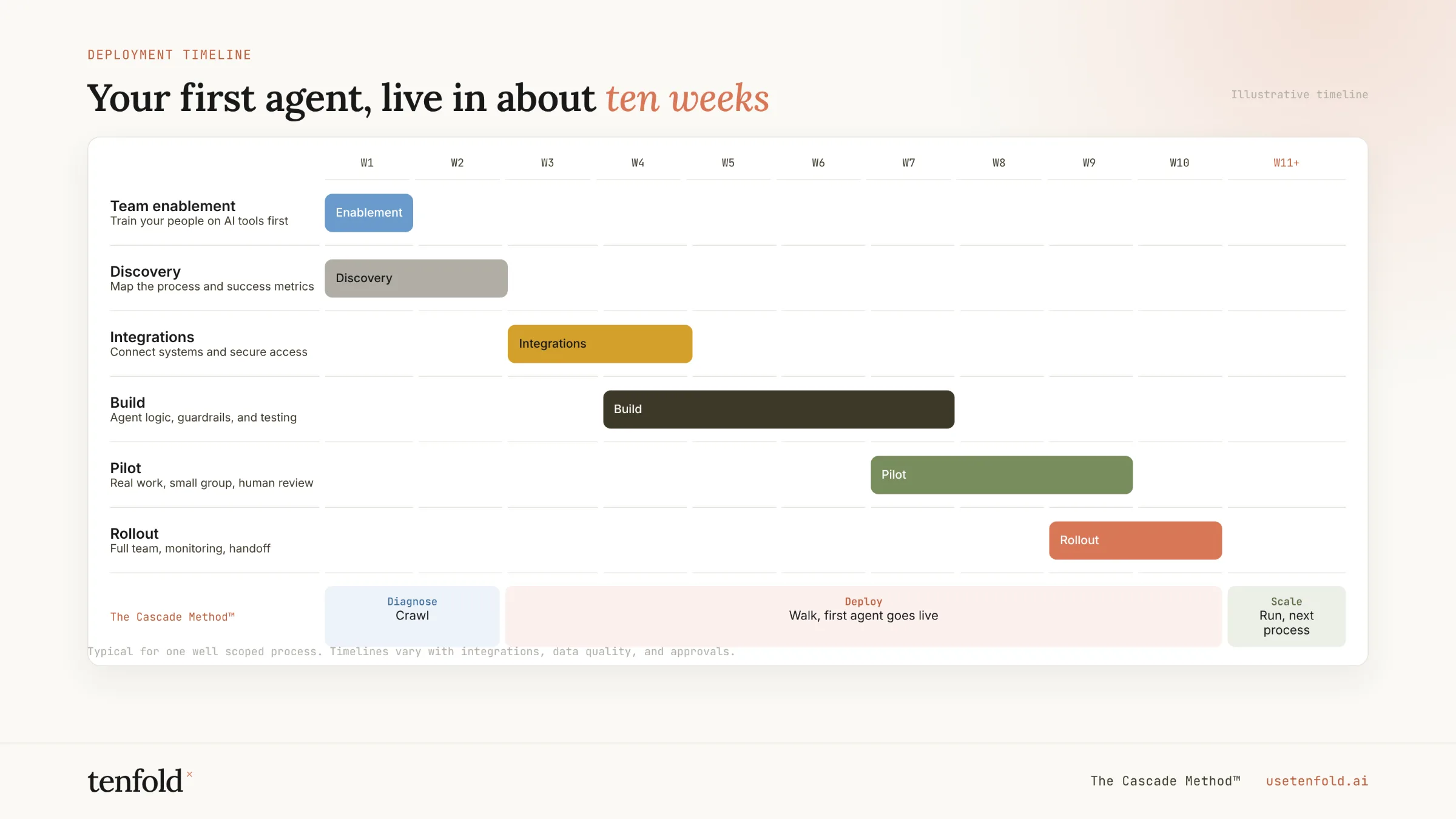
For a single, well-scoped workflow, typically about 6 to 10 weeks from kickoff to production. That includes discovery, data and integration setup, building and testing, a supervised pilot, and rollout. Timelines stretch when the workflow isn't clearly defined, the data is messy, or the agent needs to connect to systems without good APIs. They shrink when there's a clear owner, clean data, and quick decisions.
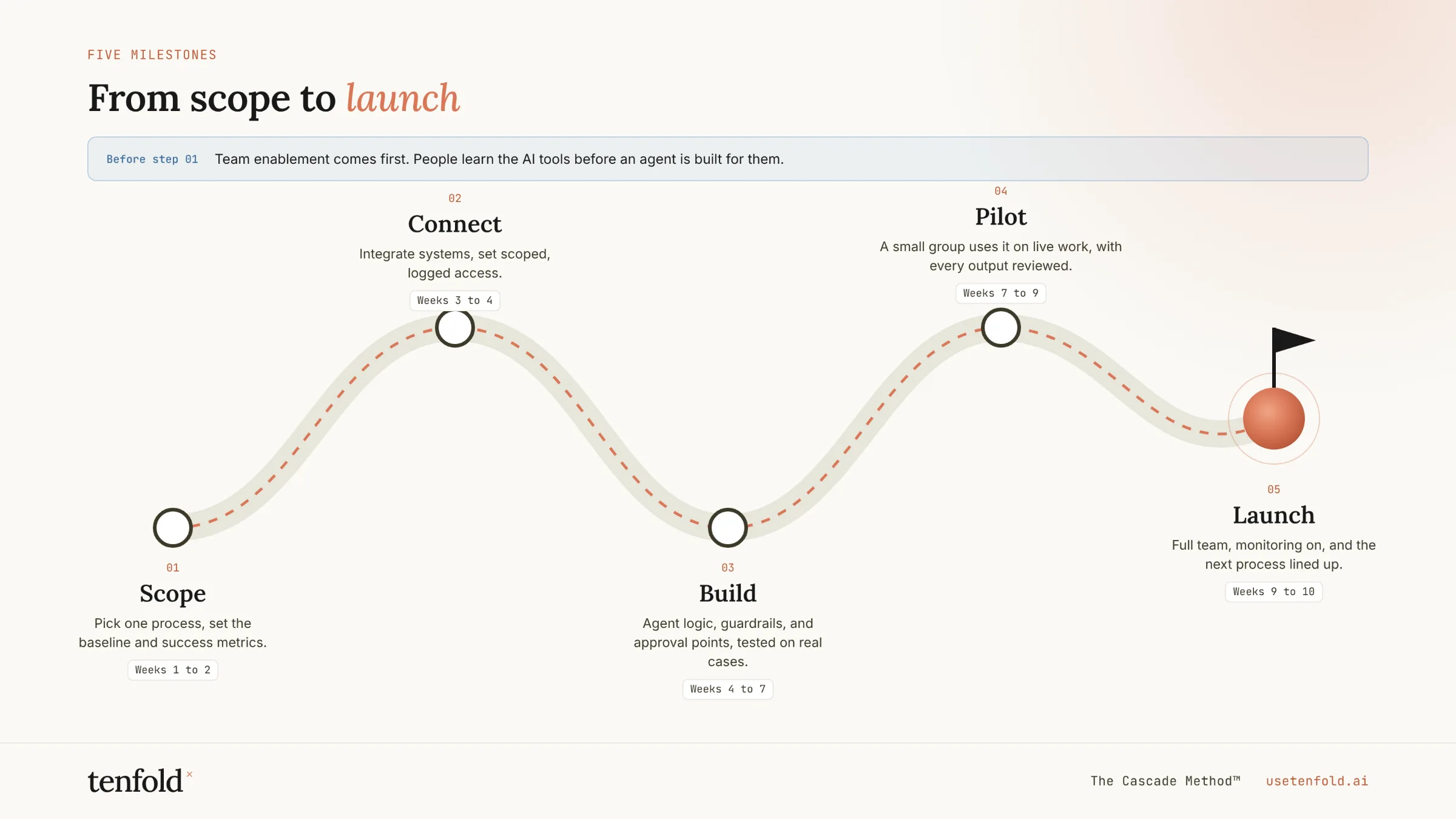
Quick Answer: A typical first AI agent deployment follows five phases: discovery and scoping (weeks 1 to 2), data and integration setup (weeks 2 to 4), build and configuration (weeks 3 to 6), testing and a supervised pilot (weeks 5 to 8), and rollout with optimization (weeks 7 to 10). Simple agents connected to one or two modern systems can launch faster. Agents that span many systems, handle regulated data, or need significant data cleanup take longer.
Key Takeaways:
A single, well-scoped AI agent typically takes about 6 to 10 weeks to reach production.
MIT's NANDA research found that top-performing mid-market firms moved from pilot to full implementation in about 90 days, while large enterprises took nine months or longer.
The biggest timeline risks are unclear scope, messy data, slow access to systems, and slow decisions.
A supervised pilot with real work is the most important phase. It's where the agent earns trust.
Each additional agent usually deploys faster, because integrations, guardrails, and processes are already in place.
Why Timelines Vary So Much
Ask five vendors how long it takes to deploy an AI agent and you'll hear five different answers, from "a few days" to "six months." Both can be true. A basic agent that answers questions from a knowledge base can be live quickly. An agent that reads your CRM, updates records, sends client communications, and hands off to your team takes longer, because it has to be connected, tested, and trusted.
The pace also depends on the organization. MIT's NANDA initiative, in its 2025 report The GenAI Divide, found that top-performing mid-market companies moved from pilot to full implementation in about 90 days, while large enterprises often took nine months or longer. Smaller teams with clear owners make decisions faster.
The bottleneck isn't the AI. It's scope, data, access, and decisions.
The Week by Week Timeline
Weeks 1 to 2: Discovery and scoping
The goal is to define exactly what the agent will do and how success will be measured.
Map the current workflow step by step, including exceptions
Define what the agent owns, what it hands off, and what needs human approval
Identify the systems and data the agent needs
Capture baseline metrics like volume, time per task, and response times
Name the business owner and agree on success criteria
Deliverable: A clear workflow definition, scope, guardrails, and success metrics.
Weeks 2 to 4: Data and integration setup
The agent needs access to the systems where the work happens.
Connect to the CRM, email, calendar, phone system, practice management software, or ERP
Set up permissions with least-privilege access
Clean the data the workflow depends on, like duplicate contacts or outdated records
Gather the knowledge the agent needs, like policies, templates, FAQs, and pricing
Deliverable: Working connections and the data the agent needs to do the job.
Weeks 3 to 6: Build and configuration
This is where the agent takes shape.
Configure the agent's instructions, tone, and decision logic
Build the actions it can take, like booking meetings, updating records, or drafting messages
Set up escalation rules and human approval steps
Add logging and monitoring
Test against real examples from your historical data
Deliverable: A working agent ready for live testing.
Weeks 5 to 8: Testing and supervised pilot
The agent starts doing real work, with people watching closely.
Run the agent on a limited volume, a single team, or a specific segment
Have humans review outputs and approve actions
Track accuracy, escalation rates, and response times against the baseline
Refine instructions and handling of edge cases based on what you see
Gradually expand the agent's autonomy as it proves reliable
Deliverable: Evidence that the agent performs well on real work, plus a decision to go live.
Weeks 7 to 10: Rollout and optimization
The agent moves to full production.
Expand to full volume and all relevant teams
Train staff on how to work alongside the agent and handle handoffs
Monitor performance weekly and keep improving
Report results against the baseline
Identify the next workflow to automate
Deliverable: An agent in production with measured results.
What Speeds a Deployment Up
A single, clearly defined workflow. Narrow scope moves faster than broad ambition.
A decisive business owner. Someone who can answer questions and approve changes quickly.
Clean, accessible data. Less time cleaning means more time building.
Modern systems with APIs. Cloud tools with good integrations connect quickly.
Fast access approvals. IT and security reviews scheduled early, not discovered late.
What Slows a Deployment Down
Scope creep. Adding "one more thing" mid-build resets the timeline.
Legacy systems. On-premise tools without APIs need workarounds.
Messy data. Duplicates and gaps have to be fixed before the agent can be trusted.
Slow security reviews. Especially in regulated industries, if they start late.
No owner. Without someone accountable, decisions stall.
After the First Agent
The first deployment is the slowest. It includes the setup work every future agent can reuse: integrations, permissions, guardrails, monitoring, and the team's experience working with AI. Second and third agents often deploy noticeably faster.
At Tenfold, we've found that the organizations deploying AI agents fastest aren't the ones with the biggest budgets. They're the ones that clearly define which workflows they want to hand off, make decisions quickly, and give the agents the access and authority to actually run them.
Summary
A single, well-scoped AI agent typically takes about 6 to 10 weeks to deploy, moving through discovery, integration setup, build, a supervised pilot, and rollout. MIT research shows top-performing mid-market firms can reach full implementation in about 90 days, far faster than large enterprises. The timeline depends less on the AI itself and more on scope, data quality, system access, and how quickly decisions get made. Start narrow, prove it in a supervised pilot, and every agent after the first gets faster.
Tenfold helps organizations scope, deploy, and scale AI agents on realistic timelines, with a clear plan from kickoff to production.
Frequently Asked Questions
Q: How long does it take to deploy an AI agent?
A: A single, well-scoped AI agent typically takes about 6 to 10 weeks from kickoff to production. Simpler agents connected to one or two modern systems can launch faster, while complex or regulated workflows take longer.
Q: What's the longest part of an AI agent deployment?
A: Usually data and integration setup, and the supervised pilot. Connecting systems, cleaning data, and proving the agent on real work take more time than configuring the agent itself.
Q: Can an AI agent be deployed in a few days?
A: Simple agents, like one that answers questions from a knowledge base, can be live quickly. Agents that take actions across systems, like updating records or booking meetings, need more time for integration, testing, and guardrails.
Q: Why do some AI agent projects take months?
A: Common causes are unclear scope, scope creep, messy data, legacy systems without APIs, late security reviews, and no business owner making decisions.
Q: Do future AI agents deploy faster?
A: Yes. Integrations, permissions, guardrails, and monitoring built for the first agent can be reused, so additional agents typically move faster.
