
How Do You Measure ROI on AI Agents? The Metrics That Actually Matter
You measure it the same way you'd measure any operational investment: capture a baseline, define the business outcome the agent owns, track the change, and compare it against the full cost of running the agent. The problem is that most companies skip the baseline, track activity instead of outcomes, and end up with an AI project they "feel good about" but can't defend in a budget review.
Quick Answer: To measure ROI on AI agents, track four categories of metrics: time and capacity recovered, cost per transaction, revenue impact, and quality and risk. Capture a baseline for each before launch, attribute changes to the specific workflow the agent owns, and calculate ROI as total value gained minus total cost, divided by total cost. Most well-scoped AI agents should show measurable results within 60 to 90 days.
Key Takeaways:
Only 25% of AI initiatives have delivered expected ROI over the past three years, and just 16% have scaled enterprise-wide, according to IBM's 2025 CEO Study of 2,000 CEOs.
MIT's NANDA initiative reported that roughly 95% of enterprise generative AI pilots produced no measurable P&L impact.
Only 39% of organizations report any EBIT impact from AI, per McKinsey's State of AI 2025.
The most common reason AI ROI is unclear isn't poor performance. It's that no baseline was captured before launch.
Measure outcomes (hours recovered, revenue gained, cost per transaction), not activity (messages sent, tasks touched).
Why Most Companies Can't Prove AI ROI
The data on AI returns is sobering, and most of it points to a measurement problem as much as a performance problem.
IBM's 2025 CEO Study, which surveyed 2,000 CEOs, found that only 25% of AI initiatives delivered the ROI leaders expected over the past three years, and only 16% scaled enterprise-wide. IBM has also found that only 29% of executives say they can confidently measure AI ROI.
MIT's NANDA initiative went further in its 2025 report, The GenAI Divide, finding that roughly 95% of enterprise generative AI pilots produced no measurable P&L impact. The figure is debated, but the pattern behind it isn't: the companies that succeeded tended to pick one specific pain point, execute well, and partner with specialists.
McKinsey's State of AI 2025 survey tells a similar story. While 88% of organizations use AI in at least one function, only 39% report any impact on EBIT.
So what's going wrong? In most cases, it's one of three things:
No baseline. The company launched without measuring how the workflow performed before the agent.
Wrong metrics. The team tracked usage and activity instead of business outcomes.
No owner. Nobody was accountable for translating agent performance into financial impact.
The bottleneck isn't AI performance. It's measurement.
The Four Categories of AI Agent ROI Metrics
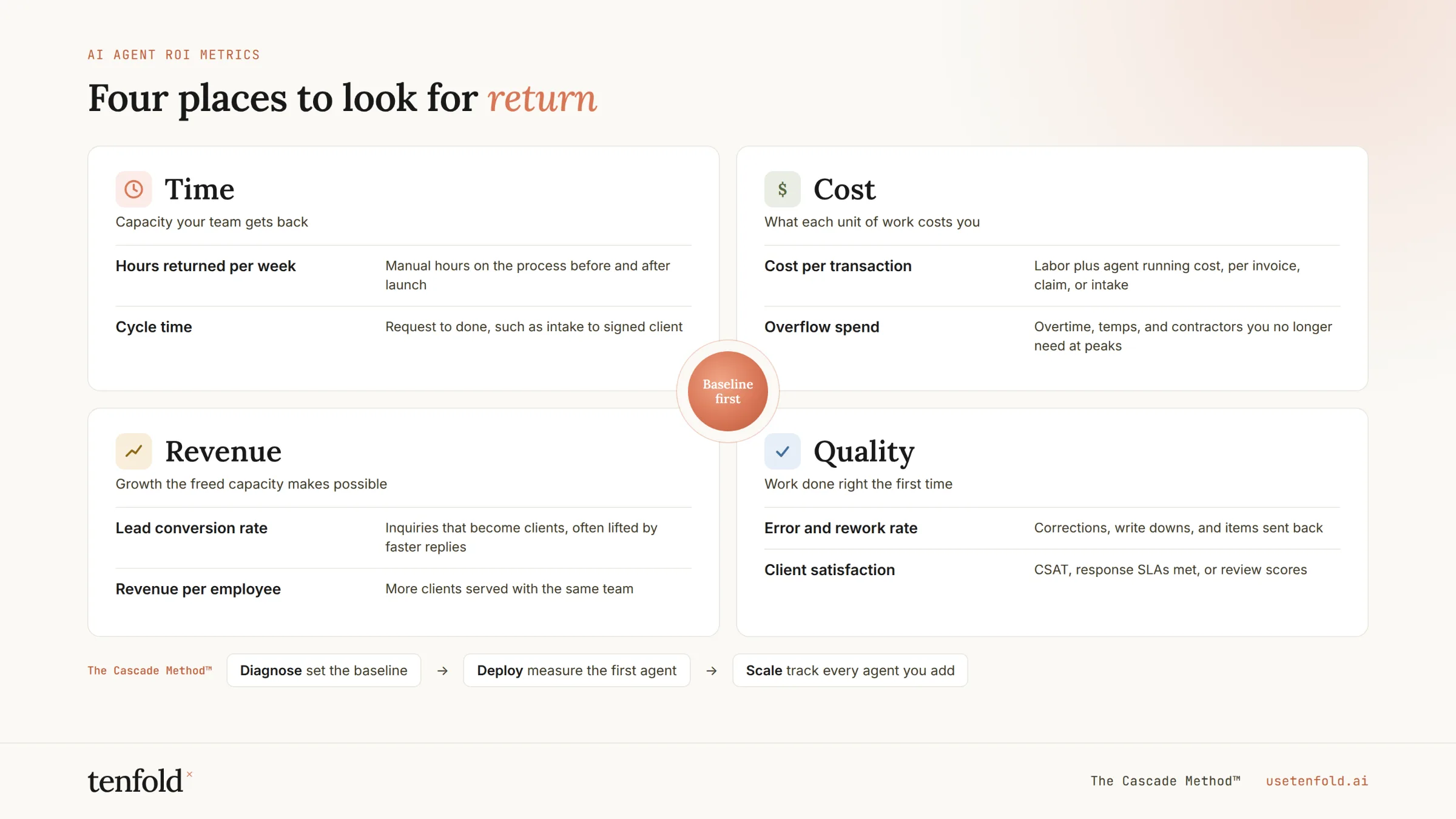
Every AI agent should be measured against a small set of metrics tied to the workflow it owns. They fall into four categories.
1. Time and capacity recovered
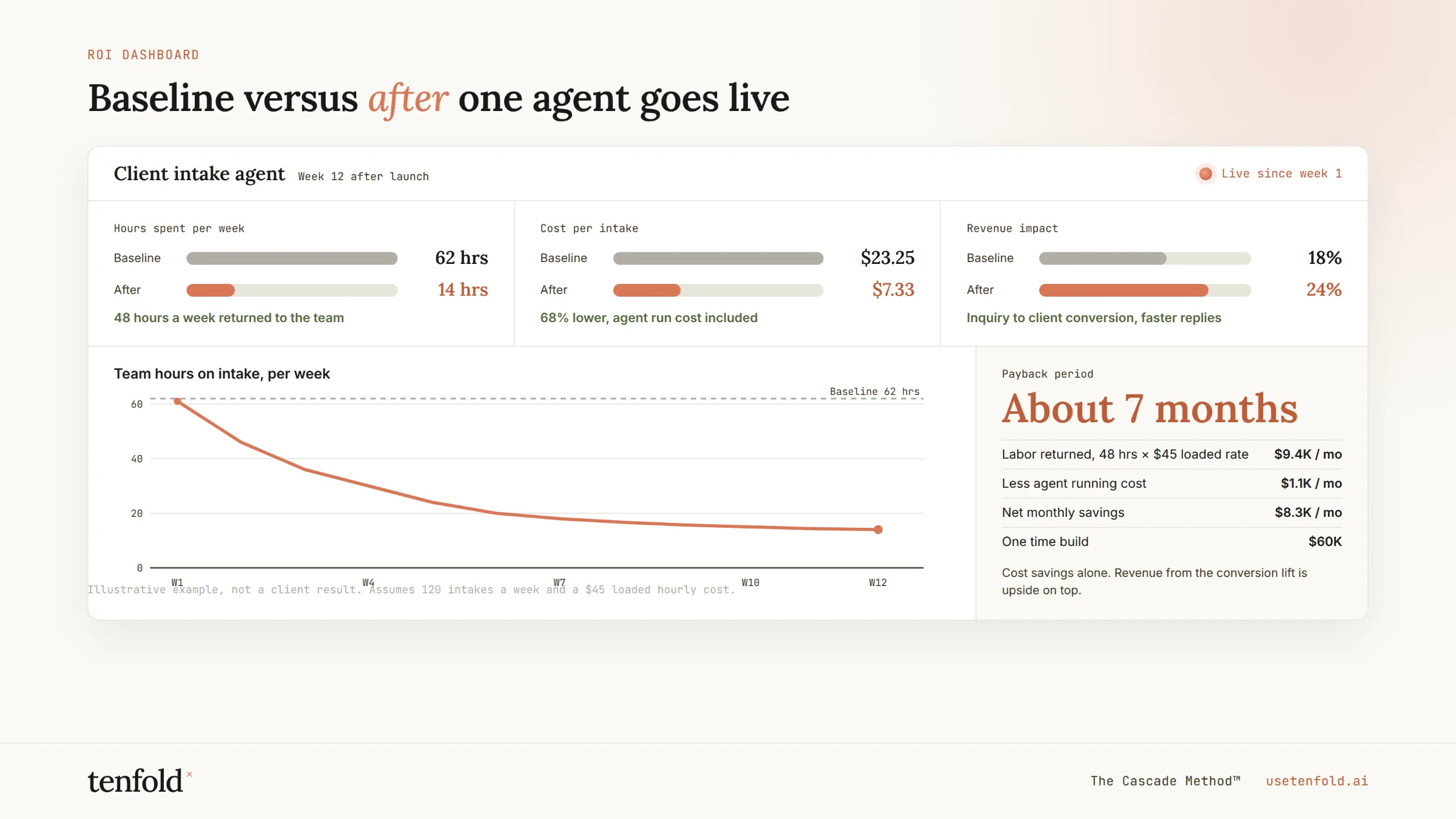
This is the most immediate and easiest-to-measure return. How many hours per week did your team spend on this workflow before the agent, and how many now?
Hours saved per week or month
Tasks completed by the agent without human involvement
Staff capacity redeployed to higher-value work
Turnaround time per task (for example, intake to booked meeting)
Time saved only becomes ROI when it's redeployed. Track what the recovered hours are being used for, whether that's more billable work, more client conversations, or avoided hiring.
2. Cost per transaction
Compare the fully loaded cost of completing one unit of work before and after the agent: one lead qualified, one invoice processed, one client onboarded, one support ticket resolved.
Cost per transaction (labor plus tools)
Avoided hiring or overtime costs
Reduced outsourcing or contractor spend
3. Revenue impact
Agents that touch customers or prospects often create revenue lift, not just savings. This category usually produces the largest numbers, but it requires careful attribution.
Speed to lead and lead-to-meeting conversion rate
Revenue recovered from missed calls, no-shows, or abandoned inquiries
Faster billing cycles and reduced days sales outstanding
Increased capacity to take on new clients
4. Quality and risk
These metrics protect the value you're creating and are often what convinces leadership to expand an agent's scope.
Error and rework rates
Compliance and policy adherence
Escalation rate (how often the agent hands off to a human)
Customer or client satisfaction scores
How to Calculate AI Agent ROI
The formula is simple:
ROI = (Total value gained minus total cost) ÷ total cost
The hard part is being honest about both sides.
Total value gained includes labor hours recovered (valued at fully loaded cost or the revenue those hours now generate), hard cost savings, attributable revenue lift, and quantifiable risk reduction.
Total cost includes platform and usage fees, implementation and integration work, internal time spent on setup and oversight, and ongoing maintenance and optimization.
Here's a simple illustrative example. Say a professional services firm deploys an AI agent for client intake. Before launch, intake took 25 staff hours per week. After launch, it takes 5. At a fully loaded cost of $50 per hour, that's 20 hours and $1,000 saved per week, or about $52,000 a year. If faster response also converts two additional clients per quarter worth $5,000 each, that adds $40,000. Against a first-year total cost of $30,000, the ROI is ($92,000 minus $30,000) ÷ $30,000, or roughly 207%.
Your numbers will be different. The point is that every input in that calculation needs a baseline.
Build Your Baseline Before You Launch
This is the single most important step, and the one most often skipped. Before an agent goes live, spend two to four weeks measuring:
Current volume of the workflow (per week or month)
Time spent per task and total staff hours
Current cost per transaction
Current conversion, error, and turnaround rates
Any revenue currently lost to delays or missed follow-up
Write these down and get agreement from the business owner and finance before launch. That baseline is what turns "the agent seems to be working" into "the agent saved us $X this quarter."
Leading vs Lagging Indicators
Not every metric moves at the same speed. Track both types so you can catch problems early and prove value later.
Leading indicators move within days or weeks: agent task completion rate, escalation rate, response time, and adoption by your team.
Lagging indicators take 60 to 90 days or more: cost per transaction, revenue impact, client retention, and EBIT contribution.
If leading indicators look strong but lagging indicators don't move, the agent may be working well but the recovered time isn't being redeployed, which is a management issue, not a technology one.
At Tenfold, we've found that the companies proving AI ROI fastest aren't the ones with the most sophisticated agents. They're the ones that defined the business outcome upfront, captured a baseline, and gave one owner responsibility for the numbers.
Summary
Most companies struggle to prove AI agent ROI, not because agents don't work, but because they never measured the starting point. IBM found only 25% of AI initiatives deliver expected ROI, and only 29% of executives can confidently measure it. The fix is straightforward: capture a baseline before launch, measure outcomes across time, cost, revenue, and quality, account for the full cost of running the agent, and assign one owner to the numbers. The constraint isn't what AI can do. It's whether you're set up to prove it.
Tenfold helps organizations scope, implement, and measure AI agents with clear ROI frameworks from day one, so every deployment has numbers leadership can trust.
Frequently Asked Questions
Q: What's the best way to measure ROI on an AI agent?
A: Capture a baseline before launch, then track changes in time recovered, cost per transaction, revenue impact, and quality for the specific workflow the agent owns. Calculate ROI as total value gained minus total cost, divided by total cost.
Q: How long does it take to see ROI from an AI agent?
A: Leading indicators like response time and task completion usually improve within the first few weeks. Financial results like cost savings and revenue lift typically become measurable within 60 to 90 days for a well-scoped deployment.
Q: Why do so many AI projects fail to show ROI?
A: IBM found that only 25% of AI initiatives delivered expected ROI. The most common causes are launching without a baseline, tracking activity instead of business outcomes, choosing poorly scoped use cases, and not assigning an owner responsible for results.
Q: Should time saved count as ROI?
A: Only if the time is redeployed to something valuable, like more billable work, more client conversations, or avoided hiring. Hours saved that disappear into general busyness don't show up on the P&L.
Q: What costs should be included in AI agent ROI?
A: Include platform and usage fees, implementation and integration costs, internal staff time for setup and oversight, and ongoing maintenance and optimization. Leaving out internal time is one of the most common reasons ROI calculations look better on paper than in reality.
