
From Pilot to Production: How to Scale an AI Agent Across Your Organization
Here's the uncomfortable statistic at the center of enterprise AI: 78 percent of organizations have at least one AI agent pilot running, but only around 14 percent have reached production scale. The pilot works beautifully in the demo. Then it quietly dies on the way to production — starved of the governance, infrastructure, and organizational readiness that no pilot ever tests for.
The most-cited number in 2026 enterprise AI conversations is that 88 percent of agent pilots never reach production. And the reason matters enormously: it has almost nothing to do with model quality. Claude, GPT, and Gemini are all capable enough. Organizations fail because they treat agent deployment as a software problem when it is fundamentally an organizational one.
Quick Answer: Scaling an AI agent successfully comes down to four structural moves the 12 percent who succeed share: name an agent owner with budget authority before the second pilot; treat evaluation and observability coverage as your production-readiness metric; design the workflow before the agent; and start narrow — a single well-defined task proven stable for 90+ days before expanding scope.
Key Takeaways:
The median time-to-value on agent deployments is 5.1 months, with SDR agents paying back in 3.4 months and finance/ops agents in 8.9 months, per BCG and Forrester 2026 surveys.
Five gaps account for roughly 89 percent of scaling failures: integration complexity with legacy systems, inconsistent output quality at volume, absence of monitoring tooling, unclear organizational ownership, and insufficient domain training data.
Of deployments that report negative ROI at 12 months, Forrester attributes 41 percent to unclear success criteria and 33 percent to insufficient tool or data access — scoping problems, not model problems.
Pilots take 6 to 12 weeks; production deployments take 6 to 12 months. Organizations consistently underestimate this delta.
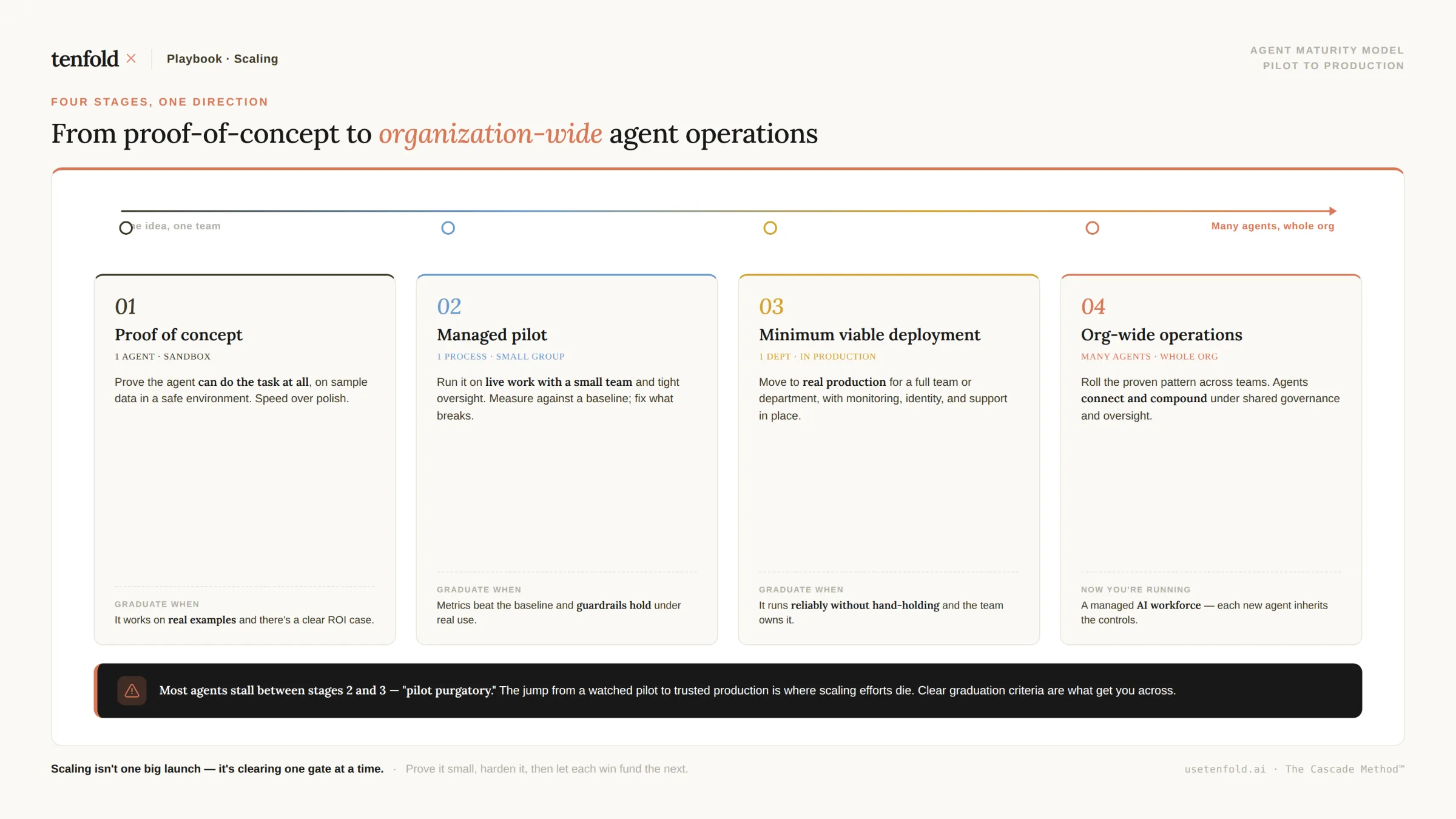
The transition from one pilot to five-to-twenty production agents is where roughly 60 percent of enterprises stall.
Why Pilots Lie to You
Pilots succeed under conditions production never offers. They run on clean, pre-curated data — a SharePoint folder, a staging API that returns predictable JSON. Production means a 20-year-old ERP whose only API is a batch export, a CRM with 600 undocumented custom fields, and the messy tail of real inputs. That tail — the rare, malformed, ambiguous 1 to 5 percent of volume — is never tested in the pilot. At production scale it's no longer negligible: if 3 percent of 10,000 daily tasks produce incorrect outputs, that's 300 errors a day propagating silently through downstream systems.
Pilots are also evaluated on the wrong metrics — model accuracy and benchmark scores — rather than business outcomes and reliability under real conditions.
The Four Moves That Separate Scalers
1. Name an owner with budget authority. Pilots live in innovation labs that lack the authority to change production workflows. When it's time to embed an agent into a live sales pipeline, the pilot team can't compel operations to adopt it. Unclear ownership is the failure mode that leaves monitoring gaps unfilled, which makes quality problems invisible until they compound. Appoint a dedicated owner before the second pilot.
2. Treat evaluation coverage as the readiness metric. The single largest production blocker cited by leaders is evaluation and observability. The agents that survive have automated quality monitoring, end-to-end observability that surfaces degradation in real time, and a defined acceptable failure rate tested against a deliberately constructed set of difficult inputs.
3. Design the workflow before the agent. The 22 percent of deployments with negative ROI almost never lost the model fight — they lost the scoping fight. Define measurable KPIs tied to business outcomes, not model accuracy. If the use case doesn't connect to a strategic priority, scaling just amplifies waste.
4. Start narrow, expand slowly. Narrow single-function agents scale more reliably than broad multi-function ones. Successful deployments scope to one well-defined task and expand only after it has proven stable for 90+ days. The companies that fail to leave the first stage typically get ambitious too early — building a "multi-purpose assistant" before learning what production reliability looks like for a single task.
Build the Infrastructure Before You Need It
The architecture that supports a reliable production agent looks different from the one that supports a pilot: standardized integration patterns instead of bespoke connectors, real-time observability, and safe-fail design — explicit control boundaries, escalation paths, and rollback mechanisms that prevent autonomous actions from causing irreversible consequences. Organizations that try to build this after a pilot succeeds are doing the work in the wrong order. The concept of an "agent factory" — a repeatable system for building and deploying new capabilities — is what separates organizations that scale one agent from those that scale dozens.
Don't Forget the Humans
At enterprise scale, change management that happened organically in a small pilot team now requires structured stakeholder mapping, communication plans, and champion networks. In engineering organizations, 78 percent of pilot failures trace to poor stakeholder alignment. Security requirements that were implicit ("the team knows what the agent can access") become explicit, auditable, and often legally mandated.
Summary
The pilot-to-production chasm is real, but it's crossable — and the path is organizational, not technical. Name an owner, instrument evaluation, scope the workflow tightly, start narrow, and build production infrastructure before you scale. The window for early-mover advantage is closing as competitors move from piloting to deploying. If your agents are stuck in pilot purgatory, the Tenfold team can help you build the operating model to get them into production.
Frequently Asked Questions
Q: Why do most AI agent pilots fail to scale? A: Not because of model quality. The top causes are organizational: unclear ownership, missing evaluation and monitoring tooling, integration complexity with legacy systems, and inadequate scoping. Roughly 88 percent of pilots never reach production.
Q: How long does it actually take to go from pilot to production? A: Pilots take 6 to 12 weeks; production deployments take 6 to 12 months. The median time-to-value once deployed is about 5.1 months, varying by function.
Q: What's the single most important thing to get right? A: Evaluation and observability coverage — it's the largest production blocker and the metric that best predicts whether an agent survives. Closely followed by naming an accountable owner with budget authority.
Q: Should we build one big agent or several small ones? A: Start narrow. Single-function agents scoped to one well-defined task scale far more reliably. Expand scope only after the narrow version has run stably for 90+ days.
