
Code with Claude 2026: What Actually Happened and What It Means for Your Engineering Org
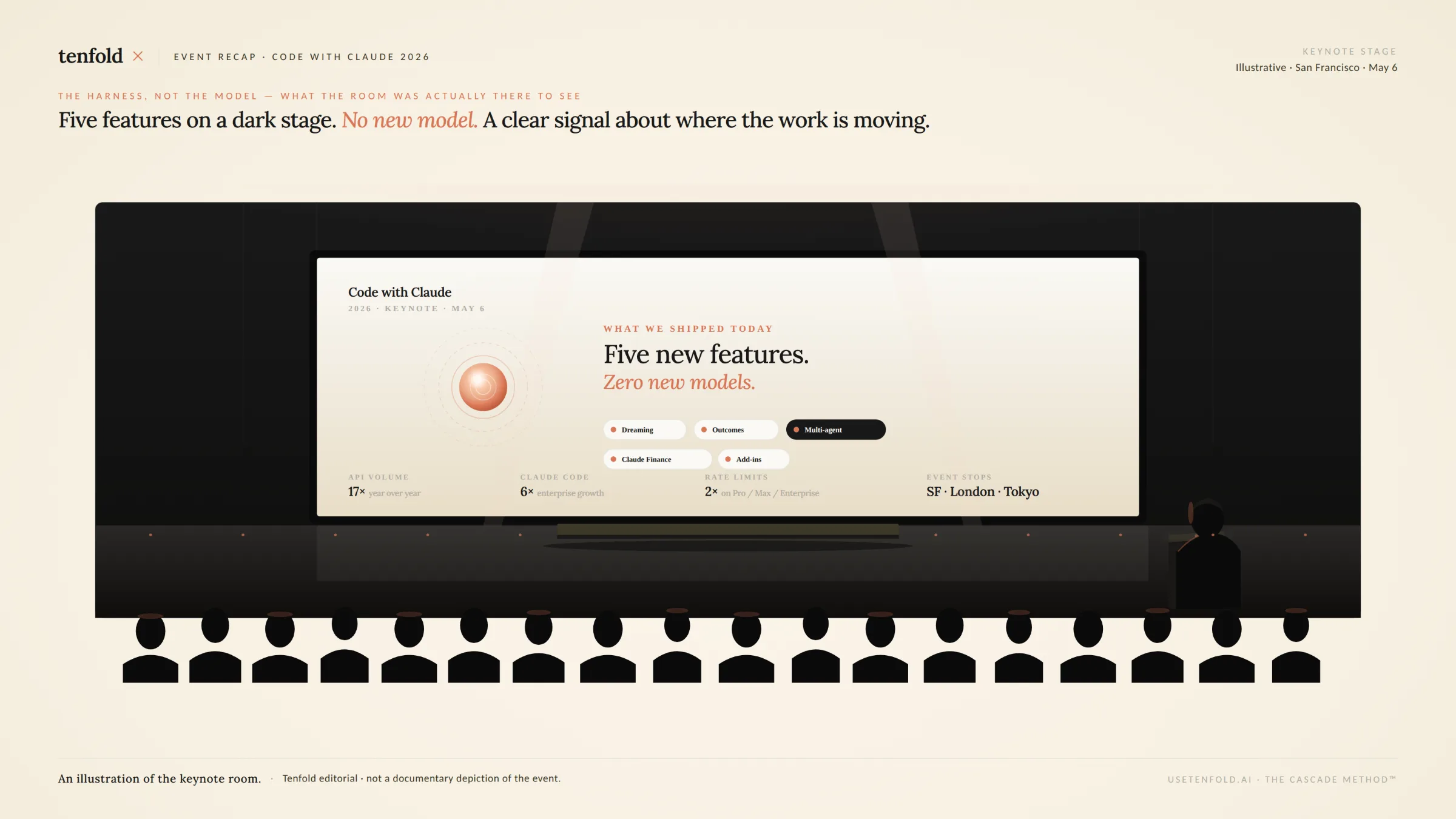
Code with Claude 2026 was not a product launch. Anthropic's CPO Ami Vora said it plainly from the keynote stage: "Today is about how we are making our products work better for you." No new model. No benchmark reveal. What Anthropic shipped instead was a complete managed-agent infrastructure stack — and a clear signal that the competitive race has shifted from model quality to agent operations.
For operations leaders and engineering teams evaluating AI, this event is worth understanding in full. Here's what happened, what it means, and what you should act on.
Key Takeaways:
Anthropic announced three major Claude Managed Agents features: Dreaming, Outcomes, and Multi-Agent Orchestration.
API volume on the Anthropic platform grew 17x year-over-year — and Anthropic admits the growth outpaced their own infrastructure.
Claude Code usage limits were doubled across all paid tiers, backed by a 300+ megawatt compute deal with SpaceX.
The average developer now spends 20 hours per week inside Claude Code.
Writing code is no longer the bottleneck. Verifying it, reviewing it, and coordinating across agents is.
What Code with Claude 2026 Actually Was
Code with Claude is Anthropic's annual developer conference. The first edition was held in May 2025 — a relatively intimate gathering at The Midway in San Francisco focused on real-world API and MCP implementations. This year, demand far outpaced capacity.
According to Anthropic, the 2026 edition expanded to a three-city international tour: San Francisco on May 6, London on May 19, and Tokyo on June 10. The San Francisco event drew several thousand attendees to SVN West and was simultaneously livestreamed globally — free of charge.
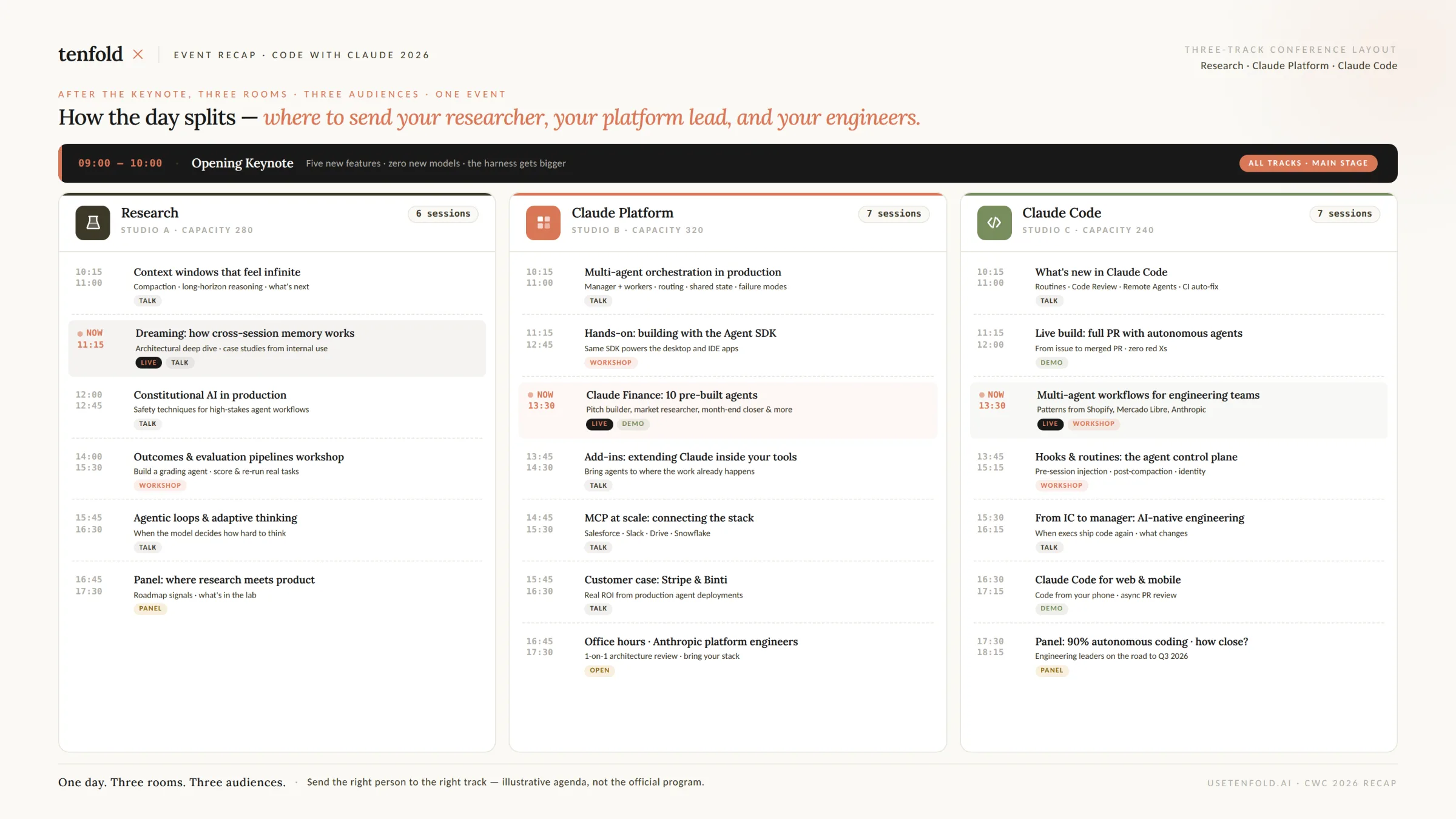
The conference ran three parallel tracks: Research, Claude Platform, and Claude Code. Each track targeted a distinct layer of how engineering teams actually work with Claude in production.
The Three Managed Agents Features That Matter
The headline announcements all lived inside Claude Managed Agents, which entered public beta on April 8, 2026. Three new capabilities were announced during the keynote.
Dreaming is a scheduled process that reviews previous agent sessions and memory stores, extracts patterns, and curates memories so agents improve over time — without human intervention. It is currently in research preview. According to Anthropic's release notes, Harvey Law used Dreaming to help their agents remember filetype workarounds and tool-specific patterns between sessions, with completion rates increasing approximately 6x in their internal tests.
Outcomes lets teams define a success rubric for a given task. Claude then iterates until the output meets that rubric — moving quality enforcement from human review to automated evaluation. Outcomes is in public beta.
Multi-Agent Orchestration enables a lead agent to break a complex job into pieces and delegate each piece to specialist sub-agents, each with its own model, prompts, and tools. Sub-agents work in parallel on a shared file system. Every step is fully auditable inside Claude Console — which agent did what, in what order, and why.
According to MindStudio's post-event analysis, these three releases cluster around three unsolved problems in production agent systems: memory degrades across sessions, output quality is hard to enforce without human review, and complex jobs require coordination between multiple agents. Anthropic shipped something for each.
The Infrastructure Behind the Announcements
Anthropology's growth story is striking. Dario Amodei told attendees the company planned for 10x growth — and got 80x annualized in Q1 2026. According to Shashi Bellamkonda's post-event analysis, API volume on the Claude platform is up nearly 70x year-over-year, and the average developer using Claude Code now spends 20 hours per week with the tool.
That growth created real infrastructure strain. The capacity response was concrete: Claude Code's five-hour rate limits were doubled across Pro, Max, Team, and Enterprise plans — effective May 6. Peak-hours throttling for Pro and Max was removed. And Anthropic announced a compute partnership with SpaceX giving them access to Colossus 1, adding more than 300 megawatts of new capacity (over 220,000 NVIDIA GPUs) within the month.
These are not roadmap items. They are infrastructure triage for a platform growing faster than its own projections allowed.
What Enterprise Teams Are Already Doing
The keynote didn't rely on hypotheticals. Real org commitments were on display.
According to Simon Willison's live blog of the event, Mercado Libre — with 23,000 engineers — is targeting 90% autonomous coding by Q3 2026. Shopify is running Claude Code at production scale. Netflix presented a dedicated session on moving engineers up the Claude Code maturity ladder.
These are not pilot commitments. They are organizational bets with quarterly targets attached.
One of the sharpest insights from the day came from attendee Chris Ebert's session notes: several speakers converged on the same theme — writing code is no longer the slow part. Verifying it, reviewing it, coordinating around it, and figuring out what to build next are now the bottlenecks.
That's the transition Managed Agents is built to address. Not faster code generation — better coordination and quality enforcement around the code that gets generated.
The Context Window Reality Check
Dianne Penn's keynote hinted at "context windows that feel infinite." The rest of the conference told a more grounded story.
According to Chris Ebert's post-event writeup, context window limits have stayed constrained to roughly 1 million tokens for over a year across AI providers — and that box is not getting bigger anytime soon. Managing context effectively remains one of the most important skills for anyone building with AI.
One practitioner example from the day: a sports company reduced token usage by 66% simply by switching tool output from JSON to markdown, removing unneeded fields, and stripping timestamps. These changes both cut cost and improved Claude's output quality.
For teams building agent workflows, context discipline is not an edge case — it is the core operational skill.
The Platform Bet, Stated Plainly
Code with Claude 2026 was, at its core, a strategy declaration.
According to Gadget Bond's pre-event analysis, Anthropic is actively positioning Claude as a platform — one with a growing ecosystem of enterprise customers (GitHub, Netflix, Datadog, Asana), cloud partnerships (Amazon Bedrock, Google Cloud Vertex AI, Microsoft Foundry), and a developer community it is now investing real resources to build.
The shift from model releases to managed infrastructure is deliberate. As MindStudio noted in their post-conference analysis: "The bottleneck for most production agent systems right now isn't model capability — it's the infrastructure around the model."
That is where Anthropic is now competing.
Summary
Code with Claude 2026 confirmed a shift that was already underway: the frontier model race has quieted relative to the infrastructure race. Dreaming, Outcomes, and Multi-Agent Orchestration are Anthropic's answer to the three biggest failure modes in production agent systems — memory degradation, inconsistent output quality, and poor coordination across complex tasks. For engineering and operations leaders, the event's most important signal is not which features shipped. It's that Shopify, Mercado Libre, and Netflix are no longer evaluating Claude — they're setting quarterly targets around it.
At Tenfold, we help organizations build agent infrastructure that's ready for this level of deployment. The organizations that move from pilot to production this year will set a pace that's difficult to close.
Ready to build agent infrastructure your org can actually operate at scale? [Get in touch with the Tenfold team.](#)
Frequently Asked Questions
Q: What was announced at Code with Claude 2026?
A: Anthropic did not announce a new model. The main announcements were three new Claude Managed Agents features — Dreaming (research preview), Outcomes (public beta), and Multi-Agent Orchestration (public beta) — along with doubled Claude Code rate limits, a SpaceX compute deal, and expanded enterprise integrations including Microsoft 365 add-ins and ten financial agent templates.
Q: What is Claude Dreaming and how does it work?
A: Dreaming is a scheduled process that reviews an agent's previous sessions and memory stores, extracts patterns, and curates memories so the agent improves over time without human intervention. It is currently available as a research preview for Claude Managed Agents users.
Q: What is Multi-Agent Orchestration in Claude Managed Agents?
A: Multi-Agent Orchestration lets a lead agent break a complex task into sub-tasks and delegate each to a specialist sub-agent with its own model, tools, and prompts. Sub-agents work in parallel, and every step is fully auditable in Claude Console.
Q: How is Code with Claude different from a typical product launch?
A: Code with Claude is Anthropic's developer conference, not a product keynote in the traditional sense. The 2026 edition was deliberately positioned around making existing products work better for builders — focused on agent infrastructure, operational tooling, and enterprise deployment patterns rather than model benchmarks.
Q: What should my team do based on the Code with Claude 2026 announcements?
A: Start by evaluating whether your current agent workflows have memory, quality enforcement, and coordination gaps. If your teams run long-horizon agentic tasks, request access to the Dreaming research preview. If you're building orchestration manually, review the Managed Agents Multi-Agent documentation. And if you haven't addressed context management, that's the first infrastructure problem to solve.
