
Can AI Agents Replace Your Virtual Assistant? A Cost and Capability Comparison
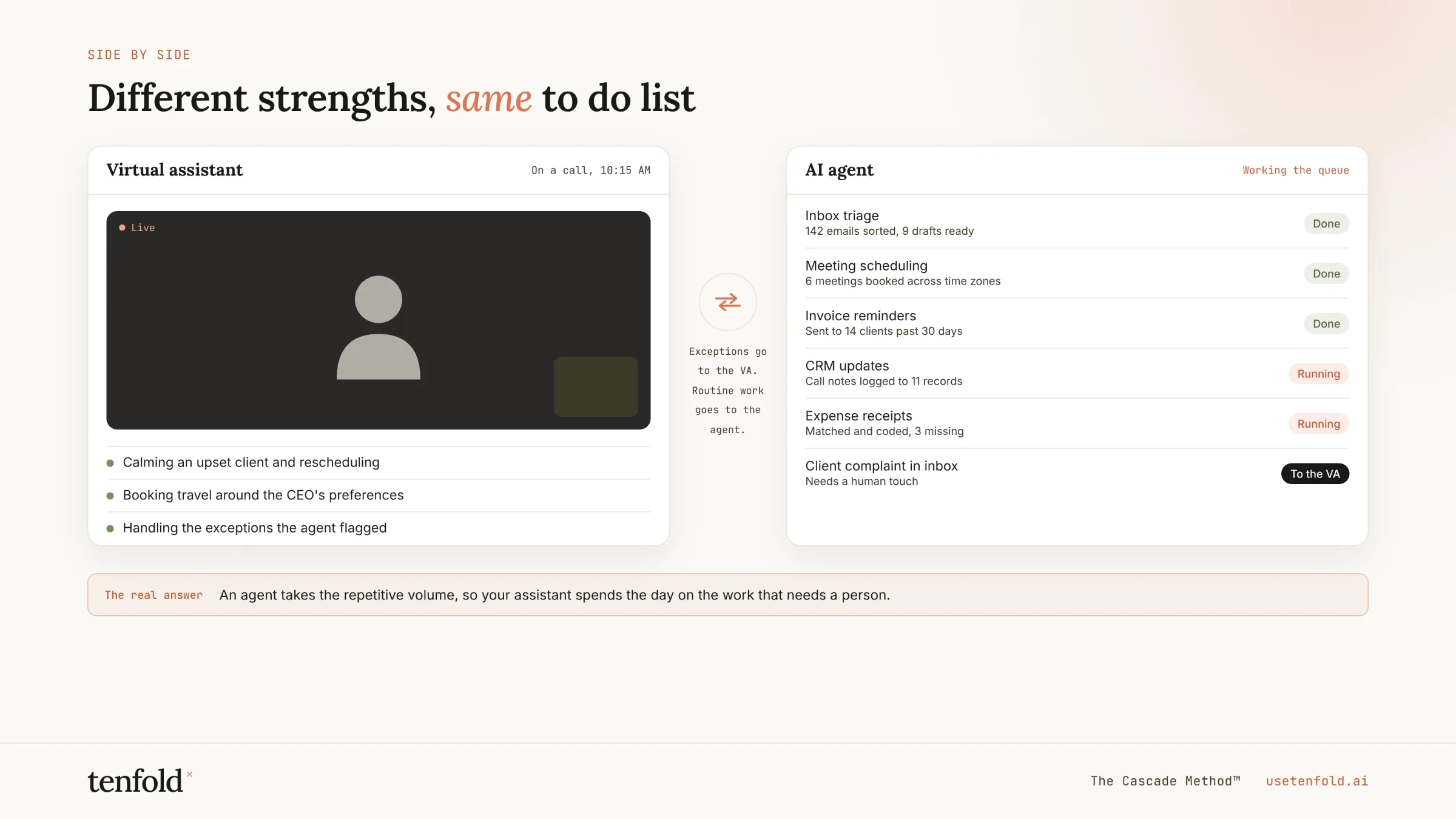
For some tasks, yes. For others, not yet. AI agents are better at high-volume, repetitive, rules-based work that needs to happen instantly and around the clock. Virtual assistants are better at work that needs judgment, relationships, flexibility, and a human touch. For most businesses, the best answer isn't one or the other. It's letting AI agents handle the volume so your virtual assistant can focus on the work that actually needs a person.
Quick Answer: AI agents can replace a virtual assistant for repetitive, structured tasks like inbox triage, lead response, appointment scheduling, data entry, CRM updates, invoice follow-up, and routine customer questions. They work 24/7, respond instantly, and scale without hiring. Virtual assistants remain better for tasks that need judgment, relationship building, complex problem-solving, or handling unusual situations. Many businesses get the best results by combining both.
Key Takeaways:
Published 2026 rate guides put US-based virtual assistants at roughly $20 to $50+ per hour, with offshore VAs in the Philippines and India around $5 to $15 per hour and Latin American VAs around $8 to $25 per hour.
AI agents respond in seconds, work around the clock, and handle volume spikes without extra cost per task.
VAs bring judgment, flexibility, and relationships that AI agents can't fully replicate.
The highest-value tasks to move from a VA to an AI agent are repetitive, high-volume, and time-sensitive.
A hybrid model often delivers the most value: AI agents for volume, VAs for judgment and exceptions.
What Virtual Assistants Cost Today
Virtual assistant pricing varies widely by location, experience, and whether you hire directly or through an agency. Published 2026 rate guides put typical ranges at roughly:
US-based VAs: about $20 to $50+ per hour, or roughly $3,200 to $5,300 per month full-time for general support
Latin America: about $8 to $25 per hour, with time zone overlap for US businesses
Philippines and India: about $5 to $15 per hour
On top of the rate, there's the time spent recruiting, training, managing, and covering for time off, plus turnover when a VA moves on.
What AI Agents Cost
AI agent costs depend on the complexity of the workflow, the systems it connects to, and how much it's used. Most deployments involve a setup or implementation cost and an ongoing monthly cost for the platform, usage, and support.
The cost structure is different from a VA in one key way: an AI agent doesn't get more expensive per hour as it handles more volume. Once it's running, handling 50 inquiries or 500 costs roughly the same in labor terms. That's why AI agents tend to deliver the strongest return on high-volume, repetitive work.
Capability Comparison: Where Each One Wins
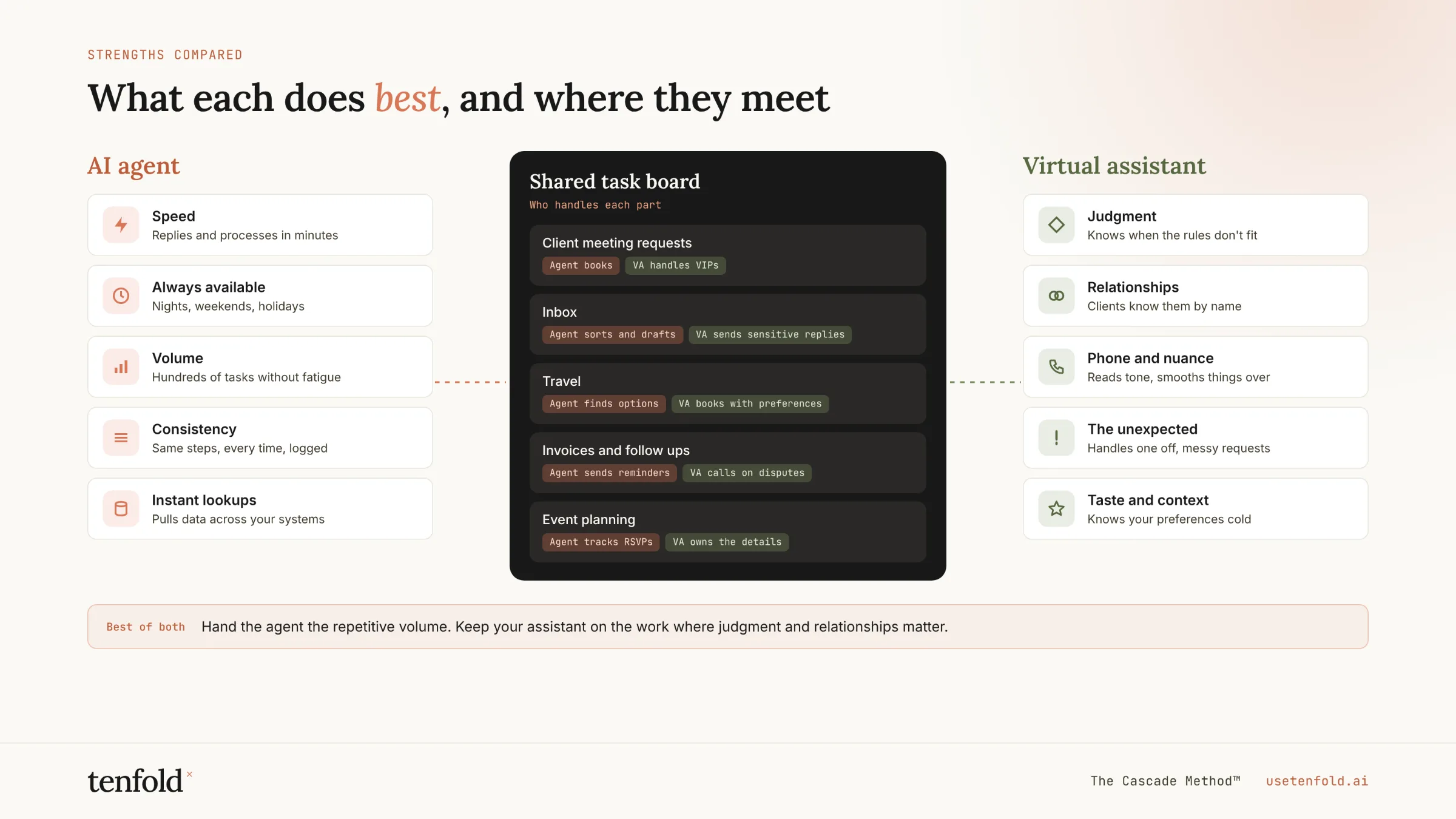
Where AI agents win
Speed. Responds in seconds, not hours.
Availability. Works nights, weekends, and holidays without overtime.
Volume. Handles spikes without hiring or burnout.
Consistency. Follows the same process every time.
System work. Updates CRMs, calendars, and databases accurately and instantly.
Documentation. Logs every action automatically.
Where virtual assistants win
Judgment. Handles ambiguous or unusual situations.
Relationships. Builds rapport with clients, vendors, and your team.
Flexibility. Picks up new, one-off tasks without setup.
Complex problem-solving. Works through messy, multi-step issues.
Personal touch. Handles sensitive conversations with empathy.
Physical-world tasks. Coordinates things that require phone calls with unpredictable outcomes, errands, or offline follow-up.
Tasks AI Agents Can Take Over from a VA
Inbox triage, categorization, and routine replies
Responding to new leads and inquiries instantly
Scheduling, rescheduling, and appointment reminders
Data entry and CRM updates
Collecting documents and following up on missing information
Invoice reminders and payment follow-up
Answering routine customer or client questions
Preparing recurring reports and meeting briefs
Tasks That Should Stay with a Person
Handling upset clients or sensitive situations
Managing executive priorities that change daily
Building relationships with key clients, partners, and vendors
Making judgment calls with incomplete information
One-off projects and research that require creativity
Reviewing and approving what AI agents produce
The Hybrid Model: AI Agents and VAs Together
For most businesses, the smartest move isn't replacing a virtual assistant. It's changing what they spend time on.
Let the AI agent handle the high-volume, repetitive work: first responses, scheduling, data entry, reminders, and routine questions. Your VA then focuses on exceptions, relationships, quality control, and the higher-value work that's been getting pushed aside. The VA also becomes the natural owner of the agent, reviewing its work and flagging improvements.
The result is more capacity without more headcount, and a VA whose time is spent where a person actually adds value.
At Tenfold, we've found that the businesses getting the most from AI agents aren't the ones replacing people. They're the ones that clearly define which tasks to hand off to agents, and let their people focus on the work that needs judgment and relationships.
Summary
AI agents can replace a virtual assistant for repetitive, high-volume, time-sensitive tasks like lead response, scheduling, data entry, and follow-ups. They work around the clock, respond instantly, and scale without added cost per task. Virtual assistants, which typically cost about $20 to $50+ per hour in the US and less offshore, remain better at judgment, relationships, and handling the unexpected. For most businesses, the best results come from combining both: AI agents handle the volume, and people handle what needs a human. The constraint isn't what AI can do. It's whether you've decided which work to delegate.
Tenfold helps businesses identify which tasks to move to AI agents, deploy them alongside their existing team, and measure the results.
Frequently Asked Questions
Q: Can an AI agent replace a virtual assistant?
A: For repetitive, rules-based tasks like scheduling, lead response, data entry, and follow-ups, often yes. For work that needs judgment, relationships, or flexibility, a person is still the better fit. Many businesses use both.
Q: Is an AI agent cheaper than a virtual assistant?
A: For high-volume, repetitive work, an AI agent is often more cost-effective because its cost doesn't rise with every additional task. For low-volume or highly varied work, a VA may be the more economical choice.
Q: How much does a virtual assistant cost in 2026?
A: Published rate guides put US-based VAs at roughly $20 to $50+ per hour, Latin American VAs at about $8 to $25 per hour, and VAs in the Philippines and India at about $5 to $15 per hour, depending on experience and hiring model.
Q: What tasks should I give an AI agent instead of a VA?
A: Tasks that are high-volume, repetitive, time-sensitive, and follow clear rules, such as inbox triage, scheduling, lead response, CRM updates, document collection, and payment reminders.
Q: Can AI agents and virtual assistants work together?
A: Yes, and that's often the best setup. The AI agent handles volume and routine tasks, while the VA handles exceptions, relationships, and reviews the agent's work.
