
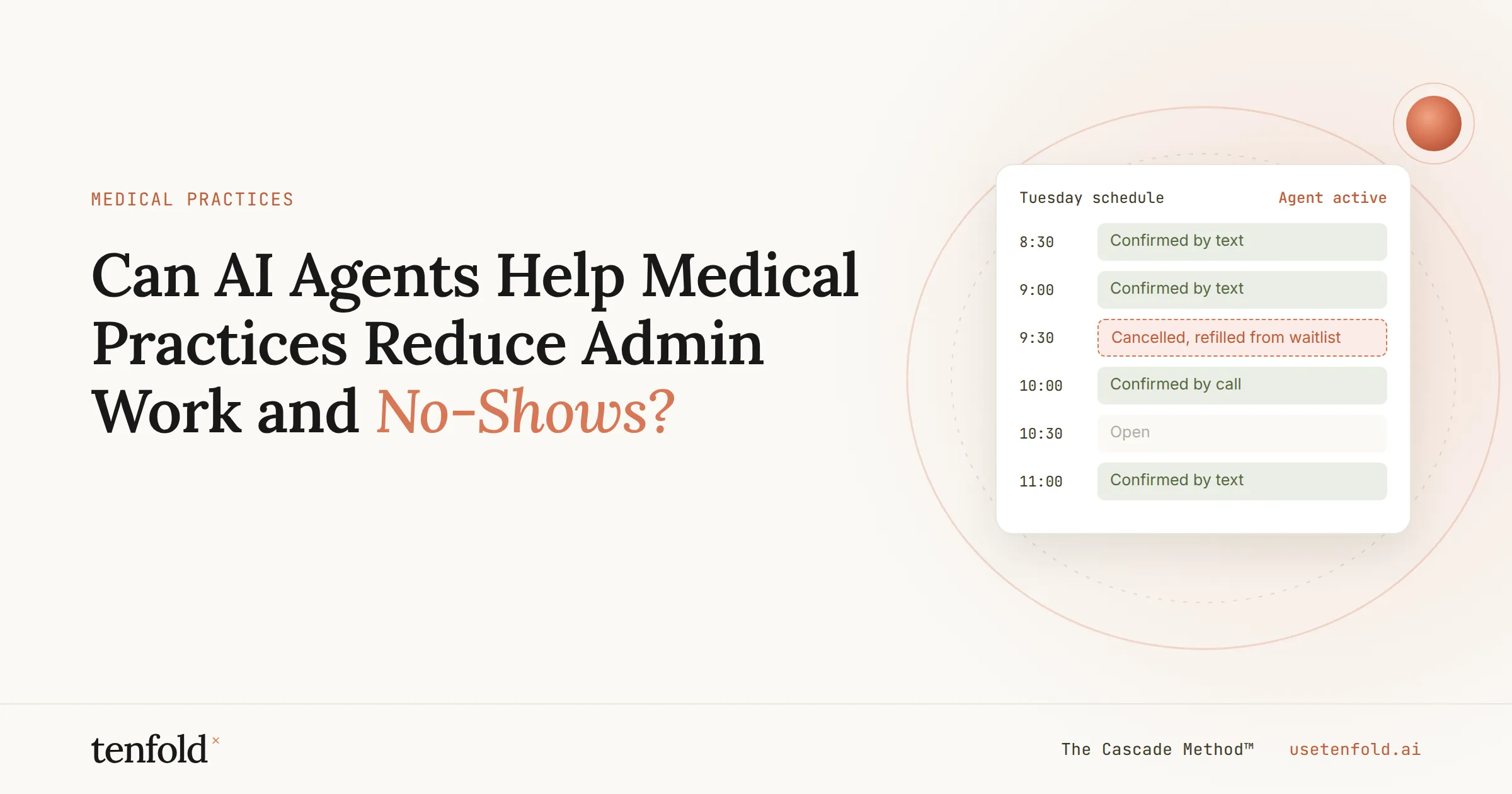
Can AI Agents Help Medical Practices Reduce Admin Work and No-Shows?
Yes — and the data is no longer theoretical. AI agents are actively cutting no-show rates by 25–35%, reducing prior authorization processing time by 30–40%, and giving physicians back hours they've been losing to paperwork for years. The question for most practices today isn't *whether* AI agents work. It's whether the practice is set up to let them.
Quick Answer: AI agents reduce medical practice administrative burden by automating scheduling, reminders, prior authorization, clinical documentation, and billing workflows. Practices deploying multi-layer AI scheduling see 25–35% fewer no-shows within 60 days, and revenue cycle automation is producing documented six-figure savings within a single year.
Key Takeaways:
No-shows cost the U.S. healthcare system an estimated $150 billion annually — and the average physician practice loses roughly $150,000 per year to missed appointments alone.
AI scheduling agents reduce no-shows 25–35% by combining predictive risk scoring, multi-channel reminders, and two-way rescheduling.
Physicians currently spend 1.5–2 hours on administrative tasks for every hour of direct patient care — AI agents are the only intervention proven to reclaim that time at scale.
Prior authorization AI is cutting authorization turnaround by 30–40% and denial rates by 40–50% at organizations that have fully implemented it.
Physician burnout dropped from 51.9% to 38.8% in 30 days among clinicians using ambient AI scribes, per a Yale-led study published in JAMA Network Open.
The Real Cost of Admin Work and No-Shows in Medical Practices
Before evaluating any solution, it helps to understand the actual scale of the problem.
According to BMC Health Services Research, healthcare appointments see an average no-show rate of 27% — making it one of the hardest-hit sectors across all appointment-based industries. Curogram puts the annual system-wide cost at roughly $150 billion, with individual independent physician practices losing $150,000 or more per year to missed slots. A single no-show costs approximately $200 in lost revenue.
For outpatient clinics specifically, MGMA 2024 benchmarking data places the no-show rate between 18–23% nationally. At $150–$400 per missed visit, a four-provider practice losing 15 no-shows per week is forfeiting $2,250–$6,000 every single week.
The admin burden side is just as damaging. According to research published in the National Institutes of Health, healthcare professionals in the U.S. spend approximately 25% of their working hours on administrative duties — and that administrative burden is a primary driver of physician burnout. The AMA's most recent survey found that excessive administrative tasks, led by documentation, were cited as the top burnout driver by the widest margin.
The bottleneck isn't AI capability. It's that most practices aren't yet set up to delegate to it.
How AI Agents Reduce No-Shows: The Three-Layer Model
AI agents address the no-show problem at three distinct levels — and the compounding effect is where the real numbers come from.
Layer 1: Multi-channel automated reminders
AI scheduling platforms send reminders via SMS, email, and voice at proven intervals — typically 72 hours, 24 hours, and 2 hours before the appointment. In a Cochrane systematic review of randomized trials, attendance rose from 67.8% with no reminder to 78.6% with a text-message reminder alone. Multi-channel outperforms single-channel in every comparative study.
Layer 2: Two-way rescheduling
Patients who can't make an appointment often ghost instead of calling to reschedule — because calling is friction. AI agents eliminate that friction by enabling self-service rescheduling through any channel. This is consistently reported as the highest-ROI feature in scheduling platforms, because it converts a no-show into a rebook rather than a revenue loss.
Layer 3: Predictive no-show scoring
This is where agentic AI separates from simple automation. Rather than sending identical reminders to all patients, AI agents apply predictive risk models — scoring each appointment slot based on patient history, demographics, appointment type, and behavioral patterns. High-risk slots get additional outreach or overbooking. According to NCBI research, AI-supported reminders reduced no-show rates from 19.3% to 15.9%, helping ensure timely treatment and better use of provider time. Agentic AI goes further by learning from patient behavior and clinic flow changes, adjusting scheduling priorities with minimal human input.
Practices deploying all three layers see 25–35% no-show reductions within 60 days, according to Layer3 Labs' 2026 practice management analysis. For a practice generating $1.5M annually, that translates to $225,000–$300,000 in additional revenue.
One documented example: Memorial Hospital at Gulfport achieved nearly $804,000 in additional revenue in seven months after cutting no-shows by 28% through AI-driven data and reminders, translating to more than $1 million annually, according to Health Catalyst.
Administrative Automation Beyond Scheduling
No-show reduction is the most visible win, but the administrative stack AI agents are automating runs much deeper.
Clinical Documentation
Physicians currently spend 1.5–2 hours on documentation for every hour of direct patient care, per the AMA. Over a full clinical week, that's 15–20 hours of administrative work — much of it on personal time. Ambient AI scribes are changing that calculus in measurable ways.
A Yale-led study published in JAMA Network Open (2025) found that burnout among 263 physicians at six U.S. health systems fell from 51.9% to 38.8% after just 30 days of using an ambient AI scribe. That's not a marginal improvement — it's a 13-percentage-point drop in a month. A separate 2025 American Medical Association survey found that 57% of physicians identified reducing administrative burdens through automation as AI's biggest opportunity.
The adoption signal is clear: in 2025, 68% of physicians report increased use of AI for documentation — up sharply from previous years.
Prior Authorization
Physicians spend an average of 13 hours every week just dealing with prior authorization, according to Innovaccer. AI agents are automating the full workflow: reading patient charts, extracting relevant clinical evidence, populating payer-specific forms, and routing completed packets for signature and submission.
The results are measurable. Healthcare organizations implementing AI prior authorization are seeing 30–40% reductions in average authorization turnaround time and 40–50% decreases in denial rates, according to Innovaccer's analysis. One documented health system experienced a 22% decrease in prior-authorization denials by commercial payers and saved 30–35 hours per week by reducing the need to write back-end appeals, per the American Hospital Association.
Revenue Cycle Management
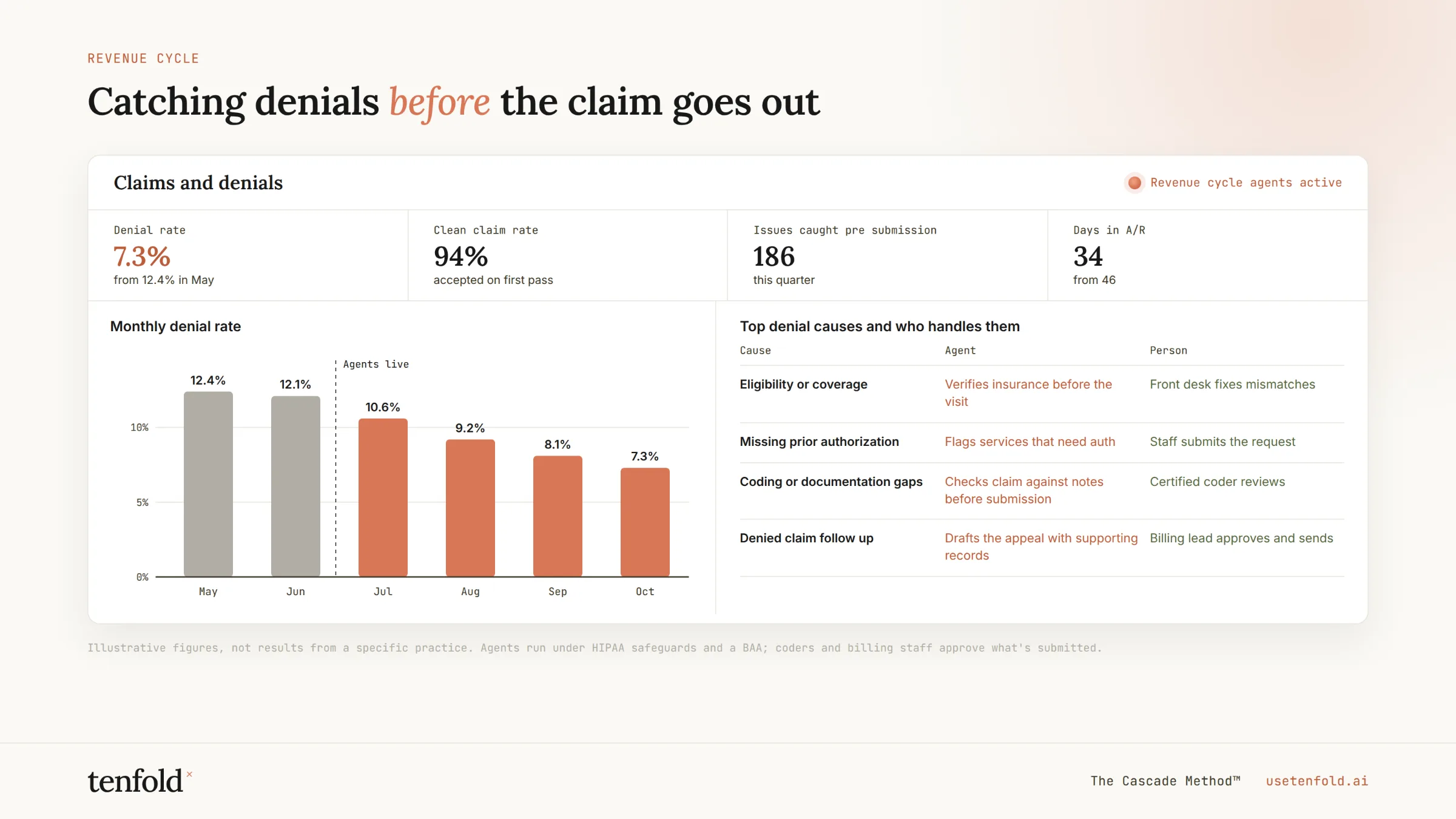
The HFMA and AKASA 2025 revenue cycle survey found 80% of health systems were exploring, piloting, or implementing generative AI tools for revenue cycle management — a 38-percentage-point increase in under two years. The global AI in revenue cycle management market was $20.63 billion in 2024 and is projected to reach $70.12 billion by 2030, per Grand View Research.
83% of healthcare organizations reported that AI-driven automation reduced administrative costs in revenue cycle operations, per Black Book Research's 2025 survey of 1,303 stakeholders.
What Separates AI Agents from Basic Automation
Most practices already use some form of automation — appointment reminders, basic EHR templates, digital intake forms. So what makes AI agents different?
Traditional automation is rule-based: *if X, then Y*. It handles what you've already anticipated. AI agents are goal-directed: they interpret context, learn from outcomes, and act without waiting to be triggered.
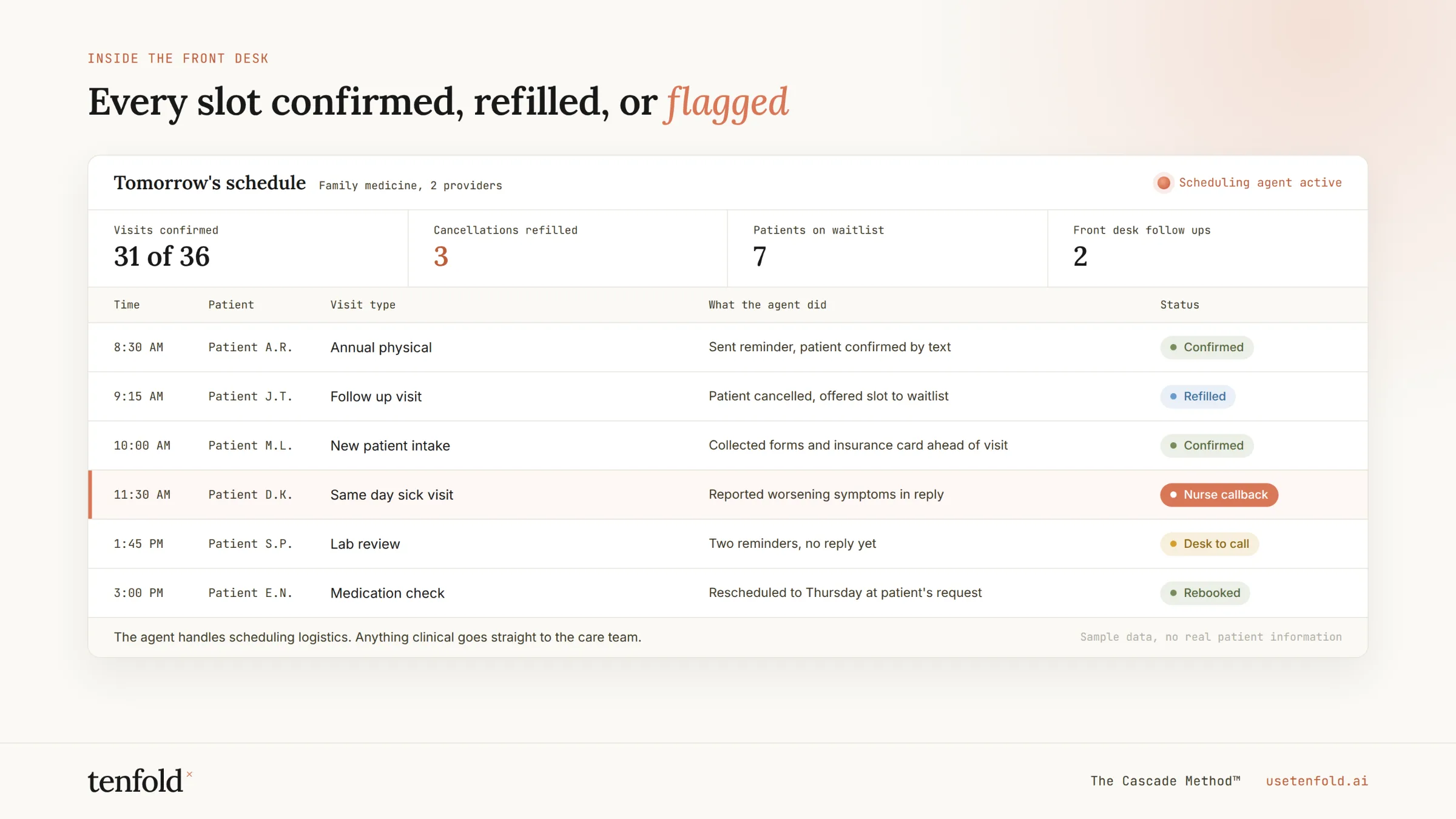
In scheduling, that means an AI agent doesn't just send a reminder — it decides which patients need a phone call versus a text, when to offer a reschedule before the appointment window closes, and which open slots to fill from the waitlist automatically. Waitlist automation fills cancelled slots from a live waitlist, recovering 60–80% of same-day cancellations, according to Layer3 Labs.
In documentation, it means an AI scribe doesn't just transcribe — it structures clinical notes, flags incomplete information, and integrates with EHR systems like Epic, Athena, and Kareo via standard APIs.
In prior authorization, it means the agent isn't waiting for staff to pull a chart — it reads the EHR, extracts relevant clinical evidence, matches it against the specific payer's current medical policy, and assembles the authorization request in the format that payer expects.
This is the distinction that matters operationally. Automation saves time on tasks you've already assigned. Agents take over ownership of entire workflows.
Where Practices Should Start
Not every practice needs to automate everything at once. The highest-ROI entry points, based on documented outcomes, are:
1. AI scheduling and reminders — fastest implementation, fastest payback. Direct revenue impact within weeks of deployment.
2. Ambient AI documentation — highest impact on physician experience and retention. Measurable burnout reduction within 30 days.
3. Prior authorization automation — largest time recapture per workflow. Best ROI for practices with high-volume authorization requirements.
4. Revenue cycle AI — broadest financial impact, but requires clean data infrastructure and integration planning.
The infrastructure question matters. AI agents are only as effective as the systems they connect to. Practices running fragmented EHRs, inconsistent data entry, or legacy scheduling platforms will need to resolve those gaps before agents can operate at full capacity.
At Tenfold, we've found that the practices seeing the fastest results aren't the ones with the most sophisticated technology — they're the ones that have clearly defined which workflows they want to hand off, and have given the agents the access and authority to actually run them.
Summary
Medical practices are losing revenue, physician hours, and staff morale to an administrative load that existing tools haven't resolved. AI agents — purpose-built for scheduling, documentation, prior authorization, and revenue cycle management — are producing documented, measurable results across all four areas. The data is no longer preliminary: no-show reductions of 25–35%, burnout drops of 13 percentage points in 30 days, and six-figure annual revenue recoveries are real outcomes at real organizations. The constraint isn't what AI can do. It's whether your practice is ready to delegate.
Tenfold helps organizations evaluate, implement, and operationalize AI agents across their administrative workflows — with the Inforge delivery model as proof that agent-first operations work at scale.
Frequently Asked Questions
Q: How much can AI agents actually reduce no-shows in a medical practice?
A: Practices deploying multi-layer AI scheduling — combining predictive risk scoring, multi-channel reminders, and two-way rescheduling — see no-show reductions of 25–35% within 60 days, according to MGMA benchmarking data and Layer3 Labs' 2026 analysis. The three layers compound: reminders alone move the needle, but predictive scoring and self-service rescheduling are where the largest gains appear.
Q: Will AI agents replace front-desk staff at medical practices?
A: No. AI agents handle repetitive, rule-based communication and data workflows so that front-desk staff can focus on patient interactions that require human judgment and care. The goal is capacity reallocation, not headcount reduction. Practices using AI agents typically redeploy staff from administrative queues to higher-value patient-facing roles.
Q: How do AI agents handle prior authorization without clinical staff involvement?
A: AI prior authorization platforms read the EHR, extract relevant clinical documentation, match it against the specific payer's current medical policy, and assemble the authorization request in the required format. Completed packets are then routed to clinical staff for signature and submission. Staff involvement is reduced to review and sign-off — not data gathering, chart pulling, or form filling. Organizations implementing these systems report 30–40% reductions in authorization turnaround time.
Q: Is AI documentation safe for clinical use?
A: Ambient AI scribes are designed to assist, not replace, clinical judgment. They generate draft clinical notes from recorded encounters, which physicians review, edit, and sign before the note is finalized. Physicians remain the accountable party for documentation accuracy. The 2025 JAMA Network Open study found significant burnout and cognitive workload reductions with no documented increase in documentation errors.
Q: What's the first AI agent implementation a medical practice should prioritize?
A: For most practices, AI scheduling and reminder automation delivers the fastest, most measurable ROI — revenue impact within weeks, no major infrastructure changes required, and direct effect on the no-show problem that practices feel most acutely. Practices with high authorization volume should consider prior auth automation as an equal or higher priority, given the documented 13-hour-per-week physician time cost of manual prior auth workflows.
