
Can AI Agents Handle Client Intake? How Law Firms Are Cutting Response Time from Days to Minutes
Yes — AI agents can fully handle law firm client intake, and the firms deploying them are not just saving time. They are winning cases that slower competitors are losing by default. The average law firm takes more than 24 hours to respond to a web form submission, and the data is unambiguous: firms that respond within five minutes convert at roughly eight times the rate of those that wait 30 minutes. AI agents close that gap by responding in under 90 seconds, every time, day or night.
This is not a speculative future. It is what is happening at firms that have made the shift in 2025 and 2026.
Key Takeaways:
Law firms that respond to an inquiry within five minutes convert at up to 8x the rate of slower responders — yet most firms still miss that window entirely.
AI intake agents reduce response time from 24–48 hours to under 90 seconds, and cut total intake processing time by up to 60%.
42% of all law firm inbound calls arrive after business hours — without AI, those leads go to voicemail and rarely convert.
Firms using AI-driven intake have documented conversion rate jumps from 8% to 29%, with some capturing 280% more qualified leads.
78% of legal clients hire the first attorney who responds — meaning speed is now the single most decisive intake variable.
Quick Answer: AI agents can handle the full first-contact intake workflow — answering inquiries, running qualification questions, screening for conflicts, booking consultations, and delivering structured summaries to attorneys — without human involvement. They operate 24/7, respond in seconds, and free senior legal staff to focus on billable work.
The Intake Crisis Most Law Firms Are Ignoring
The numbers behind law firm intake are stark. According to a 2025 study of 1,333 law firms by Hennessey Digital, 26% of firms never respond to an online lead at all, and 39% either take more than two hours or never reply. According to the Clio 2024 Legal Trends Report, only 40% of law firms even answer the phone when a prospective client calls — down from 56% in 2019.
The downstream cost is severe. According to LexScale's 2026 AI Adoption in Law Firms data, 78% of legal clients hire the first attorney who responds. Nearly four in five clients never contact a second firm — they hire whoever picked up or replied first.
That means the intake workflow is not just an operations issue. It is the single most decisive revenue variable your firm controls.
According to data from Pareto Legal, firms that adopt AI widely are nearly three times more likely to report revenue growth — 69% of wide adopters saw positive revenue impact versus 36% of legal professionals overall. The gap is not about the quality of legal work. It is about who shows up first.
What an AI Intake Agent Actually Does
An AI intake agent is not a chatbot that routes visitors to a contact form. It is a structured, adaptive workflow that replaces the entire first-contact sequence.
According to Enterprise DNA's analysis of AI client intake workflows, a production-ready legal intake system typically involves at least two agents working in sequence: an Intake Voice Agent and a Matter Triage Agent. In firms handling high document volumes, a Document Review Agent prepares the first internal summary before any attorney reviews the matter.
Here is what the agent sequence looks like in practice:
Step 1: Every Inquiry Gets Answered — Instantly
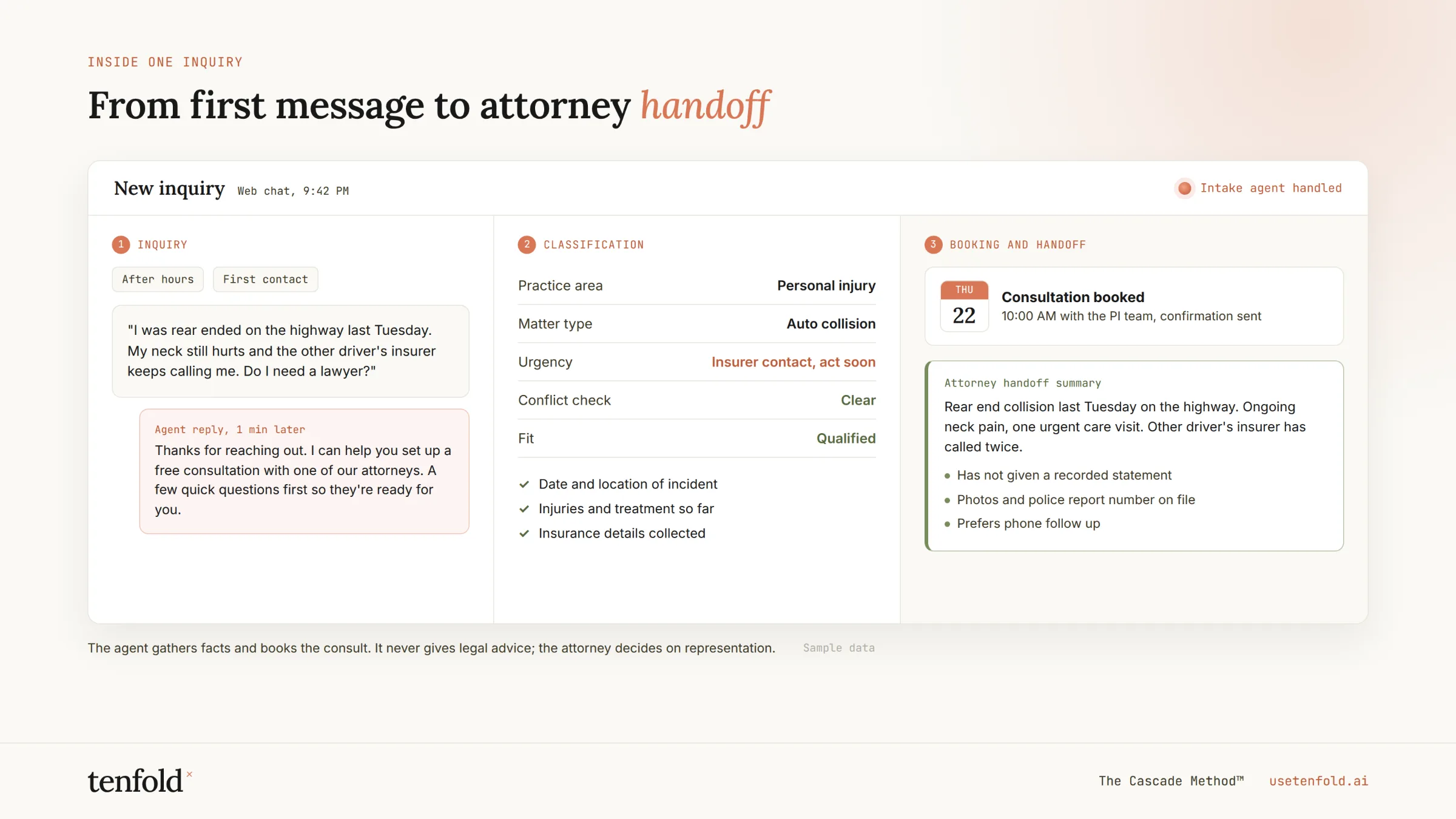
The Intake Voice Agent answers calls, web chat messages, and form submissions in real time. According to Dapta.ai's breakdown of AI intake for law firms, the agent answers the call, speaks conversationally with the potential client, runs qualifying questions, captures the details, and books the consultation — without an attorney or paralegal on the line.
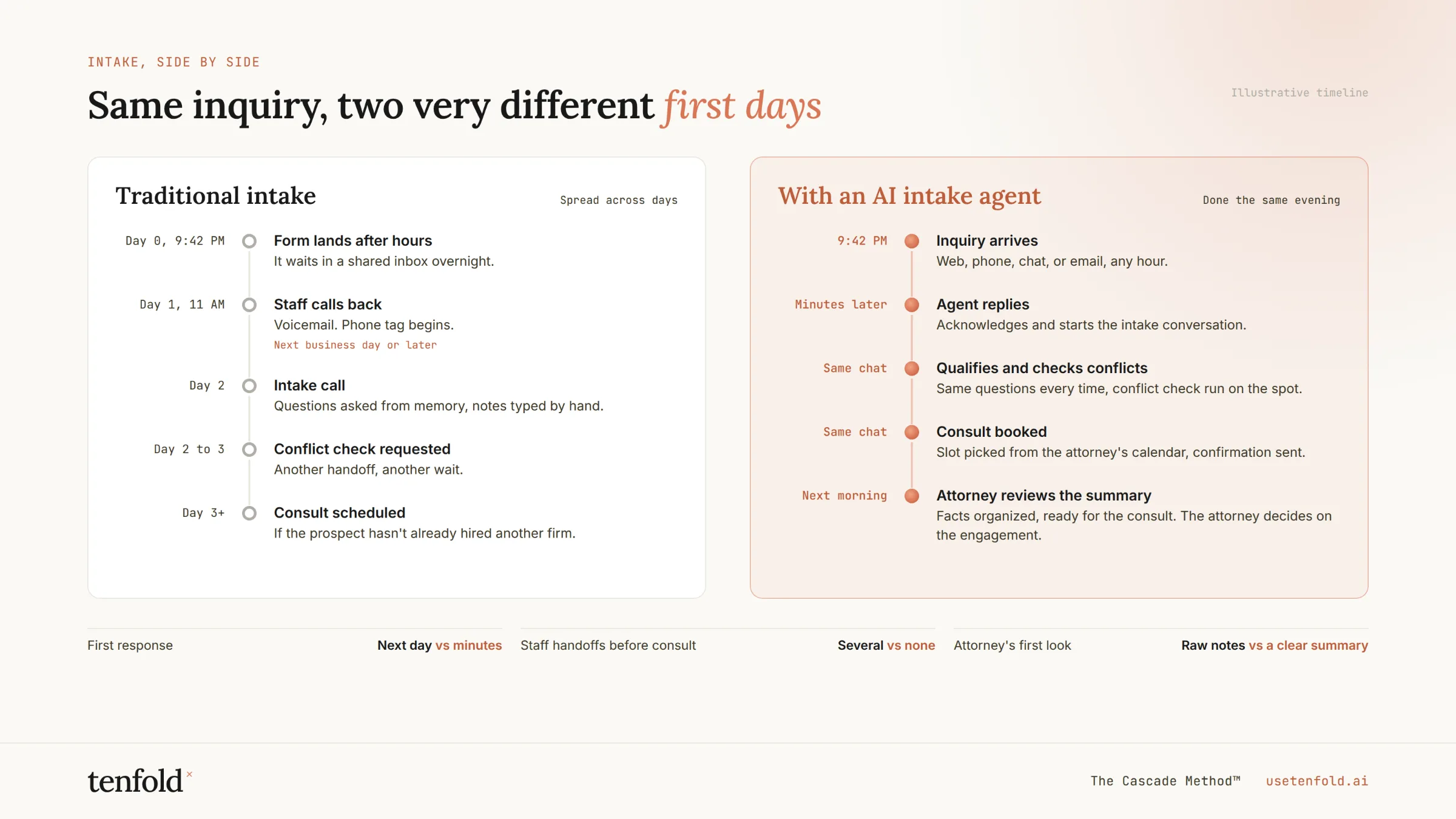
The response happens in seconds. According to Attorney Assistant's benchmarking data, response time drops from the traditional 24–48 hours to under 90 seconds with AI. That single change puts your firm inside the five-minute conversion window that research consistently identifies as the threshold that separates winning firms from losing ones.
Step 2: Forms and Emails Are Classified — Not Just Collected
The Matter Triage Agent monitors inbound channels and reviews every submission against your firm's intake framework. According to Enterprise DNA, it classifies the likely practice area, identifies the type of legal issue, scores fit against your acceptance criteria, identifies missing information, and distinguishes between a strong potential client, a current-client service request, a vendor inquiry, a job application, and an irrelevant message.
This is the step that eliminates hours of paralegal time per week. Routine triage — the work that consumes a significant share of the 48% of time legal professionals spend on administrative tasks, per MindStudio's research — gets handled before a human is involved.
Step 3: Attorneys Receive a Structured Handoff — Not a Raw Voicemail
When a matter qualifies for attorney review, the agent does not hand over a recording or a message thread. It delivers a structured summary: matter type, key facts captured, conflict screening results, urgency classification, and the next scheduled touchpoint. The attorney walks in with context, not a cold lead.
According to Bland.ai's 2025 analysis, AI voice agents for legal intake can handle up to 80% of routine client inquiries without human intervention, converting after-hours calls that previously converted at near-zero rates into qualified, scheduled appointments before the next business day.
The After-Hours Problem AI Solves Permanently
Traditional intake has a structural flaw that no amount of staffing can fix affordably: 42% of all inbound law firm calls arrive after business hours, according to CallRail's 2025 Legal Industry Report. Evenings, weekends, holidays — the moments when prospective clients have time to deal with a legal situation they have been putting off.
Without AI coverage, those leads hit voicemail. And according to Toppeca Consulting's client intake research, 74% of clients who reach voicemail never follow up with that firm.
AI agents have no office hours. According to Smith.ai and Answering Legal client data aggregates (2025), law firms using always-on AI intake capture an average of 23% more qualified leads monthly compared to firms relying solely on daytime staff — with the majority of the gain coming from evenings and weekends.
The math is simple. If your firm receives 100 inbound inquiries per month and 42 arrive after hours, and you are currently converting zero of them, a 24/7 AI intake layer represents a direct expansion of your qualified pipeline with no incremental marketing spend.
What the Conversion Data Actually Shows
Skepticism about AI intake usually centers on quality — the concern that automation will lose nuance or push away clients who want a human. The conversion data does not support that concern.
According to Attorney Assistant's benchmarking of AI-driven intake at personal injury law firms, AI lifts conversion rates from 10% to 35%, delivers 280% more qualified leads, and cuts intake time by over 60%. Conversion rates jumping from 8% to 29% and signed cases doubling are now documented outcomes for firms deploying AI intake systems. 95% of clients complete the intake process without needing human escalation at all.
The pattern holds at scale. According to Clio's platform data, firms using client-facing intake features generate 51% more leads and 52% higher revenue on average. And Clio's 2025 Legal Trends Report found that among legal professionals using AI, 63% report better client responsiveness as a direct result.
This is not about replacing attorneys. It is about making sure every lead is caught, qualified, and moved to the right next step — automatically, consistently, and within the conversion window that determines whether you get the case or your competitor does.
[INTERNAL LINK: link to AI agent qualification and routing post — anchor: AI agent qualification workflows]
The Compliance Layer You Cannot Skip
Legal intake automation carries specific ethical and compliance requirements that generic AI tools do not address. According to Enterprise DNA's framework for law firm AI intake, the agent must not imply representation, guarantee outcomes, provide legal advice, or make promises about fees. Every client-facing interaction must use pre-approved language, and the agent's role must be disclosed plainly.
This is not optional. According to Clio's 2025 consumer research, 78% of clients want disclosure when their lawyer uses AI. Meanwhile, only 35% of legal professionals rarely or never disclose it — a gap that creates both ethical exposure and client trust risk.
Conflict screening also requires careful design. The agent can collect names and search relevant systems, but a qualified person must review potential matches before representation proceeds. The intake agent accelerates the screening process; it does not replace the human judgment at the end of it.
Proper implementation means building these controls into the workflow from the start — not retrofitting them after go-live. Firms that deploy AI intake correctly treat compliance as an architectural requirement, not an afterthought.
How to Start: A Practical Framework
For most firms, the fastest path to meaningful results follows three layers:
Layer 1: Answering coverage. Deploy an AI voice agent configured around your practice areas, intake criteria, and escalation rules. This alone solves the after-hours gap and eliminates the 26% of inquiries that currently get no response at all.
Layer 2: Triage and classification. Add a matter triage agent that monitors inbound channels, classifies practice area and matter type, scores fit against your criteria, and flags missing information before it reaches a human.
Layer 3: CRM and case management integration. Connect the intake workflow to your existing tools — Clio, Filevine, MyCase, or your CRM of choice. Every qualified lead creates a record automatically. Every attorney handoff includes a structured summary. Nothing falls through the cracks because there is no manual handoff to drop.
According to Kinematic Labs' guide to AI agents for law firms, firms deploying intake automation recover hours of senior attorney time per week within the first 30 days of deployment. The return is fast because the workflow being automated is high-frequency and well-defined — exactly the type of task that AI agents handle with the most consistency.
At Tenfold, this is the kind of agent-first implementation we build and run. The intake workflow is one of the clearest use cases in professional services: structured questions, defined qualification criteria, predictable routing, and measurable conversion outcomes. It is also one of the fastest to show ROI — not because the technology is new, but because the cost of not having it is visible in every lead that goes unanswered.
Summary
Law firms are not losing cases because of inferior legal talent. They are losing cases because of intake workflows that were designed for a world where 9-to-5 coverage and a 24-hour callback were acceptable. That world is gone. AI agents for law firm client intake now handle the full first-contact sequence — answering instantly, qualifying systematically, routing intelligently, and handing off with context — at a fraction of the cost of staffing the equivalent human coverage.
The firms that move first on this are not just more efficient. They are capturing the cases their competitors are losing by default. At Tenfold, we build the agent infrastructure that makes this operational — not as a demo, but as a live system your firm runs on.
Frequently Asked Questions
Q: Can AI agents really replace human intake staff at a law firm?
A: AI agents can automate up to 80% of routine intake interactions without human involvement, including answering calls, running qualification scripts, booking consultations, and delivering structured summaries to attorneys. For complex, emotionally sensitive, or legally nuanced situations, a hybrid model — AI first, human escalation on trigger — delivers the best conversion outcomes and client experience.
Q: Is AI intake compliant with legal ethics rules?
A: Yes, if implemented correctly. The ABA Formal Opinion 512 (2024) and state bar ethics guidelines require that AI tools used in client-facing contexts do not imply legal representation, provide legal advice, or guarantee outcomes. Firms must disclose AI use during intake — 78% of clients expect this disclosure, per Clio's 2025 research. Enterprise-grade intake agents are built with these controls; generic consumer AI tools are not.
Q: How fast can an AI intake agent actually respond?
A: Under 90 seconds for the first response, compared to the industry average of 24–48 hours for web form follow-up and 13+ minutes even for the fastest-responding firms. This matters because firms responding within five minutes convert at roughly 8x the rate of those that wait 30 minutes, and 78% of legal clients hire the first attorney who responds.
Q: What integrations does an AI intake system need to work properly?
A: A production-ready AI intake system should integrate directly with your case management platform (Clio, Filevine, MyCase, Smokeball), your CRM for lead tracking, your calendar for consultation booking, and your conflict screening system. Without these integrations, the agent creates work rather than eliminating it.
Q: How quickly will a law firm see ROI from AI intake?
A: Most firms recover measurable ROI within the first 30 days, primarily through recovered after-hours leads and reduced paralegal time on triage. Firms deploying full intake automation report savings of 1,300+ administrative hours per year and conversion rate improvements of 20+ percentage points — both of which show up quickly in signed cases and revenue.
