
Build, Buy, or Partner? How Mid-Market Firms Should Approach AI Agents
For most mid-market firms, the answer is to buy where a proven tool already fits, partner where the workflow is specific to your business, and build only what truly differentiates you. Building everything in house sounds like control, but it usually means slower timelines, higher costs, and a much lower chance of reaching production. The firms getting results are the ones that match the approach to the workflow, not the ones with the biggest engineering budgets.
Quick Answer: Mid-market firms should buy off-the-shelf AI agents for standard, well-defined workflows like scheduling, support triage, or meeting notes. They should partner with a specialist for workflows that depend on their own systems, data, and processes, like client intake, reporting, or operations. Building in house only makes sense when the workflow is a core competitive advantage and the firm has the engineering and AI talent to maintain it long term. MIT research found vendor and partner-led AI deployments succeed about 67% of the time, roughly twice the rate of internal builds.
Key Takeaways:
MIT's NANDA initiative found that AI tools bought from specialized vendors or built with partners succeed about 67% of the time, while internal builds succeed only about one-third as often.
The same research found roughly 95% of enterprise generative AI pilots produced no measurable P&L impact. How firms approach AI matters as much as which tools they choose.
Buying works best for standard workflows. Partnering works best for workflows tied to your specific systems and processes. Building works best only for true differentiators.
Most mid-market firms don't have the in-house AI engineering capacity to build and maintain agents across multiple workflows.
Many firms end up with a hybrid: buy the commodity pieces, partner on the core workflows, and build selectively later.
Why the Build vs Buy Decision Matters So Much for AI Agents
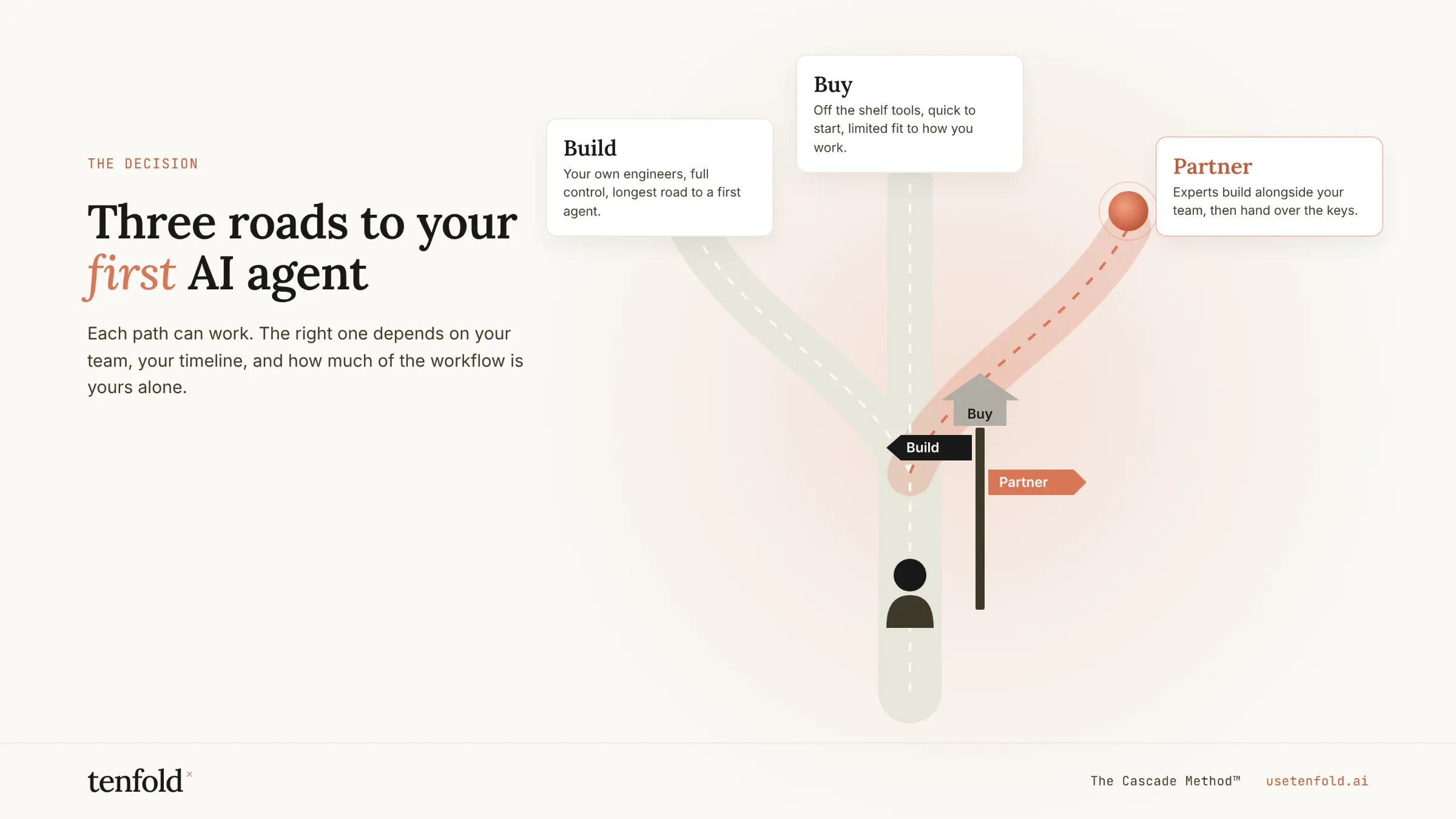
Every mid-market leadership team considering AI agents eventually hits the same question: do we build this ourselves, buy a product, or bring in a partner?
The data suggests that choice has an outsized impact on whether the project succeeds. MIT's NANDA initiative, in its 2025 report The GenAI Divide, analyzed 300 public AI deployments along with leadership interviews and employee surveys. It found that roughly 95% of enterprise generative AI pilots delivered no measurable P&L impact. But the success rate varied dramatically by approach: tools purchased from specialized vendors or built through partnerships succeeded about 67% of the time, while internal builds succeeded only about one-third as often.
The report's explanation is practical, not technical. Successful companies picked one specific pain point, executed well, and partnered with providers who brought domain expertise and integration experience.
For mid-market firms, the stakes are even higher. Unlike large enterprises, most mid-market companies don't have a dedicated AI engineering team, an ML platform, or the budget to absorb a failed internal build.
The bottleneck isn't access to AI. It's choosing the right path to production.
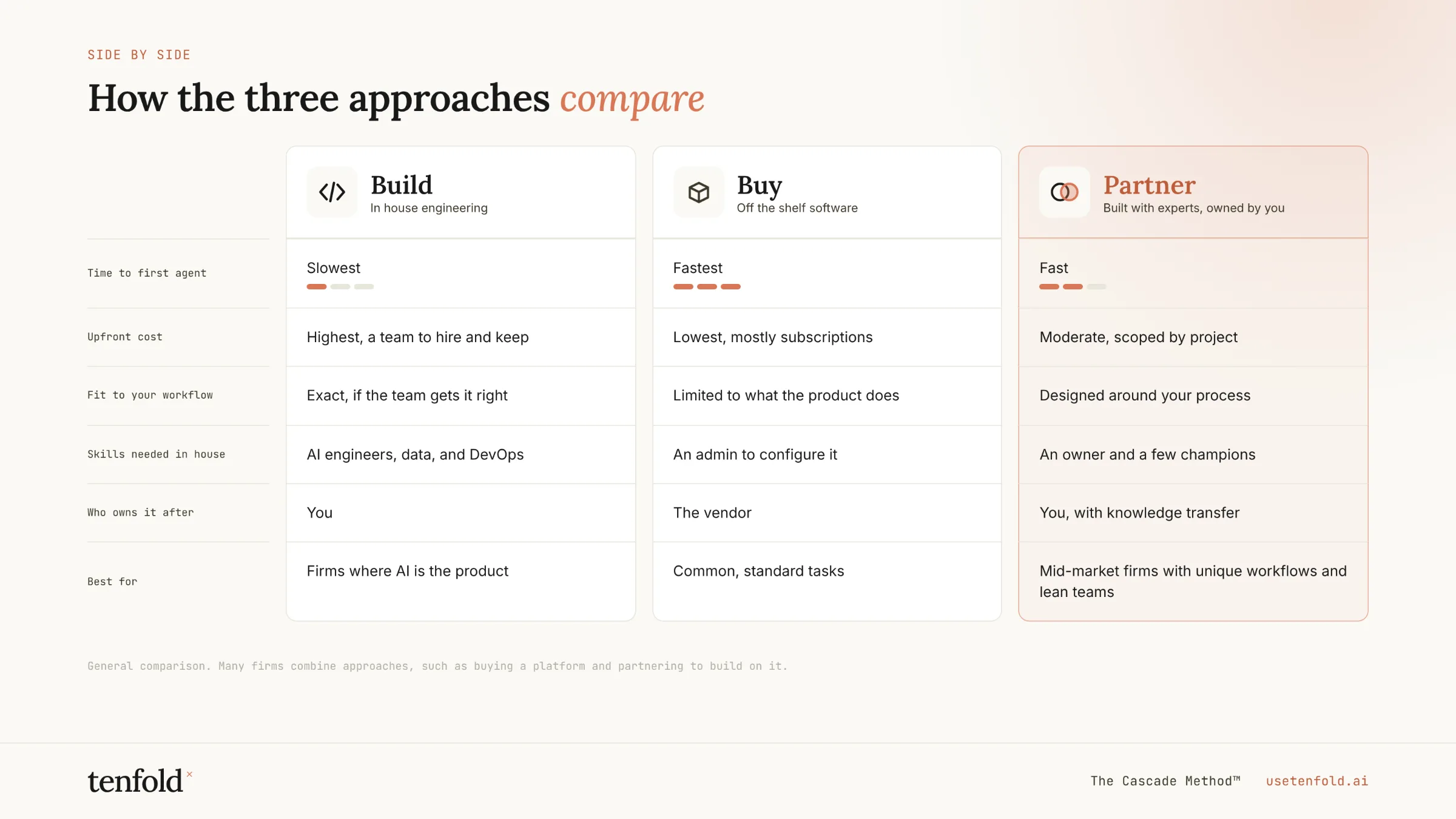
Option 1: Build In House
Building means your own team designs, develops, integrates, and maintains the AI agent using foundation models, frameworks, and your own infrastructure.
When it makes sense:
The workflow is a core competitive advantage that no vendor understands as well as you do
You have experienced AI and software engineers on staff, not just interest
You're prepared to own ongoing maintenance, monitoring, security, and model updates
Time to value is less important than long-term control
The trade-offs: Internal builds take longer, cost more than most teams estimate, and depend on a small number of people who can maintain them. AI agents also aren't "set and forget." Models change, integrations break, and workflows evolve. Most mid-market firms underestimate the ongoing cost of ownership.
Option 2: Buy Off the Shelf
Buying means licensing a ready-made AI agent or AI feature, either a standalone product or one built into software you already use, like your CRM, help desk, or practice management system.
When it makes sense:
The workflow is standard across industries, like meeting notes, scheduling, support triage, or basic lead response
A proven product already does 80% or more of what you need
You want fast deployment with minimal technical effort
The tool integrates cleanly with the systems you already use
The trade-offs: Off-the-shelf tools are fast, but they're built for the average customer. When your workflow depends on your specific data, your rules, or connections across several systems, a packaged product often hits its limits. Firms also risk ending up with a collection of disconnected AI tools that each solve one small problem.
Option 3: Partner with a Specialist
Partnering means working with an AI implementation firm that designs, configures, integrates, and often manages AI agents built around your specific workflows, using proven platforms and components rather than starting from scratch.
When it makes sense:
The workflow depends on your own systems, data, and processes
You need the agent to take real actions, not just answer questions
You don't have in-house AI engineering capacity, or you don't want to build it
You want production results in weeks, not quarters
You need help with change management, guardrails, and measuring ROI
The trade-offs: Partnering requires choosing the right firm and investing time upfront to define workflows clearly. It also requires a partner who transfers knowledge and builds on platforms you can own, rather than locking you into a black box.
A Simple Framework for Making the Call
Score each workflow you're considering on four questions:
Is this workflow standard or specific to us? Standard workflows lean toward buy. Specific ones lean toward partner or build.
Does it differentiate us competitively? If it's a true differentiator and you have the talent, building may be worth it. If not, don't build it.
How many systems does it touch? One system often means buy. Several systems, with real actions across them, usually means partner.
Who will maintain it in 12 months? If the honest answer is "nobody," don't build it.
Apply the framework workflow by workflow, not company-wide. Most firms end up with a mix: a purchased tool for meeting notes, a partner-built agent for client intake and reporting, and perhaps an internal build later for a proprietary process once the team has matured.
Common Mistakes Mid-Market Firms Make
Building because it feels safer. Internal builds feel like control, but they fail more often and take longer to deliver value.
Buying too many point tools. Five disconnected AI tools rarely add up to one working workflow.
Choosing a partner without platform transparency. Make sure you understand what's being built, where it runs, and what you'll own.
Starting too broad. The firms in MIT's research that succeeded picked one pain point first.
Skipping the business owner. Whatever the approach, someone on the business side needs to own the outcome.
At Tenfold, we've found that the mid-market firms seeing the fastest results aren't the ones trying to build an AI department from scratch. They're the ones that clearly define which workflows to hand off, use proven tools where they fit, and bring in specialists for the workflows that are unique to their business.
Summary
For mid-market firms, the build, buy, or partner decision often determines whether an AI agent reaches production at all. MIT research found vendor and partner-led deployments succeed about 67% of the time, roughly twice the rate of internal builds. The practical approach is to buy for standard workflows, partner for workflows tied to your specific systems and processes, and build only when the workflow is a true differentiator and you have the talent to maintain it. Decide workflow by workflow, start with one pain point, and keep a business owner accountable for results.
Tenfold partners with mid-market firms to design, implement, and operationalize AI agents built around their specific workflows, so they reach production faster and keep improving after launch.
Frequently Asked Questions
Q: Should my company build or buy AI agents?
A: For most mid-market firms, buy for standard workflows and partner for workflows that depend on your own systems and processes. Building in house makes sense only when the workflow is a core competitive advantage and you have the engineering capacity to maintain it.
Q: Why do internal AI builds fail more often?
A: Internal builds often underestimate integration work, ongoing maintenance, and the expertise needed to move from prototype to production. MIT's research found internal builds succeed only about a third as often as vendor or partner-led deployments.
Q: What's the difference between buying an AI tool and partnering with an AI firm?
A: Buying gives you a packaged product designed for many customers. Partnering gives you an AI agent designed, integrated, and configured around your specific workflows, data, and systems, usually with support for rollout, guardrails, and measurement.
Q: Can we start with a partner and bring AI in house later?
A: Yes. Many firms use a partner to get their first agents into production, then build internal capability over time. Choose a partner who documents their work and builds on platforms you can own so the transition is straightforward.
Q: How do I evaluate an AI agent partner?
A: Look for experience with your type of workflow, clear integration capabilities, transparency about the platforms they use, a defined approach to security and guardrails, and a track record of measurable results in production, not just pilots.
