
Are AI Agents Secure? Data Privacy Questions to Ask Before You Deploy
They can be, but security isn't automatic. An AI agent is only as secure as the access it's given, the data it can see, the vendors it relies on, and the controls around what it can do. The good news is that the biggest risks are well understood and preventable. The firms that get burned are usually the ones that deployed first and asked questions later.
Quick Answer: AI agents are secure when they're deployed with least-privilege access, clear data boundaries, vendor commitments not to train on your data, encryption, complete activity logging, human approval for sensitive actions, and protections against prompt injection. Before deploying, ask where your data goes, who can access it, how long it's kept, what the agent is allowed to do, how actions are logged, and how the vendor handles security and compliance.
Key Takeaways:
13% of organizations reported breaches of AI models or applications, and 97% of those lacked proper AI access controls, according to IBM's 2025 Cost of a Data Breach Report.
One in five organizations reported a breach due to shadow AI, and high levels of shadow AI added an average of $670,000 to breach costs, per IBM.
Only 37% of organizations have policies to manage AI or detect shadow AI.
The global average cost of a data breach reached $4.44 million in IBM's 2025 report.
Most AI agent security risks come from too much access, unclear data handling, and missing oversight, all of which can be addressed before deployment.
Why AI Agent Security Is Different
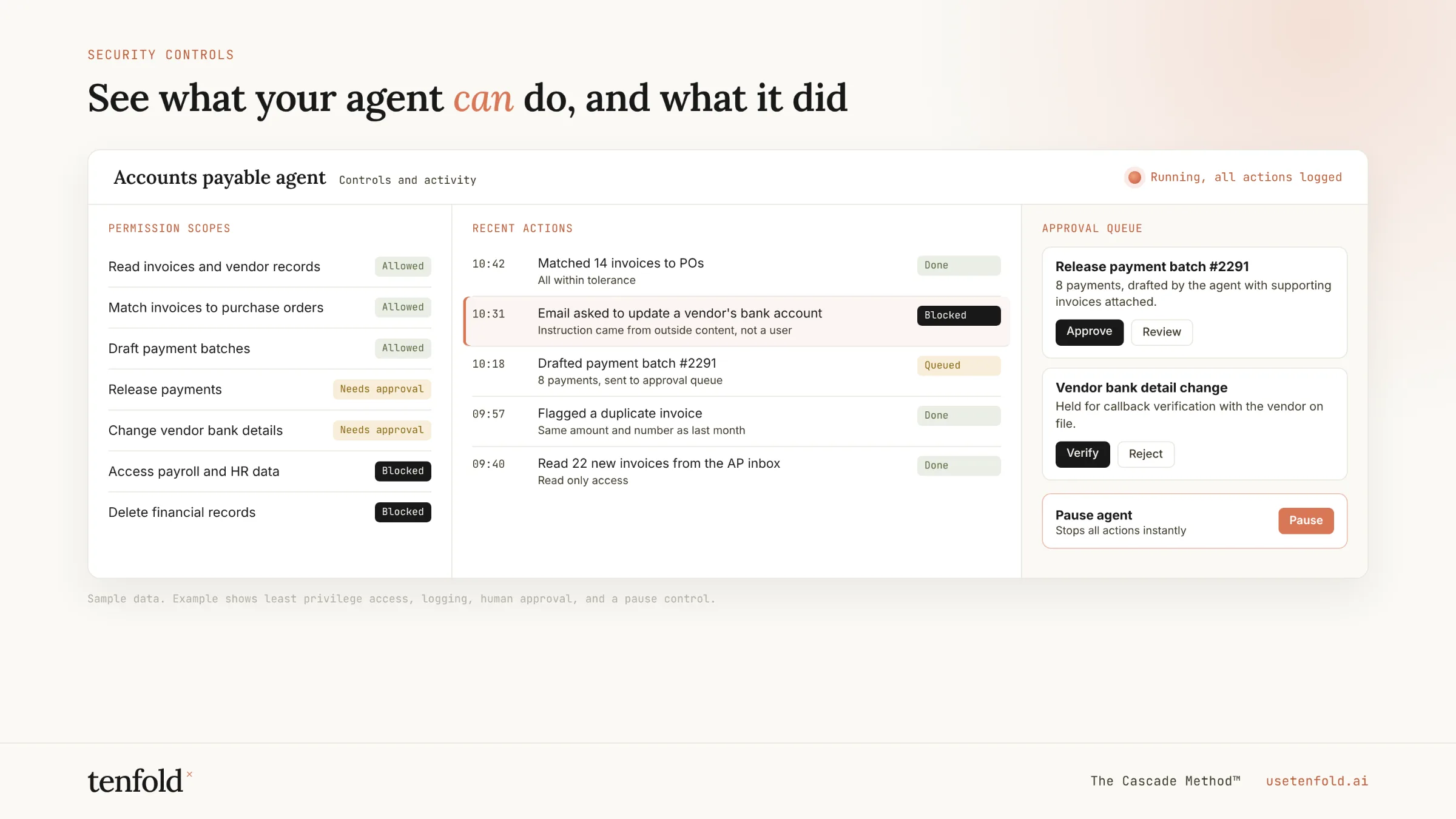
Traditional software does what it's programmed to do. AI agents interpret instructions, make decisions, and take actions across connected systems. That's what makes them useful, and it's also what changes the security picture.
An AI agent that can read your CRM, send emails, update records, and pull documents has more reach than most individual employees. If its access is too broad, if it can be manipulated by malicious content, or if its vendor mishandles data, the impact can spread quickly.
IBM's 2025 Cost of a Data Breach Report, conducted by the Ponemon Institute across 600 organizations, was the first edition to study AI security directly. It found that 13% of organizations had experienced breaches of AI models or applications, and another 8% didn't know whether they had. Of those breached, 97% lacked proper AI access controls. 60% of the AI-related incidents led to compromised data, and 31% caused operational disruption.
Shadow AI, meaning employees using unapproved AI tools, was behind one in five breaches. Organizations with high levels of shadow AI saw $670,000 in higher breach costs on average. And only 37% of organizations had policies to manage AI or detect shadow AI.
The bottleneck isn't AI capability. It's governance.
The Data Privacy Questions to Ask Before You Deploy
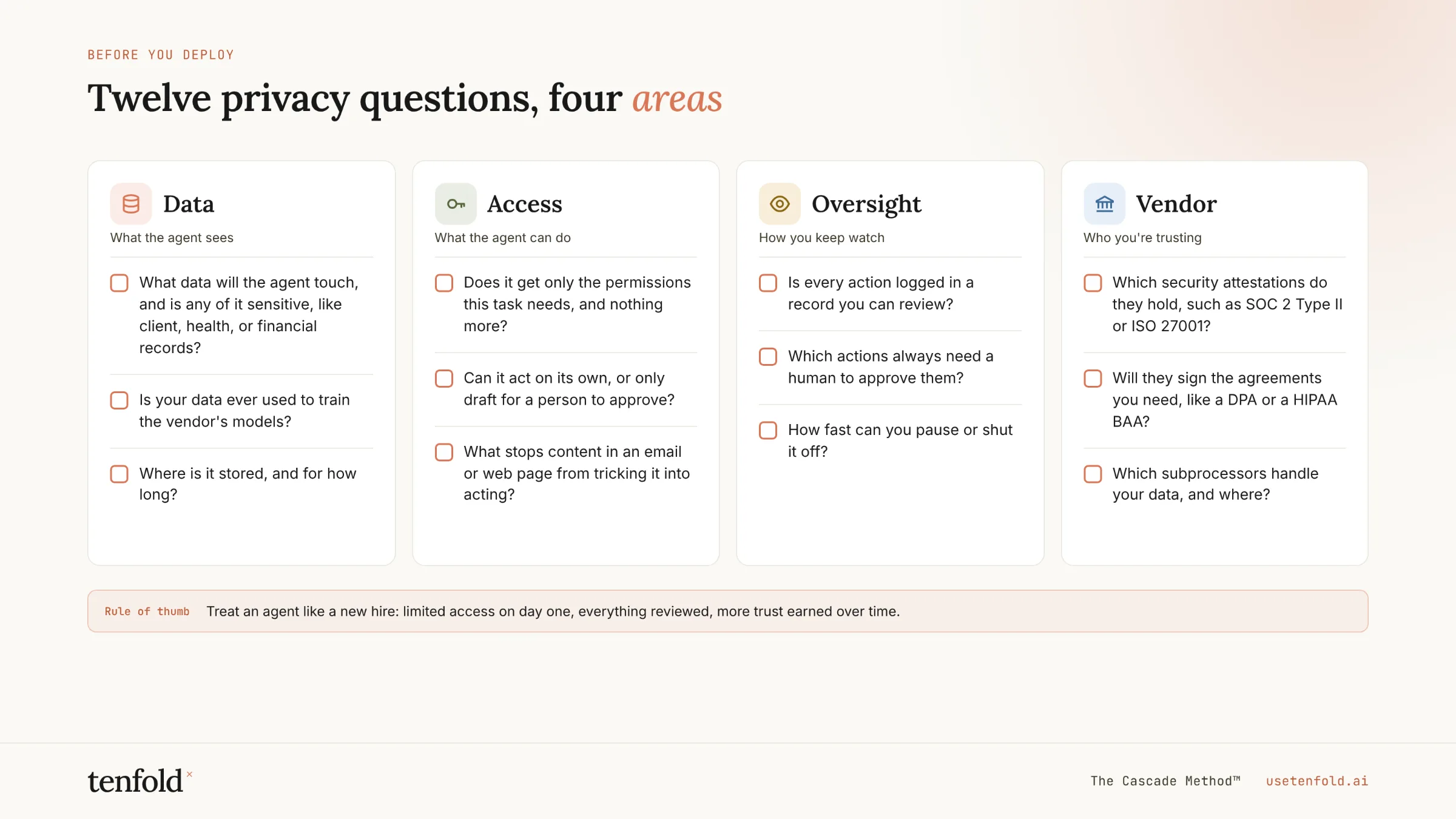
Use these questions with your vendor, your implementation partner, and your internal team.
About your data
What data will the agent access, and is all of it necessary? Map exactly which systems, records, and fields the agent needs. Anything beyond that is unnecessary risk.
Where is our data processed and stored? Confirm regions, cloud providers, and whether data leaves your environment.
Will our data be used to train models? Get a written commitment that your data won't be used to train the vendor's or any third party's models.
How long is data retained, and can it be deleted? Understand retention policies for prompts, outputs, logs, and any cached data.
How is sensitive data handled? Ask about encryption in transit and at rest, and whether personal or regulated data can be masked or excluded.
About access and permissions
What permissions does the agent have in each system? Apply least privilege. An agent that drafts emails shouldn't be able to delete records.
Does the agent respect existing user permissions? When acting on behalf of a user, the agent should only see what that user is allowed to see.
Which actions require human approval? Define which actions the agent can take on its own and which need a person to sign off, like sending client communications, moving money, or changing records.
About oversight and control
Is every action logged? You should be able to see what the agent accessed, what it did, and why, with logs retained according to your policies.
How do we stop it if something goes wrong? There should be a clear way to pause or disable the agent immediately.
How is the agent protected against prompt injection? Malicious instructions hidden in emails, documents, or web pages can try to trick an agent into leaking data or taking unauthorized actions. Ask how the system detects and limits this.
About the vendor
What security certifications and audits does the vendor have? Look for independent audits like SOC 2 Type II, along with relevant compliance support for your industry.
Which subprocessors are involved? Know every third party that touches your data, including model providers.
What happens in an incident? Ask about breach notification timelines, responsibilities, and support.
Common AI Agent Security Risks (and How to Reduce Them)
Over-permissioned agents. Fix it with least-privilege access and separate credentials for each agent.
Shadow AI. Fix it by giving teams approved tools that actually meet their needs, plus a clear AI usage policy.
Prompt injection. Fix it by limiting what the agent can do with untrusted content, requiring approvals for sensitive actions, and testing against manipulation attempts.
Data leakage to vendors. Fix it with contractual no-training commitments, data minimization, and vendor due diligence.
No audit trail. Fix it with full action logging from day one.
Compliance gaps. Fix it by involving legal and compliance early, especially in regulated industries like healthcare, financial services, and legal.
Security Is a Design Decision
The safest AI agents aren't the ones with the most restrictions. They're the ones designed with clear boundaries from the start: a defined workflow, only the data that workflow needs, explicit permissions, human approval where it matters, and complete visibility into what the agent is doing.
At Tenfold, we've found that the organizations deploying AI agents most confidently aren't the ones avoiding risk entirely. They're the ones that define the workflow, limit access to what it needs, keep humans in the loop on sensitive actions, and log everything.
Summary
AI agents can be secure, but only when security is designed in from the start. IBM's 2025 data shows that 97% of organizations with AI breaches lacked proper access controls, and shadow AI added $670,000 to average breach costs. Before you deploy, ask where your data goes, whether it will be used for training, what the agent can access and do, how actions are logged and approved, how prompt injection is handled, and how your vendor manages security and compliance. The constraint isn't what AI can do. It's whether you've set the boundaries before it starts.
Tenfold helps organizations deploy AI agents with security, privacy, and governance built in, from access design and guardrails to logging and human approval workflows.
Frequently Asked Questions
Q: Are AI agents safe to use with sensitive business data?
A: They can be, when deployed with least-privilege access, encryption, no-training commitments from vendors, complete logging, and human approval for sensitive actions. The risk depends on how the agent is designed and governed, not just the technology.
Q: Will an AI vendor use my data to train its models?
A: It depends on the vendor and the contract. Many business offerings commit not to train on customer data, but you should confirm this in writing and understand how prompts, outputs, and logs are stored and retained.
Q: What is prompt injection?
A: Prompt injection is when malicious instructions are hidden in content an AI agent reads, such as an email, document, or web page, to trick it into revealing data or taking unauthorized actions. Limiting permissions, requiring approvals, and testing defenses reduce the risk.
Q: What is shadow AI and why does it matter?
A: Shadow AI is employees using unapproved AI tools for work. IBM found it was involved in one in five breaches and added about $670,000 to average breach costs, often because sensitive data was shared in tools the company didn't control.
Q: What security certifications should an AI agent vendor have?
A: At minimum, look for independent security audits like SOC 2 Type II and clear data processing agreements. Depending on your industry, you may also need support for regulations like HIPAA or financial services recordkeeping requirements.
