
AI Automation for Accounting Firms: Cutting Manual Work in Close and Reconciliation
The accounting profession crossed a tipping point. 46 percent of accountants now use AI tools daily, up from 18 percent in 2023, and the work that once filled billable hours — transaction coding, reconciliation, data entry — is being automated. The driver isn't just efficiency; it's survival. The profession faces a projected shortage of 340,000 CPAs by 2030, and firms are buying AI capacity because they can't hire enough people.
Accounting departments sit on one of the most structured, rule-based datasets in any organization. Every transaction follows a pattern. Every invoice has the same fields. Yet most teams still spend 40 to 60 percent of their time on manual, repetitive tasks that add zero strategic value. That's exactly the gap AI agents close.
Quick Answer: For accounting firms, bank reconciliation and the month-end close are the highest-ROI automation targets — reconciliation is over 90 percent automatable, and AI cuts close time by 40 to 60 percent. The strategic payoff isn't just cost savings; it's redirecting reclaimed capacity into advisory services that bill 40 to 60 percent higher than compliance work.
Key Takeaways:
Firms automating bank reconciliation reduce processing time by about 75 percent and recover an average of $94,000 in annual labor costs, per Deloitte's Finance Transformation data — with automated tools hitting a 94.7 percent first-pass auto-match rate.
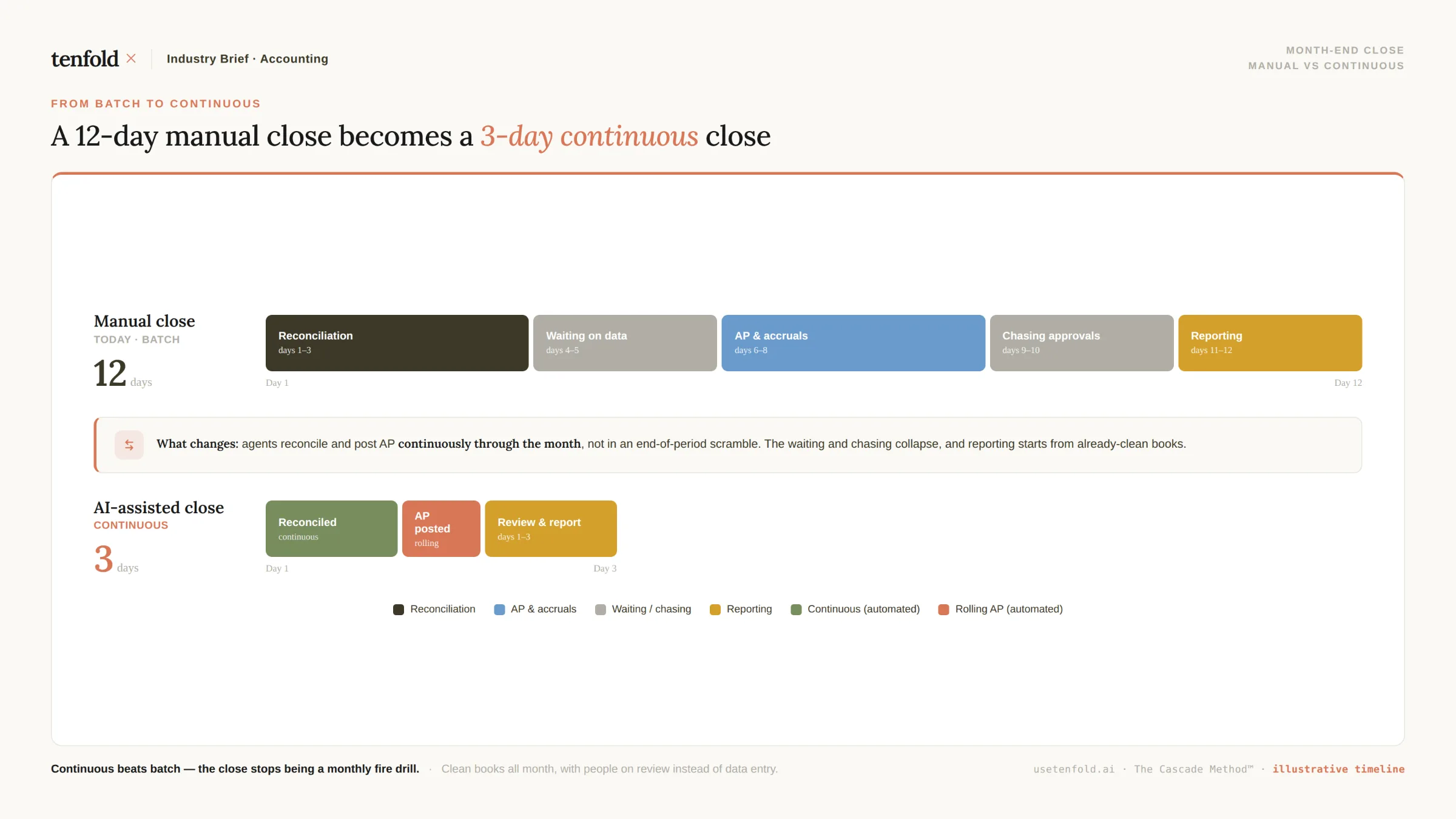
AI cuts the monthly financial close by roughly 7.5 days (Stanford/MIT 2025); manual closes that span 10 to 12 days approach a continuous close.
Automated AP departments process invoices at about $2.98 each versus $13.54 manually — a 78 percent cost reduction — in under 10 seconds per invoice.
Manual reconciliation can reach 45 percent error rates in complex operations; AI reduces routine-transaction error rates to under 0.5 percent.
Firms report 30 percent faster month-end close and 25 percent more advisory revenue after adopting AI; for a $500K-revenue firm, automating bookkeeping and tax prep frees 600 to 800 hours per year.
Why Reconciliation Is the Single Best Place to Start
Across every major benchmark — AICPA, Deloitte, Thomson Reuters, Gartner, McKinsey — bank reconciliation is the highest-ROI workflow automation available to accounting firms in 2026. The reason is simple: it consumes around 22 percent of firm billable capacity while generating zero direct revenue, and it's highly rule-based. Each manual reconciliation takes about 47 minutes when you account for download, sorting, matching, exception investigation, and review.
An AI reconciliation agent doesn't replace deterministic rules — it complements them. Rules resolve the easy cases (exact amount, date, reference); the agent takes the hard ones: partial payments, timing differences, description variations, multiple invoices paid in one transfer. A payment labeled "ACH DEP ACME CORP REF 8829372" gets matched automatically because the system has seen the pattern hundreds of times. Leading platforms report 90 percent auto-match rates and 95 percent automation in journal-entry posting; the remaining 3 to 8 percent of exceptions get flagged for human review. What took 30 hours takes 2 to 3 hours of exception review.
The Close, Reimagined
Month-end close is the most resource-intensive recurring process in accounting, concentrating financial stress into a compressed window. As one industry leader put it, once predictive models, document-extraction models, and agents work together inside the ledger, the procedural "doing" — transaction coding, statement reconciliation, schedule updates, variance analysis — simply begins happening in the background, 24/7. Humans still supervise and review; the manual labor fades. Continuous monitoring also means the books are audit-ready at any point, not just at quarter-end.
The Real Strategic Move: Advisory
Here's what separates firms that merely cut costs from firms that grow. The capacity AI frees up — 15 to 20 hours per accountant per week — gets redirected into cash-flow forecasting, tax strategy, and business planning. Advisory rates run 40 to 60 percent higher than compliance work. One $8M professional services firm dropped operational time from 60 percent to 35 percent after automating invoice processing, reconciliation, and expense management, then took on 40 percent more clients without adding headcount. The accountant's judgment matters more when the mechanical work is automated.
What Stays Human
The thought leaders agree: anything requiring judgment, ambiguity, or social interaction stays firmly in human hands. LLMs aren't built to close the books or run accounting operations reliably without human intervention, and accounting firms are fundamentally relationship businesses. The winning 2026 playbook is "automate the routine, elevate the human" — advisory isn't just about answers, it's about accountability.
Implementation Notes
Start with reconciliation, where ROI is fastest to measure. Choose an architecture with a memory layer that preserves transaction context — not just a matching engine — or you'll hit the 85-to-92-percent accuracy ceiling. Integrate governance from day one: automated audit trails, approval controls, and compliance with SOX, SOC 2, and GAAP. Track the right KPIs — auto-match rate, unresolved exceptions, close-cycle time, and cost per reconciliation.
Summary
For accounting firms, AI automation isn't about replacing accountants — it's about replacing the manual 60 percent of their job so they can do the advisory work clients increasingly demand and pay more for. Reconciliation pays back fastest, the close compresses dramatically, and the reclaimed capacity becomes your growth engine. If you want to scope reconciliation and close automation for your firm, the Tenfold team can help.
Frequently Asked Questions
Q: What accounting task should we automate first? A: Bank reconciliation. It's over 90 percent automatable, consumes about 22 percent of billable capacity with zero direct revenue, and delivers measurable ROI within 90 days — roughly $94,000 in annual labor savings for a typical firm.
Q: How much faster does AI make the month-end close? A: AI cuts close time by 40 to 60 percent — about 7.5 days on average — moving a manual 10-to-12-day close toward a 3-day or continuous close.
Q: Is AI accurate enough to trust with financial data? A: For routine transactions, AI reduces error rates to under 0.5 percent versus up to 45 percent for manual reconciliation in complex operations. Exceptions (3 to 8 percent) still route to humans, and governance with full audit trails is essential.
Q: What's the real business case beyond cost savings? A: Redirecting freed capacity into advisory services that bill 40 to 60 percent higher than compliance work. Firms report 25 percent more advisory revenue and the ability to take on more clients without adding headcount.
