
AI Agents in the Insurance Industry: What They Actually Do and Why Most Carriers Are Still Stuck
AI agents in the insurance industry are not a future-state concept. They are live, in production, and generating measurable results right now — in claims processing, underwriting, fraud detection, compliance monitoring, and customer service. The carriers seeing the biggest returns are not the largest ones. They are the fastest ones.
The harder truth? Most insurers are nowhere near fast.
Quick Answer: AI agents help insurance carriers by autonomously executing multi-step workflows — reading documents, assessing risk, routing claims, flagging fraud, and triggering payments — without waiting for human input at each step. The ROI is proven. The gap is in scaling from pilot to production.
Key Takeaways:
Full AI adoption in insurance jumped from 8% to 34% in a single year (2024–2025), but fewer than 1 in 10 carriers has reached true enterprise-scale deployment.
AI agents reduce standard claims processing costs by 30–40% and cut processing time by up to 70%.
BCG finds that leading insurers using AI-powered knowledge assistants boost operations productivity by more than 30%.
The bottleneck is not AI capability. It is that most carriers are not yet organized to delegate to it.
At Tenfold, we help organizations move from stuck pilots to working production systems — because proof matters more than promises.
What an AI Agent Actually Does in an Insurance Workflow
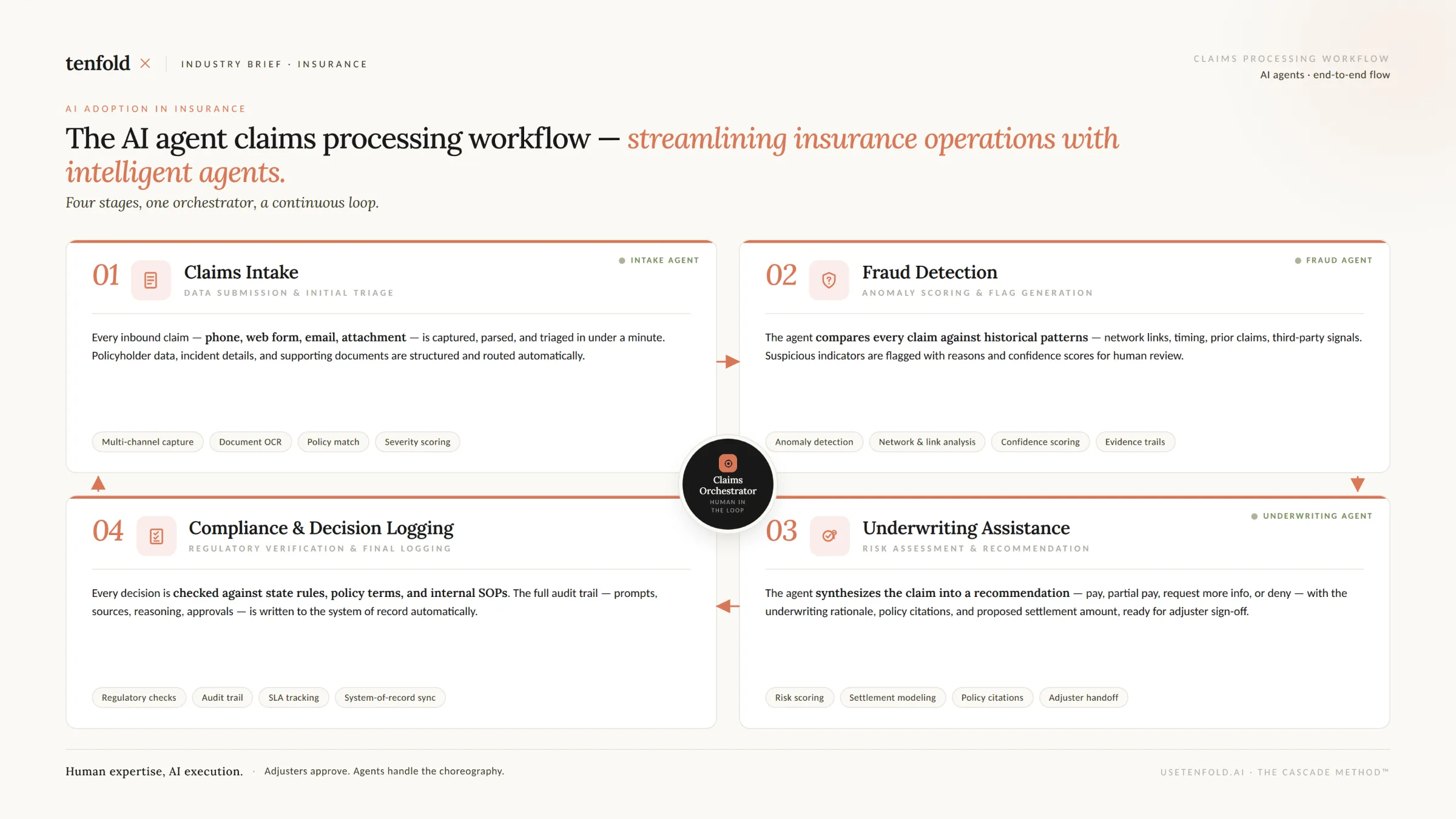
An AI agent is not a chatbot. It does not sit passively and wait for questions. It reads documents, makes decisions, routes tasks, flags anomalies, and triggers actions — across your entire workflow, without a human in the loop for every step.
According to Ment Tech's 2026 Insurance AI Guide, an AI agent "reads documents, makes decisions, routes tasks, flags fraud, and triggers payments" as a purpose-built system that bridges the gap between pilots and real operational performance.
Consider what this looks like in a live claims workflow. A policyholder submits damage photos and unstructured documentation. An AI agent extracts key information, verifies policy coverage, checks against fraud patterns, and assigns the right adjuster — automatically, in seconds. No queue. No manual triage. No lag.
This is not automation in the traditional, rules-engine sense. Agentic AI reasons across unstructured inputs. It handles the edge cases that rigid RPA systems cannot.
The Business Case Is No Longer Theoretical
The numbers are settled. The debate should be over deployment strategy, not whether to deploy.
According to Datagrid's Insurance AI Agent Statistics report, standard claims processing costs have dropped 30–40% — from $40–60 per claim to $25–36 per claim — with manual document handling reduced by 75%. These are not projections. These are production benchmarks.
BCG's 2025 insurance AI analysis found that leading firms equipping service and operations employees with AI-powered knowledge assistants are boosting productivity by more than 30%. The same research identified that the AI for insurance market surpassed $10 billion in 2025 and is on track to reach $35.76 billion by 2029.
On the fraud side, CoinLaw's 2025 AI in Insurance Statistics report shows AI-powered claims automation is reducing processing time by up to 70%, saving insurers an estimated $6.5 billion annually. Predictive analytics has increased fraud detection rates by 28%.
And according to McKinsey's analysis of multiagent systems in insurance, carriers using AI across their value chain see 10–20% improvement in new-agent success rates, 10–15% premium growth, and 20–40% reduction in customer onboarding costs.
The ROI is real. The question is execution.
Where AI Agents Deliver the Most Impact
Not all use cases carry equal weight. Here is where the proven ROI lives — and where carriers should prioritize.
Claims Processing
Claims is the highest-ROI starting point for most carriers. It accounts for 70% of a property insurer's total expenses, according to Deloitte research cited by Databricks. AI agents can compress the entire claims lifecycle — from FNOL submission through settlement — by automating intake, document extraction, coverage verification, fraud flagging, and payment routing.
Claims processing leads AI adoption across the industry at 64%, according to Datagrid's adoption data, and it is easy to see why: the volume is high, the workflows are repetitive, and the cost of delay is directly visible on the combined ratio.
Underwriting
Underwriting is where AI agents create the largest long-term structural advantage. BCG estimates that 36% of total AI value in insurance can be captured in the underwriting function alone.
AI agents pull telematics data, third-party risk signals, loss history, and satellite imagery to build risk profiles. They suggest pricing. Human underwriters review and approve. The manual rekeying — which consumed hours of junior underwriter time daily — is gone.
A real example: Allianz UK deployed an AI tool called BRIAN to help underwriters navigate complex guidance documents. Since its January 2025 rollout, it has saved approximately 135 working days in information gathering, according to Appinventiv's AI underwriting guide.
Fraud Detection
Fraud detection at 65% adoption is the most mature AI use case in insurance, and for good reason. AI agents analyze claim patterns in real time, cross-reference behavioral signals, and flag anomalies faster and more consistently than any manual review process. CoinLaw reports deep learning models have helped some insurers achieve a 35% reduction in fraudulent claims.
Compliance Monitoring
Insurance is one of the most regulated industries on earth. State rules change. Federal mandates shift. AI agents monitor regulatory feeds, flag changes that affect active policies, and alert compliance teams before deadlines pass — without requiring dedicated analyst headcount to watch every feed.
The Real Problem: Most Carriers Are Still Stuck in Pilot Mode
Here is the uncomfortable data point that most vendor presentations skip.
Full AI adoption in the insurance industry jumped from 8% to 34% year-over-year, according to Datagrid. But according to BCG's Build for the Future 2024 Global Study, only 7% of insurance companies have successfully brought AI to scale. About two-thirds of insurers are still in the piloting stage.
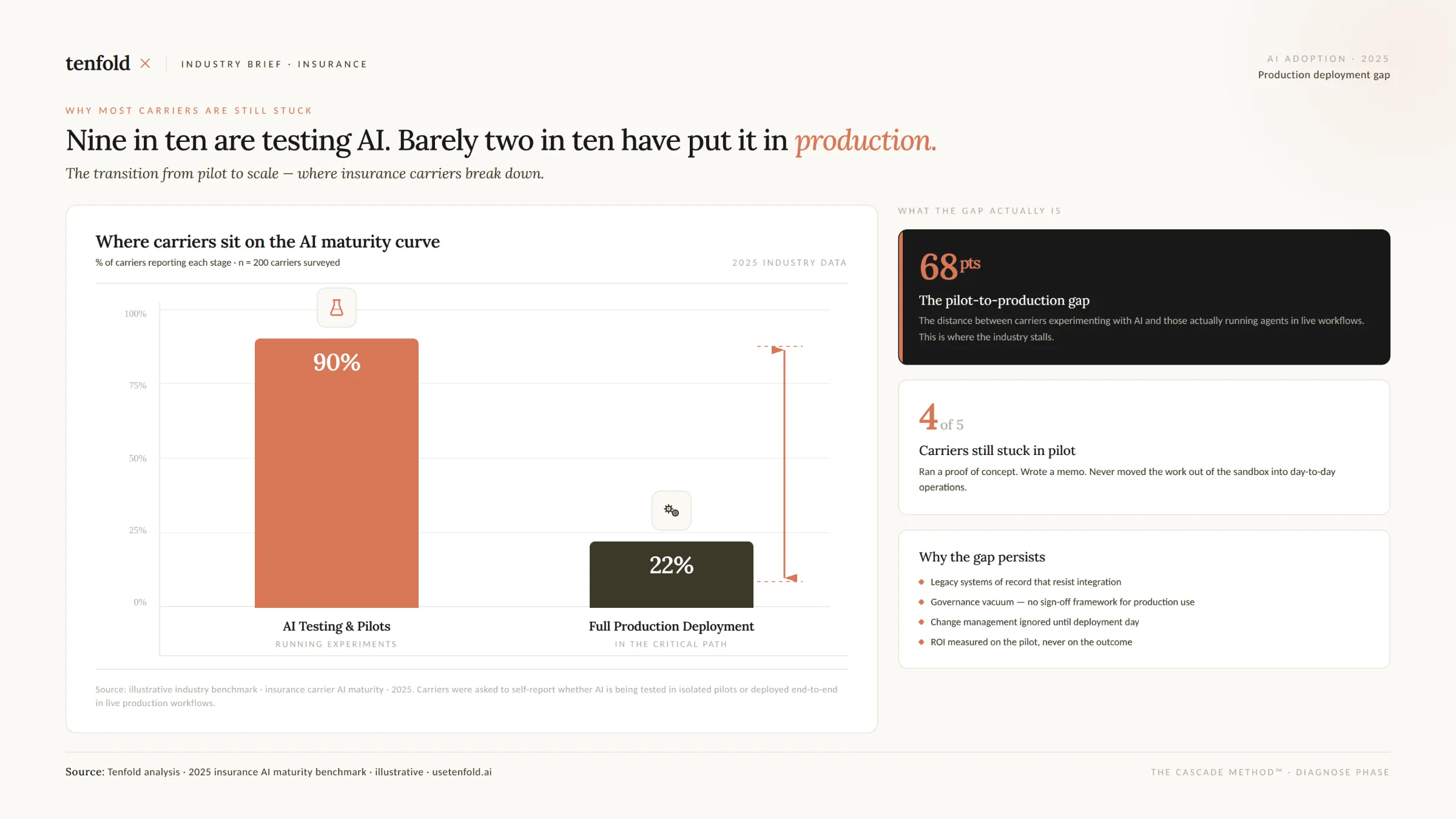
A 2025 Conning survey found that 90% of carriers tested AI in 2025. Only 22% reached full production.
The gap between testing and production is not a technology problem. It is an organizational one. Fragmented data pipelines, legacy core systems, change management resistance, and governance gaps — these are the real blockers. The AI works. The infrastructure and operating model around it often does not.
As SAS insurance specialist Andrew Pollard noted, agentic AI can accelerate repetitive and data-intensive work, but the real value only emerges when insurers combine agents with trusted, domain-specific solutions and human expertise. "The fuel for all of this remains data," he said. "Insurers must ensure their data is not just high-quality, but connected and available in real-time."
This is precisely where most pilot programs stall. The agent is capable. The data feeding it is not ready.
What the Best Carriers Are Doing Differently
The carriers succeeding with AI agents share a few patterns:
They start narrow and prove ROI fast. Mid-size and regional carriers are deploying agents in single workflows — claims intake, fraud triage, submission processing — proving returns in months, then scaling from there. They do not wait for enterprise-wide transformation before taking action.
They treat governance as an enabler, not a blocker. Every AI decision is auditable. Human review thresholds are set explicitly. Regulatory compliance is built into the agent workflow from day one — not retrofitted after the fact.
They invest in data infrastructure first. AI agents are only as good as the data they act on. The carriers getting results have connected their policy admin, CRM, claims systems, and third-party data feeds so agents have full context to make decisions.
They deploy hybrid workforces by design. According to the Economist Impact / SAS 2025 report, the insurance firm of the near future will feature a hybrid workforce in which human agents and AI agents work hand-in-hand on underwriting, product development, claims processing, and more. The winners are not eliminating human judgment — they are redirecting it toward the decisions that matter.
Summary
AI agents in the insurance industry are not experimental. They are operational, and the financial case for deployment is clear: lower claims costs, faster processing, better fraud detection, and more accurate underwriting. The carriers falling behind are not doing so because AI does not work — they are doing so because they have not built the internal operating model to run it at scale.
At Tenfold, we specialize in moving organizations from stuck pilots to working production systems. The proof is in how we operate every day — and in the results our clients see in months, not years. If you are evaluating AI agents for your insurance operation, [contact the Tenfold team](/contact) to start with what is actually deployable in your environment.
Frequently Asked Questions
Q: What is an AI agent in the context of insurance?
A: An AI agent in insurance is an autonomous software system that executes multi-step workflows — reading submissions, assessing risk, routing claims, flagging fraud, and triggering payments — without requiring human input at each step. Unlike chatbots, agents act across systems and take initiative within defined boundaries.
Q: What are the biggest use cases for AI agents in insurance?
A: The highest-ROI use cases are claims processing, underwriting automation, fraud detection, and compliance monitoring. Claims processing leads in adoption at 64%, followed by fraud detection at 65%, with underwriting projected to grow rapidly as data infrastructure matures.
Q: How much can AI agents reduce claims processing costs?
A: According to industry benchmarks, AI agents reduce standard claims processing costs by 30–40% — from $40–60 per claim to $25–36 per claim — while cutting manual document handling by 75%. Processing time reductions of up to 70% have been reported across carriers in production deployment.
Q: Why are most insurance AI pilots failing to scale?
A: Most pilots stall due to fragmented data pipelines, legacy system integration challenges, and insufficient governance frameworks — not because the AI itself underperforms. Only 7% of insurers have reached true enterprise-scale AI deployment, despite 90% testing the technology in 2025.
Q: How does Tenfold help insurance companies implement AI agents?
A: Tenfold designs and deploys AI agent systems built around your existing workflows and data infrastructure. We prioritize use cases with proven ROI, build governance into the architecture from day one, and focus on getting you to production — not just another pilot.
