

AI Agents for Real Estate: What They Do and Why the Industry Can't Ignore Them
Most real estate firms are using AI. Almost none are using it correctly.
The difference is not the tool. It's the model. Generative AI gives you faster outputs. AI agents give you autonomous workflows. Those are not the same thing — and confusing them is why most real estate organizations are running expensive pilots with thin returns.
At Tenfold, we build and deploy AI agent systems for enterprises. The pattern we see in real estate mirrors what McKinsey identified in their March 2026 analysis: AI adoption is widespread, but scaled bottom-line impact is hard to find. The reason is structural. Most AI tools sit *adjacent* to workflows instead of being embedded within them.
That's the problem AI agents solve.
Key Takeaways:
AI agents in real estate execute multi-step workflows autonomously — not just generate content or answer prompts.
According to Morgan Stanley, AI can automate 37% of tasks in real estate, representing $34 billion in operating efficiencies by 2030.
The highest-value use cases are in lead management, property operations, and transaction processing — not marketing copy.
Firms that embed agents into core systems will compound efficiency gains over time. Firms running disconnected pilots will not.
The bottleneck isn't AI capability. It's that most real estate orgs aren't yet structured to delegate to it.
Quick Answer: AI agents in real estate are autonomous software systems that independently analyze data, make decisions, and execute multi-step operational workflows — from qualifying leads and updating CRM records to flagging maintenance issues and dispatching vendors — with minimal human input. They go beyond generative AI by taking action, not just producing outputs.
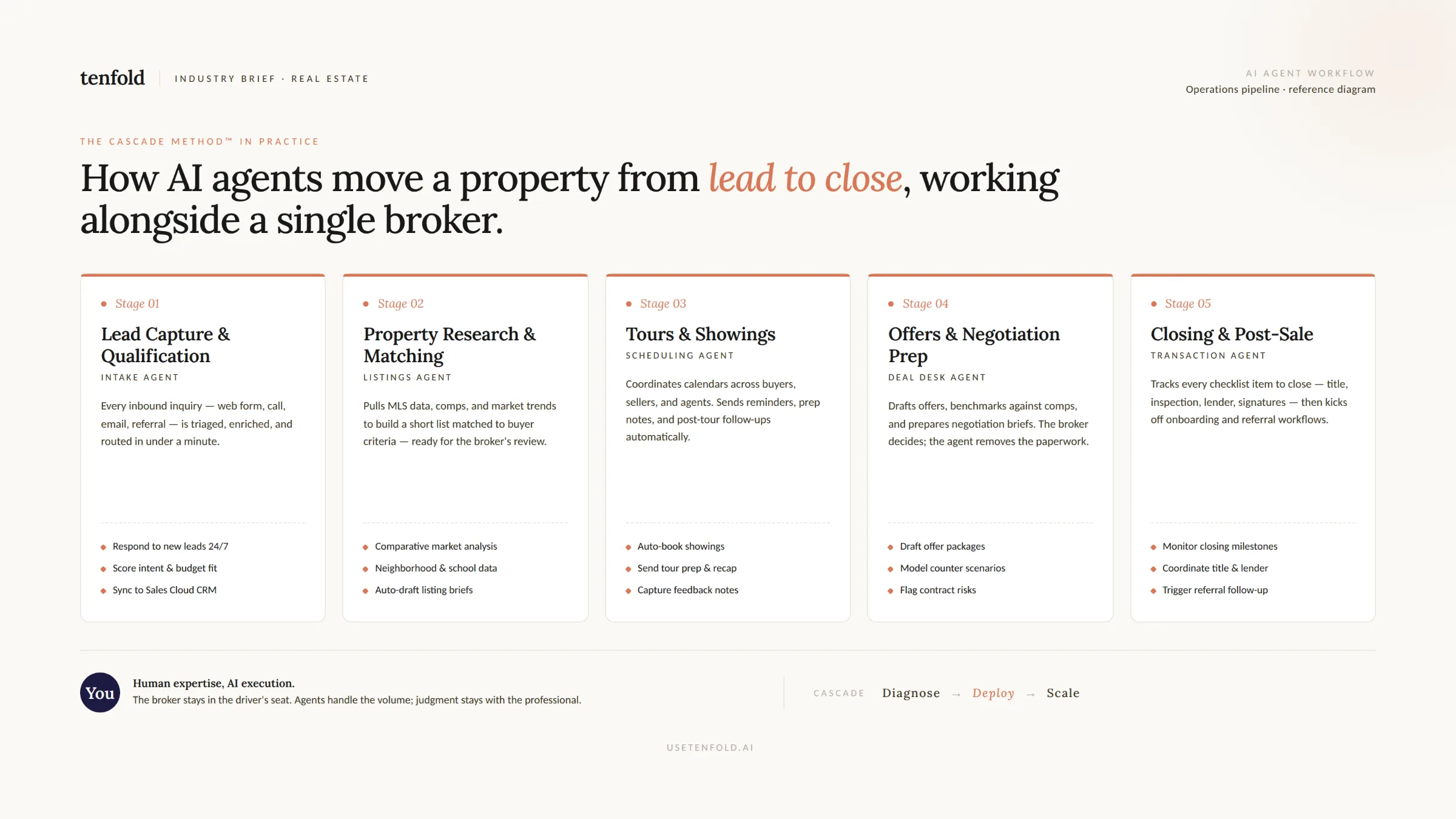
What Separates an AI Agent from an AI Tool
An AI tool responds when you prompt it. An AI agent acts toward a goal.
According to PwC's 2025 Emerging Trends in Real Estate report, generative AI produces outputs in response to prompts, while agentic AI "picks up where GenAI leaves off — it can plan and act with minimal prompting, running continuous processes with limited supervision."
For a real estate brokerage, that distinction is everything. Generative AI writes a listing description when asked. An AI agent monitors your inbound leads, qualifies them against buyer profiles, updates your CRM, schedules follow-up sequences, and flags high-intent prospects for agent review — all without a prompt.
According to HousingWire, agentic AI "enables new business models such as concierge services at scale, dynamic pricing, and continuously optimized marketing" — potential that goes well beyond routine automation.
The shift is not incremental. It changes the operating model.
The $34 Billion Case for Agentic AI in Real Estate
The ROI case for AI agents in real estate is no longer theoretical.
According to Morgan Stanley Research, which analyzed 162 REIT and CRE firms with a combined $92 billion in labor costs, AI can automate 37% of real estate tasks — representing $34 billion in operating efficiencies by 2030. The areas with the highest automation potential include management, sales and related activities, office and administrative support, and maintenance.
Brokers and services firms show the highest upside. Morgan Stanley estimates a possible 34% increase in operating cash flow for brokerage and services firms that move to AI at scale — driven by labor cost savings and productivity-led revenue gains.
This is not a forecast about some distant future. Real estate firms are already seeing results:
According to HousingWire, agents using AI-integrated CRM platforms brought in 32% more revenue, while tasks formerly taking 10 hours were cut to two minutes.
According to Morgan Stanley, one self-storage company reduced on-property labor hours by 30% through AI-powered staffing optimization, while 85% of its customer interactions shifted to self-selected digital options.
The gains are real. The question is whether your organization is structured to capture them.
Where AI Agents Are Delivering Results Right Now
Not every workflow is equally ready for agents. The highest-value deployments we see fall into four categories.
Lead Qualification and CRM Automation
AI agents interact with website visitors, capture lead data, respond to inquiries immediately, and evaluate buyer intent through conversational follow-up. They update CRM tags, score leads, and prioritize those most likely to convert — without agent involvement for any individual interaction.
According to HousingWire, AI agents "qualify leads by updating CRM tags and prioritizing those most likely to convert, ensuring every promising client receives attention while automating the nurturing of long-term prospects."
For brokerages running high lead volumes, this is where agent deployment pays off fastest.
Property Management and Predictive Maintenance
McKinsey's March 2026 analysis illustrates this precisely. An AI agent detects a sensor alert at 6:12 a.m., identifies the source apartment, alerts maintenance, grants smart lock access, connects with vendors, and drafts a resident notice with an arrival window — all before the property manager arrives. What used to require a dozen phone calls now runs automatically.
This is not a pilot scenario. It's production-ready today.
Transaction and Document Processing
AI-driven tools analyze contracts, extract critical information, and identify obligations, risks, and clauses — reducing human error and accelerating deal cycles. Workflow automation handles deadline tracking and reminders, ensuring nothing falls through on complex transactions.
Market Analysis and Valuation
AI-powered valuation models now achieve median error rates as low as 2.8%, compared with 10–15% just five years ago, according to homebuyinginstitute.com. Predictive analytics layers on top — forecasting inventory trends, pricing shifts, and buyer behavior to give agents and investors a material informational edge.
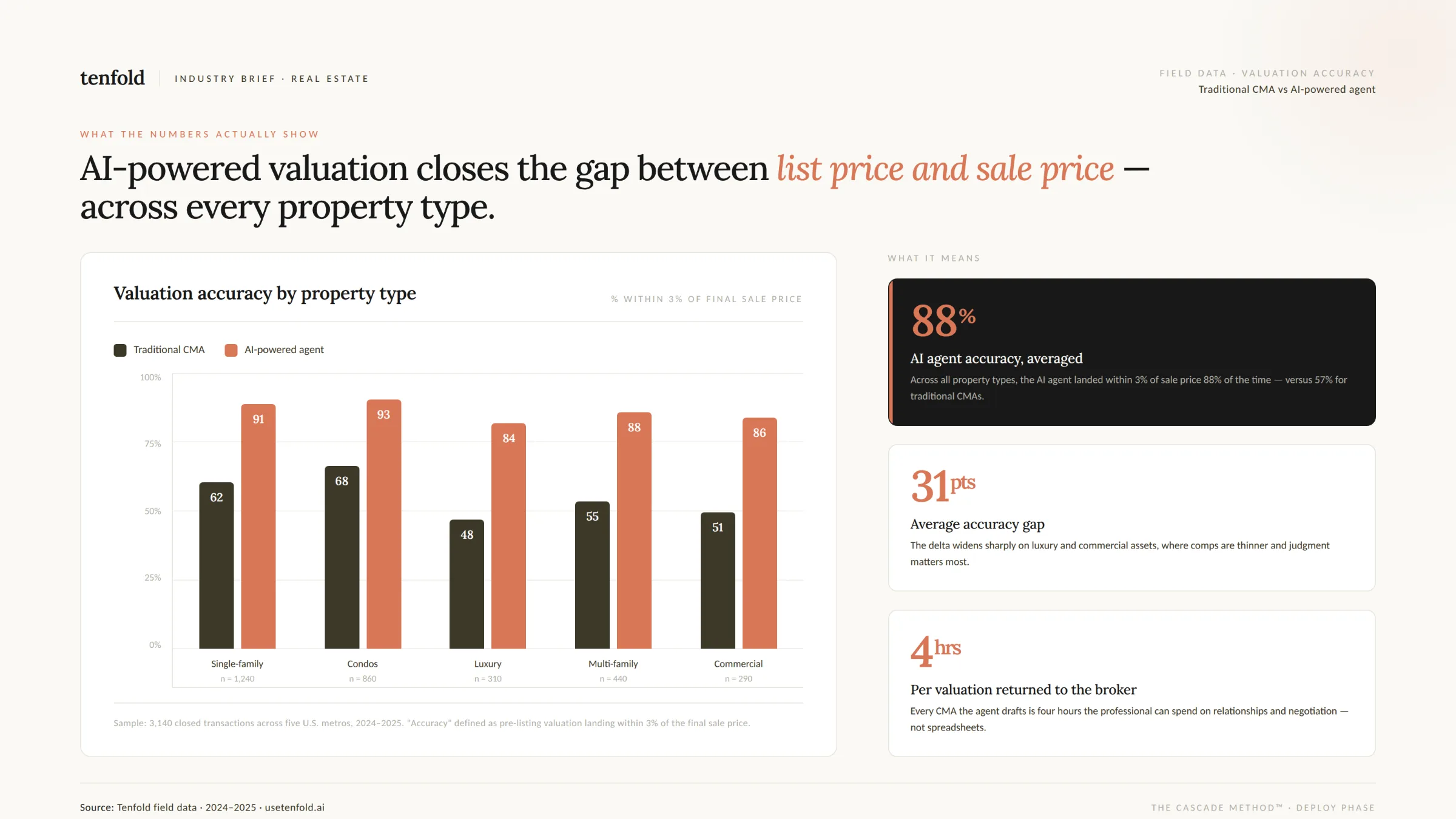
The Adoption Gap Is Widening — and That's a Strategic Problem
According to a 2025 survey cited by homebuyinginstitute.com, 87% of brokerage leaders report that agents in their firms use AI tools, and 97% of real estate professionals show active interest in AI applications. The question changed from "Should we use AI?" to "How quickly can we implement it?"
And yet, according to McKinsey, measurable bottom-line impact from AI in real estate has been slow to materialize. Most leaders have launched sensible experiments — summarize a lease, draft a memo, clean a report. These efforts make people more effective. They rarely transform how work gets done inside core systems.
The firms closing the gap are not running more experiments. They're making architectural decisions: embedding agents into lease management, lead routing, maintenance workflows, and reporting pipelines — not bolting tools onto existing processes.
According to McKinsey, "organizations that move early can use agents to reduce handoffs, improve service, and accelerate decision cycles while building the governance and operating model that makes those gains durable."
By the end of 2026, the majority of top-producing agents are expected to operate entirely within AI-integrated environments, per HousingWire. The window for early-mover advantage is open — but not indefinitely.
Why Most AI Real Estate Deployments Underperform
The failure mode is consistent. Organizations buy AI tools. They don't build AI systems.
There's a difference. Tools answer questions. Systems execute workflows. When AI sits outside your CRM, your property management platform, and your transaction pipeline, it cannot act. It can only assist.
At Tenfold, we've seen this play out repeatedly. The organizations getting outsized returns from AI agents share three traits:
1. They delegate real decisions. Not just drafting. Routing, prioritizing, flagging, closing loops.
2. They integrate at the system level. Agents have access to CRM data, lease records, vendor databases, and communication channels.
3. They build for compounding. As McKinsey notes, when workflows run through an agentic layer, every action leaves a trace — and that data trains better decisions over time.
The bottleneck isn't what AI can do. It's organizational readiness to let AI act.
Summary
AI agents in real estate represent a structural shift — not an upgrade to existing tools. The $34 billion efficiency opportunity identified by Morgan Stanley is real, and it accrues to firms that embed agents into core operational workflows, not those running disconnected pilots. Tenfold specializes in designing and deploying these agent systems for enterprise real estate organizations — with the speed and consistency that comes from doing this at scale.
If your organization is evaluating AI agent deployment and wants a clear picture of where to start, [contact Tenfold for an assessment].
Frequently Asked Questions
Q: What are AI agents in real estate?
A: AI agents in real estate are autonomous systems that execute multi-step workflows — such as qualifying leads, updating CRM records, managing maintenance requests, and processing documents — with minimal human input. Unlike generative AI tools that respond to prompts, agents act toward defined goals continuously.
Q: How is agentic AI different from regular AI tools in real estate?
A: Generative AI tools respond when prompted and produce outputs like listing descriptions or market summaries. Agentic AI plans, acts, and executes across multiple steps and systems — handling lead routing, scheduling, vendor coordination, and reporting without requiring a human to initiate each task.
Q: What's the ROI of AI agents in real estate?
A: Morgan Stanley estimates AI can automate 37% of real estate tasks, representing $34 billion in efficiency gains by 2030. At the firm level, early adopters report results including 32% revenue increases for AI-integrated agents, 30% reductions in on-property labor hours, and tasks that previously took 10 hours being completed in two minutes.
Q: What real estate workflows are best suited for AI agent deployment?
A: The highest-value starting points are lead qualification and CRM automation, predictive property maintenance, transaction and document processing, and market analysis. These share consistent, data-rich workflows that agents can execute reliably.
Q: Is real estate ready for AI agents, or is this still experimental?
A: It's production-ready for the right workflows. PwC's 2025 Emerging Trends report notes that larger real estate firms have already moved toward using AI for higher-value internal tasks and property operations. The technology is mature — the gap is in deployment architecture and organizational readiness.
