AI Agents are reshaping Private Equity and Venture Capital: here's what that actually means.
The private equity and venture capital industries run on information advantage. Whoever finds the right deal first, completes diligence fastest, and monitors portfolio companies most accurately — wins. AI agents are now the engine behind all three. This isn't theoretical. According to v7labs, 82% of PE/VC firms were actively using AI in Q4 2024, up from 47% the year prior. The shift from experimentation to operational dependency happened faster than most firms expected.
Key Takeaways:
AI adoption in PE/VC jumped from 47% to 82% in a single year — it is now a competitive baseline, not a differentiator.
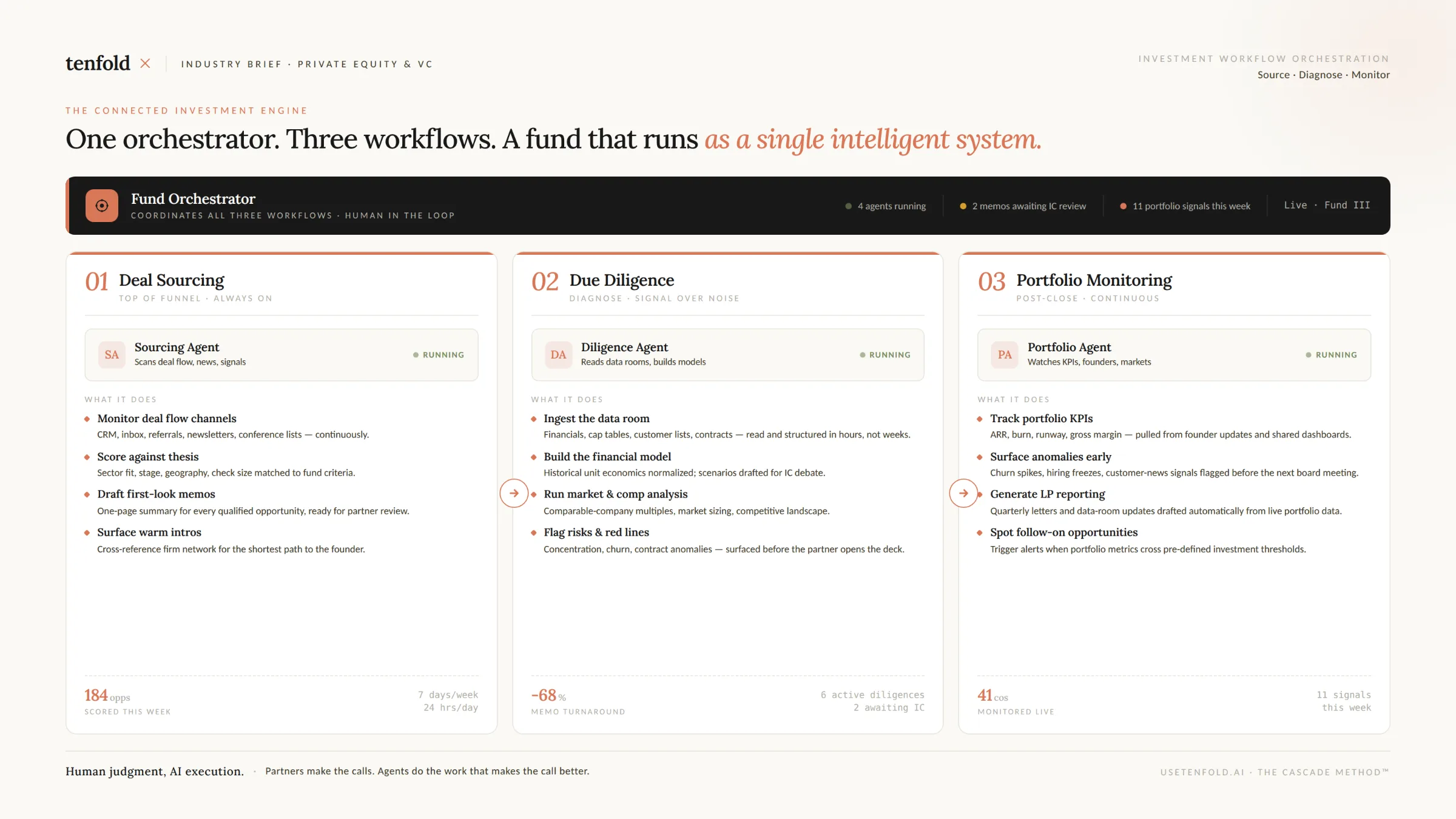
AI agents are being deployed across the full deal lifecycle: sourcing, diligence, portfolio monitoring, and LP reporting.
Agentic AI spending is projected to reach $155 billion by 2030, signaling sustained institutional commitment.
Firms that treat AI as plug-and-play will underperform those that build it into their operating model.
The bottleneck is no longer AI capability. It is firms not yet structured to delegate to it.
Quick Answer: AI agents in private equity and venture capital are autonomous software systems that execute multi-step investment workflows — scanning deal flow, extracting diligence data, monitoring portfolio KPIs, and generating LP reporting — without requiring manual intervention at each step. They compress timelines, reduce analyst grunt work, and surface insights that manual processes miss.
The Numbers Behind the Shift
The capital flowing into agentic AI tells you where the industry is headed. According to Morgan Lewis, projections suggest that spending on agentic AI could reach $155 billion by 2030. Meanwhile, Konzortia Capital reports that through Q3 2025, AI and machine learning startups raised over $192 billion, with AI deals capturing approximately 64% of all global venture capital in Q3 alone — a record high.
The OECD's 2025 Venture Capital in AI report found that AI firms working on IT infrastructure attracted $109.3 billion in VC investment in 2025 — nearly as much as all other AI industries combined. And according to J.P. Morgan Private Bank, agentic AI alone represents a $6 trillion segment of the broader $15 trillion AI opportunity.
This isn't just capital chasing hype. It is capital building infrastructure. And PE and VC firms are both investors in — and users of — that infrastructure.
How AI Agents Are Being Deployed Across the Deal Lifecycle
AI in PE/VC is not a single tool. It is a layer of autonomous agents operating across each phase of the investment lifecycle.
Deal Sourcing: From Rolodex to Real-Time Signal Detection
Traditional sourcing relies on networks, conferences, and manual screening. The problem: according to Konzortia Capital, private equity firms typically see just 16.5% of relevant deals in their target markets using traditional methods. AI agents change this equation.
AI-powered sourcing platforms scan job postings, patent filings, domain registrations, hiring trends, and news signals to surface companies that match a firm's investment thesis — before they hit a competitor's radar. According to Copiaw Wealth Studios, firms using AI-powered platforms report a 36% increase in direct sourcing deals, with deal teams performing market and company analysis 20 times faster than manual approaches.
According to Affinity, AI automates deal sourcing by scanning thousands of data points — from funding announcements to patent filings — to surface companies that match a firm's investment thesis, while relationship intelligence platforms identify warm introductions and proprietary deal flow that competitors miss.
Due Diligence: From Weeks to Days
Due diligence is the most labor-intensive phase of the investment cycle. Before AI, analysts spent 90% of their time on data extraction and only 10% on strategic judgment. AI agents flip this ratio.
According to Copiaw Wealth Studios, AI flips this ratio entirely — 10% on data processing and 90% on strategic analysis. According to Brownloop, AI platforms using OCR and NLP can scan thousands of documents in minutes, extracting key financial metrics, contract terms, and risk signals. Some private equity firms report up to 70% reduction in manual diligence hours via AI-assisted document parsing, anomaly detection, and benchmarking, per Konzortia Capital.
For middle-market PE firms — which Brightwave notes typically operate with lean deal teams and limited internal research support — AI agents function as a force multiplier. A small team can now cover deal volume that previously required significantly more headcount.
Portfolio Monitoring: Real-Time Instead of Quarterly
Post-close is where AI agents deliver some of their most durable value. Rather than waiting for quarterly portco reports — which BDO notes often arrive in disparate formats requiring manual reconciliation — AI agents continuously monitor KPIs, flag deviations from value creation plans, and surface early warnings of distress.
According to Konzortia Capital, post-investment AI portfolio management tools monitor trend shifts, competitor moves, regulatory signals, and operating metrics in real time — enabling firms to make adjustments ahead of valuation inflection points.
According to Pictet's 2025 survey cited by Dynamiq, over 60% of respondents attribute revenue increases at their portfolio companies to AI, primarily through headcount reduction and productivity gains.
LP Reporting and Compliance: Automating the Administrative Layer
LP reporting is one of the most time-consuming administrative burdens in PE operations. AI agents can auto-populate DDQs and recurring templates based on past materials, standardize reporting formats across portcos, and monitor regulatory requirements in real time.
According to Glean, prebuilt agents can auto-populate DDQs and recurring reporting templates based on past materials — cutting hours of manual preparation per reporting cycle. According to BDO, AI can automatically monitor a roster of relevant regulations against a fund's operations and generate custom compliance recommendations accordingly.
The Real Barrier to AI Adoption in PE/VC
Here is where most firms get stuck: they treat AI as a product decision instead of an operating model decision.
According to Konzortia Capital, only 2% of private equity firms expect to realize significant AI value in 2025, though 93% anticipate moderate to substantial benefits over 3–5 years. The gap between expectation and execution is not a technology problem. It is a deployment and change management problem.
AI models are only as good as the data they are trained on. Firms that have not standardized their data infrastructure — across CRMs, portco reporting, and deal tracking systems — will get inconsistent outputs. The firms pulling ahead are those building AI into their workflows, not bolting it on top.
At Tenfold, we have seen this pattern directly. The PE and VC teams that extract the most value from AI agents are not the ones with the most sophisticated models. They are the ones that have done the harder work of aligning their data, processes, and team workflows to support autonomous execution. The proof that this model works? It is how we operate every day.
What Separates Early Adopters from the Pack
According to FTI Consulting's AI Radar for Private Equity, PE firms need to examine three key dimensions of AI value creation: how you sell, what you sell, and how you create products and services. This applies internally as much as it does at the portco level.
The firms moving fastest share a few traits:
They have centralized AI orchestration at the fund level, not siloed it by team.
They are building AI transformation into both buy-side diligence and sell-side narratives.
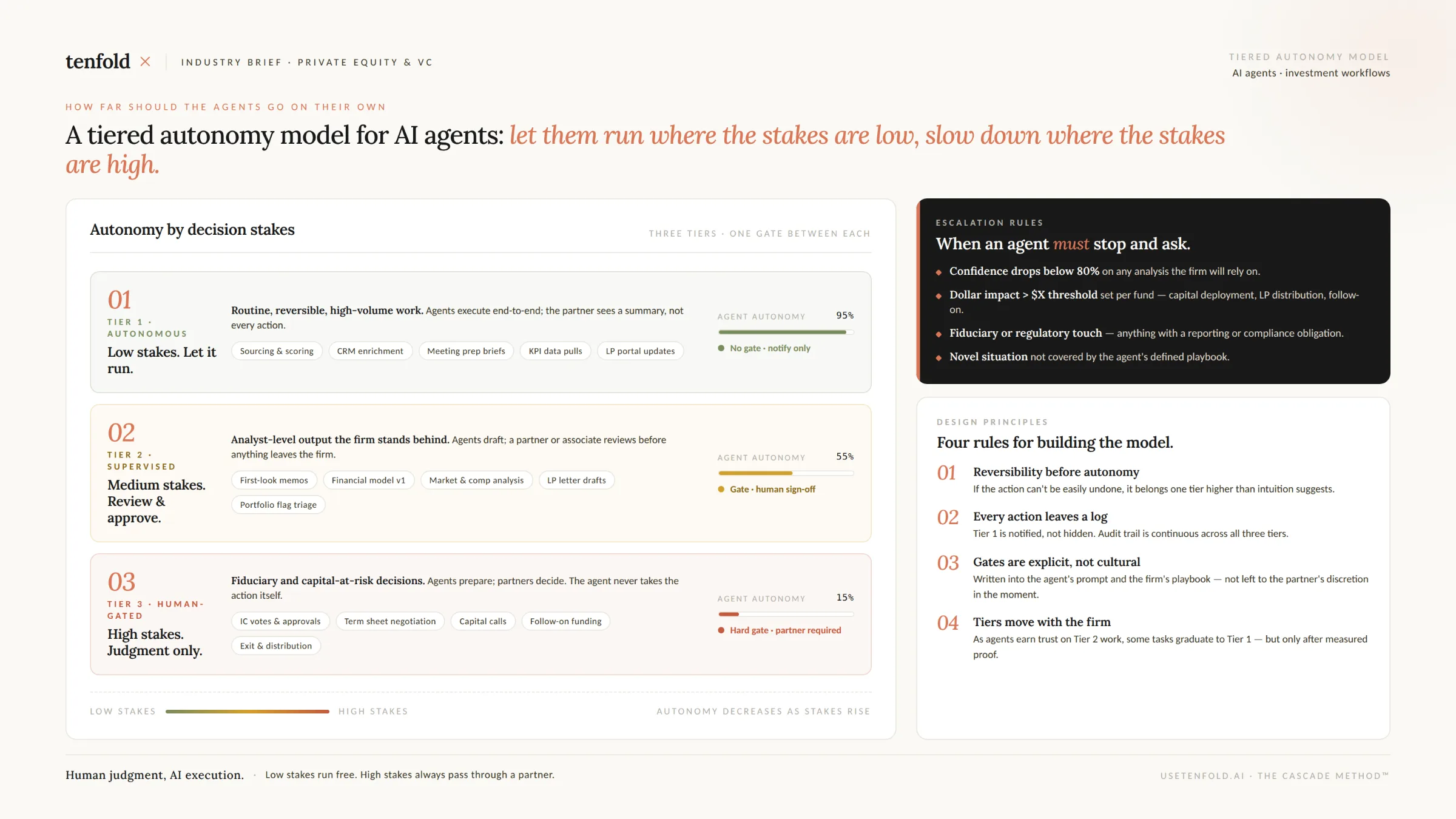
They are measuring AI against hard outcomes — IRR delta, diligence hours saved, deal pipeline quality — not activity metrics.
According to Konzortia Capital, early adopters who treat AI as a strategic advantage — not a plug-and-play cost center — will accumulate know-how and defensibility that becomes harder to replicate over time.
The window for first-mover advantage in agentic AI is real. But it is not unlimited.
Summary
AI agents have moved from experimental tooling to operational infrastructure in private equity and venture capital. The firms winning today are deploying agents across the full deal lifecycle — sourcing more deals, running diligence faster, monitoring portfolios in real time, and automating LP reporting. The bottleneck is not the technology. It is the operating model. Tenfold builds and deploys AI agent systems for investment firms and enterprise operators who are ready to restructure around agentic execution — not just add another tool to the stack.
Frequently Asked Questions
Q: What are AI agents in private equity?
A: AI agents in private equity are autonomous software systems that execute multi-step investment workflows — scanning deal flow, processing diligence documents, monitoring portfolio KPIs, and generating reports — without requiring manual input at each step. They differ from standard AI tools in that they act, not just respond.
Q: How are VC firms using AI agents for deal sourcing?
A: VC firms use AI agents to continuously scan signals like hiring data, patent filings, domain registrations, and funding announcements to surface early-stage opportunities aligned with their investment thesis. The best platforms also map relationship networks to identify warm introduction paths that competitors miss.
Q: Can AI replace human judgment in private equity due diligence?
A: No — and that is not the goal. AI agents automate the data extraction, document parsing, and anomaly detection that currently consume 90% of analyst time. Human judgment remains essential for evaluating strategic fit, relationship dynamics, and thesis alignment. AI frees up that judgment to be used more, not replaced.
Q: What is agentic AI and why does it matter for investment firms?
A: Agentic AI refers to AI systems that take actions autonomously across multi-step workflows — not just answering questions, but executing tasks. For investment firms, this means an agent that can scan a data room, extract key metrics, flag risks, draft a memo section, and update a CRM record without human instruction at each step. It is the difference between AI as a search tool and AI as a team member.
Q: How should a PE or VC firm get started with AI agents?
A: Start with your highest-volume, most structured workflow — typically due diligence document processing or portco KPI reporting. Standardize your data inputs first. Then deploy a purpose-built agent with clear success metrics tied to real outcomes: hours saved, deals evaluated, report turnaround time. Avoid generic deployments on messy data — the output will reflect the input.