

AI Agents for Law Firms: Why the era of pilot is over.
AI agents in law firms are delivering measurable outcomes right now: faster contract review, automated research workflows, reduced administrative overhead, and sharper client service. The firms that deploy them today are not experimenting — they are locking in a durable operational edge over competitors who are still waiting for clearer guidance.
At Tenfold, we work with organisations deploying AI agents across complex professional services environments. The legal industry is one of the most compelling — and one of the most underserved — sectors for agentic AI.
Key Takeaways:
AI adoption among legal professionals jumped from 23% in 2023 to 78% in 2025, but deep operational integration is still rare — creating an asymmetric opportunity.
Legal AI agents execute multi-step workflows autonomously: research, drafting, contract analysis, eDiscovery, and compliance monitoring.
Lawyers using AI tools save between one and five hours every week — with some saving more than eleven hours.
The legal AI software market is projected to reach $10.82 billion by 2030, growing at a 17.3% CAGR.
Firms that wait for perfect regulatory clarity risk falling behind clients who are already demanding AI-enabled speed and value.
Quick Answer: AI agents in law firms are autonomous software systems that plan, reason, and execute legal workflows end-to-end — without constant human prompting. They reduce time spent on research, document review, drafting, and compliance tasks while freeing lawyers to focus on high-judgement, client-facing work.
The Legal Industry Is at a Tipping Point — Not a Waiting Point
The window for cautious observation has closed. According to a global survey by Thomson Reuters, the share of legal organisations actively integrating generative AI rose from 14% in 2024 to 26% in 2025, with 45% of law firms either already using it or planning to make it central to their workflow within one year.
That momentum is being driven by client pressure, not internal enthusiasm. According to Harvard Law School's Centre on the Legal Profession, clients are not necessarily expecting reduced costs — they want quicker responses and higher-quality service. The billable hour is under structural pressure regardless of whether firms embrace AI or resist it.
The firms reading this correctly are not asking "should we adopt AI?" They are asking "how quickly can we implement it without introducing unacceptable risk?"
That is exactly the question Tenfold is built to answer.
What AI Agents Actually Do Inside a Law Firm
AI agents are not glorified search tools. By 2025, they are autonomous, multi-step, and cross-application — a fundamental shift from the single-task bots of 2023.
Here is what operational deployment looks like across the five highest-impact legal use cases:
1. Contract Review and Redlining
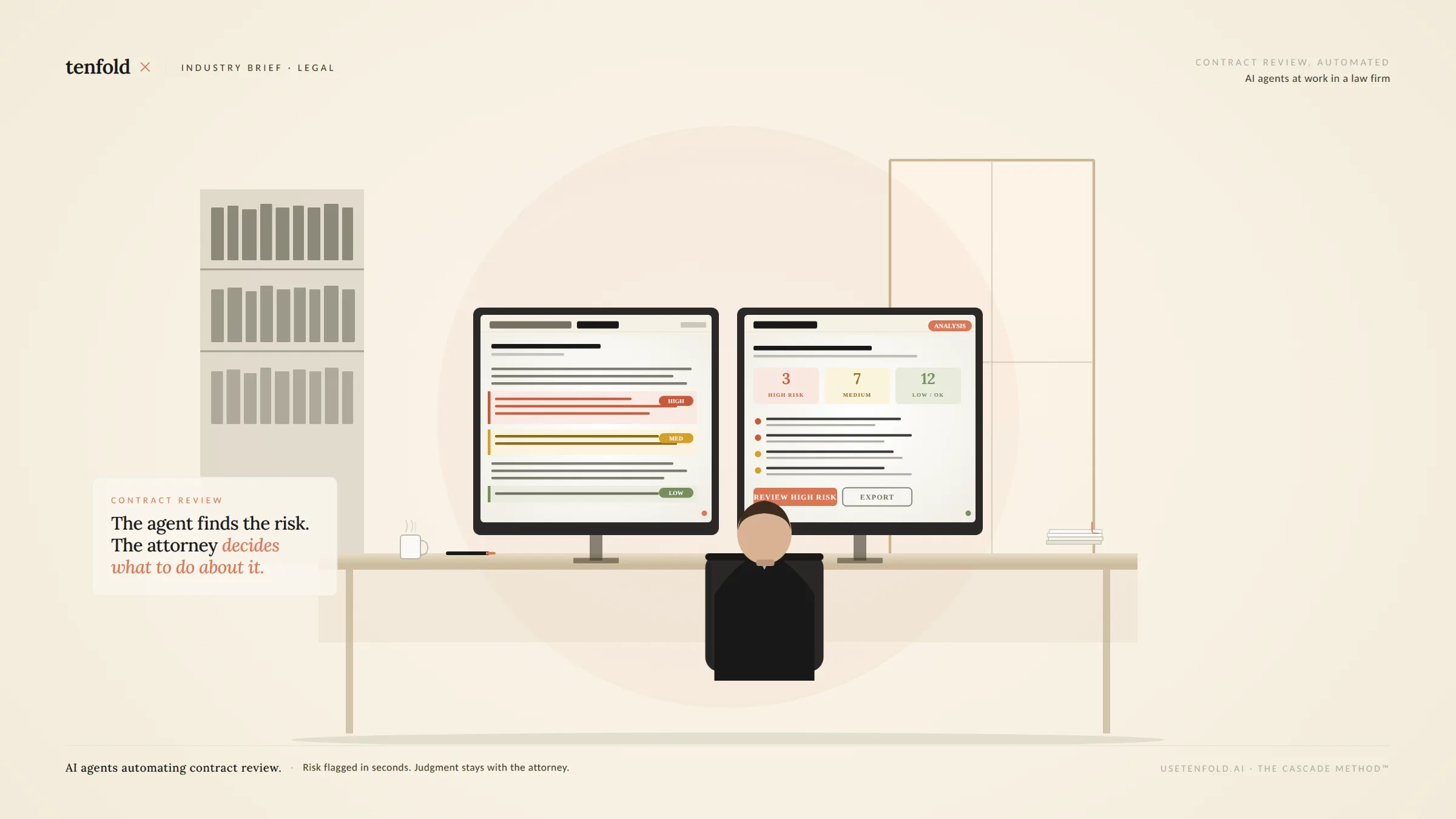
AI agents scan contracts in minutes, flagging regulatory risks, identifying hidden liabilities, and suggesting redlines based on jurisdiction-specific rules — simultaneously. According to AllAboutAI's AI in Law Statistics report, AI tools deliver 94% accuracy in contract review, enabling professionals to shift focus from repetitive markup to high-value negotiation.
2. Legal Research
According to Harvard Law School, in high-volume litigation matters, a complaint response system built with AI reduced associate time from 16 hours down to 3–4 minutes. Research that once consumed junior associate billing hours now resolves in near real-time.
3. eDiscovery and Document Analysis
Agentic workflows integrate multiple specialised agents to address complex, multi-faceted discovery challenges. Each agent contributes domain-specific expertise — reviewing, categorising, and flagging documents across large repositories without manual triage.
4. Drafting and Correspondence
The 2025 Legal Industry Report reveals that 54% of legal professionals already use AI to draft correspondence. Agents handle first-draft generation, template population, and clause insertion — while the lawyer reviews, refines, and signs off.
5. Compliance Monitoring
AI agents proactively identify risk clauses — force majeure terms, regulatory exposure, jurisdiction-specific requirements — across entire contract portfolios, without waiting for a human to run a manual audit.
The Measurable Benefits: What the Data Shows
The business case for legal AI agents is no longer theoretical. It is in the numbers.
Time savings are real and compounding. According to the 2025 Legal Industry Report (MyCase/AffiniPay), 65% of individuals who have used AI in the legal industry save between one and five hours weekly, 12% save between six and ten hours, and 7% save eleven or more hours. Compound that across a firm's entire practice and the capacity gain is substantial.
Productivity impact is unanimously agreed upon. In interviews with AmLaw100 firm leaders conducted by Harvard Law School, interview subjects unanimously agreed that lawyer productivity will increase dramatically with AI — moving the question from "if" to "when" and "how fast."
Efficiency is the primary driver. According to the 2025 MyCase Legal Industry data, 82% of legal professionals using AI report increased overall efficiency, allowing them to dedicate more time to complex tasks, strategic planning, and client nurturing.
Market investment confirms the trajectory. $4.98 billion in venture capital flowed into legal tech in 2024 — a 47% surge from 2023's $3.37 billion. Investors are not funding a trend. They are funding a structural shift.
According to Gartner, agentic AI has been named the top tech trend for 2025, describing autonomous agents that move beyond query-and-response chatbots to execute enterprise tasks without human guidance.
The bottleneck is not AI capability. It is that most law firms are not yet structured to delegate to it.
Why Law Firms Are Still Slow — And Why That Creates an Opportunity
Despite the data, adoption is uneven. The 2025 Legal Industry Report found that more than half of legal professionals (53%) say their firm has no AI policy or are unaware of one. Firm-wide adoption sits at 21% — slightly below 2023 levels.
The reasons are predictable: ethical concerns, regulatory uncertainty, integration complexity, and the structural tension between AI-driven productivity and the billable hour model. As Bloomberg Law analysis noted, firms appear to be opting for a more cautious approach, delaying broader implementation until clearer regulatory frameworks emerge.
That caution is understandable. It is also a competitive liability.
According to the Harvard Law School Centre on the Legal Profession, AI is no longer a future capability — it is the enabler of a fundamental shift in how legal and professional services firms create value, manage risk, and earn client trust.
Clients are not asking whether their firms use AI. They are expecting to see the benefits passed directly to them — more speed, more insight, more value per dollar of budget.
Firms that act now do not just gain efficiency. They gain the client relationships that will define the next decade.
How Tenfold Approaches Legal AI Agent Deployment
Tenfold deploys AI agents as operational infrastructure — not experimentation. Our approach is built on the same model our sister company Inforge uses to deliver full Salesforce implementations entirely through AI agents: faster timelines, more consistent quality, and a fraction of the cost of traditional delivery.
For legal firms, this means:
Identifying the highest-leverage workflows — where agent automation produces the fastest, most defensible return.
Deploying with appropriate oversight architecture — human review gates for high-risk outputs, full automation for repeatable low-risk tasks.
Integrating into existing systems — document management, CRM, billing platforms — without forcing the firm to abandon its existing tech stack.
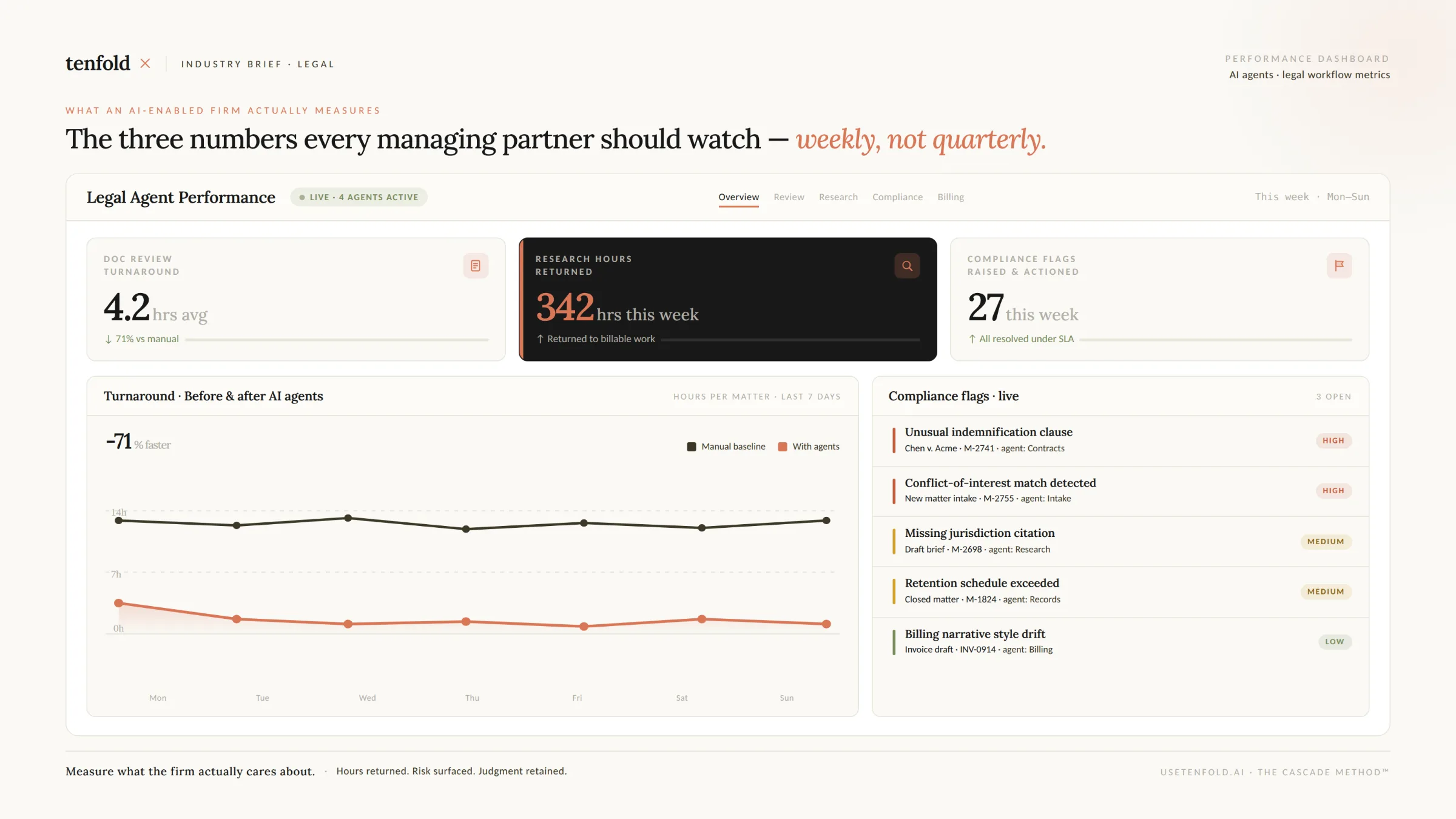
Measuring output, not just activity — turnaround time, accuracy rates, billable hour recovery, and client satisfaction.
According to NetDocuments' 2025 Legal Tech Trends report, nearly half of Am Law 100 firms already rely on external partners for AI implementation, citing cost efficiency and access to ongoing innovation as primary drivers. That is not outsourcing capability — it is accelerating it.
Summary
AI agents in law firms are past proof of concept. The data is clear: time savings are measurable, productivity gains are unanimous among firm leaders who have deployed AI, and client expectations are shifting faster than most firms are moving. The opportunity is real — and it belongs to the firms that structure themselves to delegate to AI now, not after the next regulatory guidance cycle. Tenfold exists to make that implementation fast, deliberate, and defensible.
Frequently Asked Questions
Q: What are AI agents in law firms?
A: AI agents in law firms are autonomous software systems that execute multi-step legal workflows — including research, contract review, drafting, eDiscovery, and compliance monitoring — without requiring constant human instruction. Unlike basic AI tools, agents plan and act across applications to complete end-to-end tasks.
Q: How much time do AI agents save lawyers?
A: According to the 2025 Legal Industry Report, 65% of legal professionals using AI save between one and five hours per week, with some saving eleven or more hours weekly. Research tasks that once took 16 hours have been reduced to under five minutes in documented AmLaw100 deployments.
Q: Are AI agents safe to use in legal practice?
A: Yes, when deployed with appropriate oversight architecture. Best practice involves human review gates for high-risk outputs — such as final submissions or external communications — and full automation for repeatable, low-risk tasks like document triage or first-draft generation. Bar associations now permit supervised agent use.
Q: Why are law firms slow to adopt AI agents?
A: The primary barriers are ethical uncertainty, integration complexity, and the tension between AI-driven efficiency and the billable hour model. However, the 2025 Clio Legal Trends Report confirms that 87% of legal professionals at large firms are already using AI — firm-wide policy is the lagging factor, not individual willingness.
Q: How does Tenfold help law firms implement AI agents?
A: Tenfold designs and deploys agent-first workflows tailored to legal operations — identifying high-leverage use cases, integrating into existing systems, and building oversight frameworks that satisfy ethical and regulatory requirements. Our sister company Inforge runs on this same model internally, which means the proof is already in production.
