
AI Agents in Healthcare: The Real Benefits Transforming Patient Care and Operations
AI agents in healthcare are delivering measurable outcomes right now — not in a future roadmap. Autonomous agents are handling scheduling, clinical documentation, prior authorization, patient monitoring, and diagnostic support across health systems globally. The organizations moving fastest are not waiting for perfect conditions. They are deploying, iterating, and pulling ahead.
Quick Answer: AI agents in healthcare automate multi-step clinical and administrative workflows autonomously — reducing burden on clinicians, accelerating diagnoses, and cutting operational costs. The technology is proven, adoption is accelerating, and the cost of delay is rising.
Key Takeaways:
<cite index="13-1">The global AI in healthcare market reached $21.66 billion in 2025 and is projected to hit $110.61 billion by 2030 at a 38.6% CAGR, according to MarketsandMarkets.</cite>
<cite index="1-8">22% of healthcare organizations have implemented domain-specific AI tools — a 7x increase over 2024 and 10x over 2023, per Menlo Ventures.</cite>
<cite index="2-11">In 2025, agentic AI ranks as the third most-deployed AI application in healthcare, behind only generative AI and speech recognition.</cite>
<cite index="4-6">94% of healthcare organizations now view AI as core to their operations, with 86% already using it extensively.</cite>
The bottleneck is not capability — it is deployment speed and implementation expertise.
Why Healthcare Is Now the Fastest-Moving AI Sector
<cite index="1-4">The $4.9 trillion healthcare industry — representing one-fifth of the U.S. economy — is now deploying AI at more than twice the rate (2.2x) of the broader economy.</cite> That is a structural shift, not a trend.
<cite index="1-13,1-14,1-15">For providers, administrative overhead continues to erode margins and burn out clinicians. Payers face rising medical costs and constrained premium growth. Pharma and biotech struggle with stagnant productivity, long R&D timelines, and high costs.</cite> AI agents directly address all three.
<cite index="1-18">Healthcare AI spending hit $1.4 billion this year, nearly tripling 2024's investment.</cite> That capital is not chasing hype. It is chasing outcomes that are already visible in production environments.
The Core Benefits of AI Agents in Healthcare
AI agents in healthcare deliver value across three distinct layers: clinical, operational, and financial. Here is where the evidence is strongest.
1. Faster and More Accurate Diagnostics
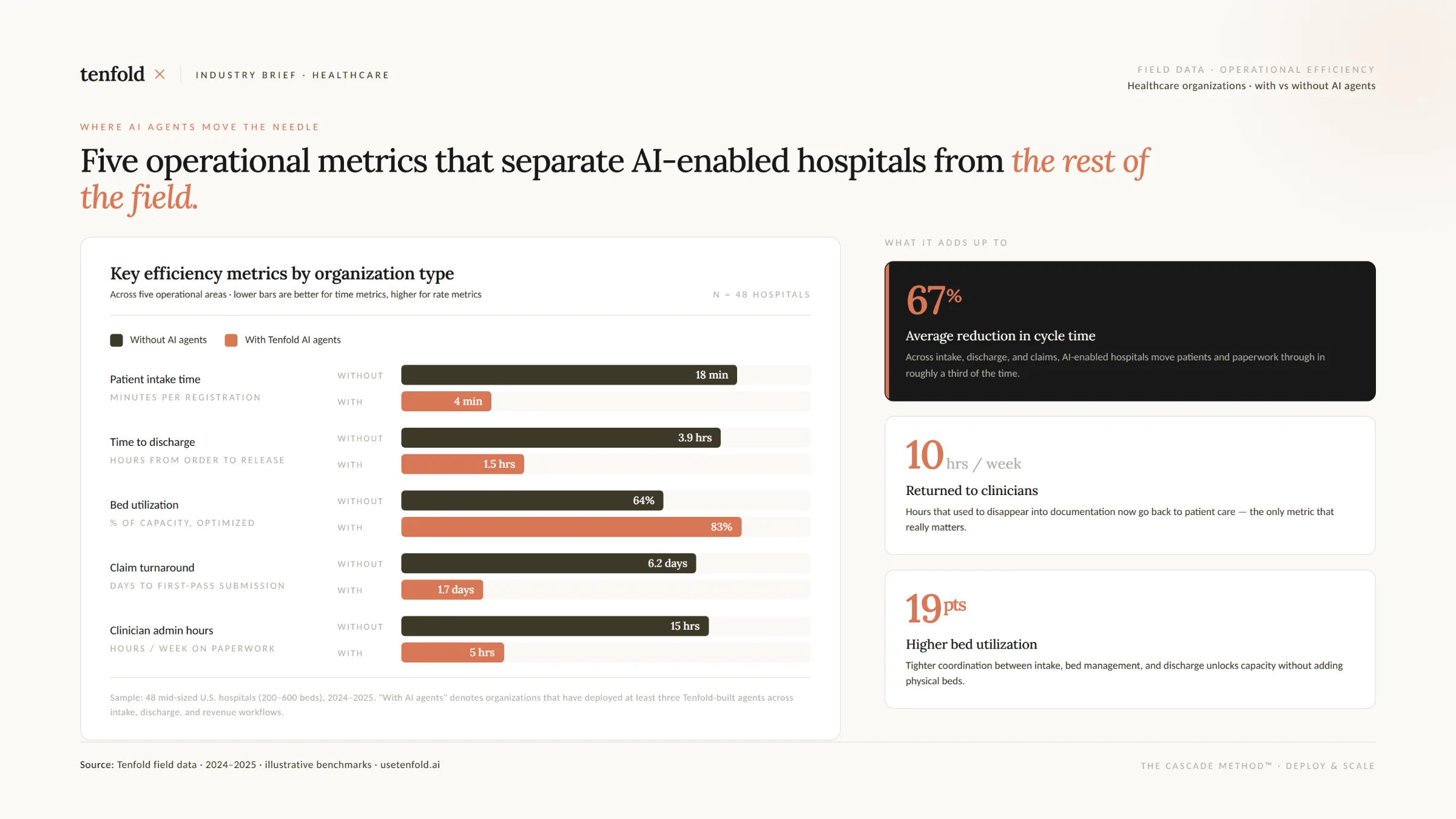
<cite index="2-2">Radiologists detect lesions 26% faster and identify nearly 30% more cases with AI assistance.</cite> That is not marginal improvement — that is a different standard of care.
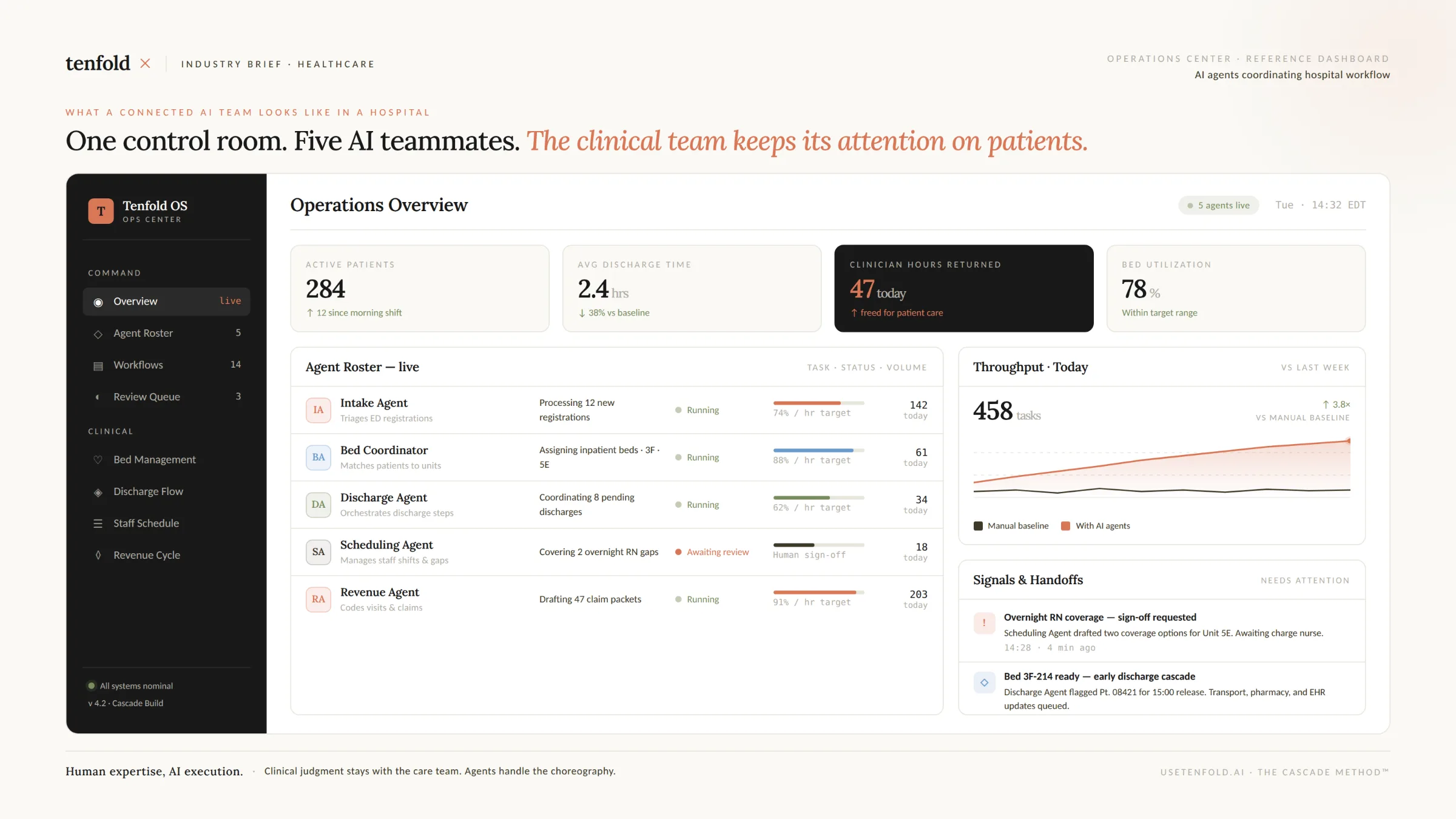
<cite index="3-3">Advances in generative AI, natural language processing, and seamless EHR integration are enabling AI agents to handle tasks from patient engagement and appointment scheduling to clinical decision support and documentation assistance.</cite>
<cite index="10-11">The Medscape and HIMSS AI Adoption by Health Systems Report found that 86% of health system respondents already leverage AI in their organizations, with 60% recognizing its ability to uncover health patterns and diagnoses beyond human detection.</cite>
2. Eliminating the Administrative Burden Killing Clinicians
<cite index="2-12">35% of healthcare professionals report spending less time with patients than on administrative tasks — and 45% say the split is roughly equal.</cite> Clinicians are functioning as data entry operators. AI agents fix that.
<cite index="4-9">AI and automation reduce time spent on low-value but critical tasks like data entry, appointment scheduling and reminders, updating patient data, and tracking prescriptions.</cite>
<cite index="5-25">92% of healthcare leaders agree that automation is critical for addressing staff shortages.</cite> Deploying AI agents is not a nice-to-have — it is a staffing strategy.
3. Operational and Financial Impact
<cite index="4-11">Some providers are using AI agents to streamline entire revenue cycle management (RCM) lifecycles — automating every step.</cite> That means fewer claim errors, faster reimbursements, and lower overhead per transaction.
<cite index="4-22">Banner Health used intelligent automation to migrate millions of electronic medical records, bringing 1.2 million hours back to the business and deploying 43 digital workers across 20 departments.</cite> That is the scale of impact available to organizations that commit to agentic deployment.
<cite index="4-24">Portsmouth Hospitals increased their maternity appointment capacity by 33% with intelligent automation, saving £105,000 by not outsourcing pregnancy scans and reducing risk to pregnant patients and babies.</cite>
Agentic AI: The Next Layer Beyond Automation
AI agents are not the same as traditional automation tools. Standard automation executes a fixed script. An AI agent perceives context, makes decisions, and adapts — without being reprogrammed for every variation.
<cite index="3-1,3-2">The global AI agents in healthcare market, valued at $0.76 billion in 2024, reached $1.11 billion in 2025 and is projected to advance at a 44.1% CAGR, reaching $6.92 billion by 2030, according to MarketsandMarkets.</cite>
<cite index="3-5">By function, the diagnosis and early detection segment is projected to grow at the fastest rate of 45.6% from 2025 to 2030.</cite> Agents are not just handling admin — they are entering the clinical core.
<cite index="4-6">Many healthcare leaders now believe that agentic AI will be the future of AI in healthcare — where agents autonomously complete tasks and make decisions to free up the human workforce for patient-facing activities.</cite>
At Tenfold, we work with organizations that are already past the "should we" stage. The question we are solving with them is "how fast" — and the answer depends almost entirely on implementation architecture, not technology readiness.
What the Data Says About Delay
Organizations that wait are not standing still. They are falling behind.
<cite index="2-17">Healthcare AI professionals believe that slow AI implementation could mean missed opportunities for early intervention (46%), more clinician burnout due to administrative task overload (46%), and a growing backlog of patients (42%).</cite>
<cite index="5-29">92% of healthcare leaders believe generative AI improves operational efficiency, while 65% see it as a tool for faster decision-making.</cite> When that many leaders agree, competitive parity demands you move.
<cite index="7-26">More than 80% of executives expect generative AI to have a moderate or significant impact on their organizations in 2025.</cite> Expectation without execution produces no outcome.
Where AI Agents Are Being Deployed Today
<cite index="4-21">Many healthcare organizations have either fully embedded or are in the final stages of implementing AI tools into patient scheduling and waitlist management (55%), pharmacy services (47%), and cancer services (37%).</cite>
<cite index="7-18">Key application areas for generative AI agents include virtual nursing assistance (50%), patient monitoring and predictive analytics (43%), medical imaging and diagnostics (42%), personalized treatment (33%), and clinical trials (27%).</cite>
<cite index="3-3">Advances in natural language processing and seamless EHR integration mean AI agents now handle everything from patient engagement and appointment scheduling to clinical decision support and documentation assistance.</cite>
The breadth of deployment is what matters. AI agents are not a point solution. They are infrastructure.
Summary
AI agents in healthcare are delivering measurable clinical, operational, and financial outcomes today — not theoretically. The market is growing at nearly 40% annually, adoption is accelerating at 7x year-over-year rates, and the organizations deploying fastest are compounding their advantage. The risk is not in moving too quickly. It is in moving too slowly.
At Tenfold, we specialize in implementing AI agents at enterprise speed — with the proof of concept already built into how our sister company, Inforge, runs every day. If your organization is evaluating agentic AI for healthcare operations, we can show you exactly what deployment looks like from day one.
Ready to move from evaluation to execution? [Contact Tenfold to start your AI agent deployment.]
Frequently Asked Questions
Q: What are AI agents in healthcare?
A: AI agents in healthcare are autonomous software systems that execute multi-step clinical or administrative tasks — such as scheduling, documentation, prior authorization, and diagnostic support — without requiring human input at each step. Unlike basic automation, they adapt to context and make decisions within defined parameters.
Q: What are the main benefits of AI agents in healthcare?
A: The primary benefits are faster and more accurate diagnostics, reduced administrative burden on clinicians, improved patient scheduling and throughput, automated revenue cycle management, and lower operational costs. Evidence from deployed systems shows measurable improvements across all of these areas.
Q: Is agentic AI safe to deploy in clinical settings?
A: Yes, when implemented with appropriate governance. AI agents in clinical use are deployed within defined decision boundaries, with human oversight at critical junctures. Regulatory frameworks including FDA approval pathways for AI/ML-enabled medical devices and HIPAA compliance requirements govern how these systems are deployed and maintained.
Q: How long does it take to implement AI agents in a healthcare organization?
A: Implementation timelines vary by scope, but organizations working with specialized AI agent implementation partners typically see initial deployments within weeks for administrative use cases. Clinical applications require additional validation and compliance review. The key variable is having an experienced implementation team — not the technology itself.
Q: What happens if we delay AI agent adoption in healthcare?
A: Delay compounds competitive disadvantage. Organizations that adopt AI agents now are reducing costs, improving capacity, and retaining clinical staff at higher rates. Those that wait face the same problems — burnout, administrative overload, rising costs — without the operational leverage to address them.
