
AI Agents in Accounting: What the Data Says and What Your Firm Should Do Next
AI agents in accounting are autonomous software routines that execute multi-step financial workflows — categorising transactions, flagging anomalies, generating reports, drafting client communications — without waiting for a human prompt at each step. They are not chatbots. They are not copilots. They operate end-to-end across systems, and the firms deploying them are pulling ahead.
Quick Answer: AI agents in accounting automate entire workflows from document intake to reporting. According to Wolters Kluwer, AI adoption among accounting firms jumped from 9% in 2024 to 41% in 2025. Firms that have integrated agents are closing books faster, serving more clients, and freeing their teams for advisory work.
Key Takeaways:
AI adoption in accounting firms surged from 9% to 41% in a single year (Wolters Kluwer, 2025).
Firms with highly integrated technology are 87% more likely to report revenue growth.
Only 11% of enterprises have deployed agentic AI at full scale — the gap between awareness and execution is the competitive opportunity.
AI agents are most mature in document intake, reconciliation, and accounts payable — but are rapidly expanding into client advisory workflows.
The bottleneck is not capability. It is governance: knowing which tasks are safe to fully delegate and how to build oversight into agent-driven workflows.
The Adoption Curve Is Steeper Than Most Firms Realise
Accounting has crossed an inflection point. According to Wolters Kluwer's 2025 Future Ready Accountant Report, AI adoption in accounting firms jumped from 9% in 2024 to 41% in 2025 — a shift the report describes as moving from "cautious experimentation to confident integration." That is not incremental growth. That is an industry realigning.
The 2025 Intuit QuickBooks Accountant Technology Survey of 700 US accounting professionals found that 95% of firms adopted automation technologies in the past year, with top uses including payroll processing (47%), accounts payable and receivable (46%), and data entry and transaction processing (43%). Meanwhile, 64% plan to invest in or upgrade AI in the coming year — up from 57% the year prior.
The firms sitting on the sidelines are not being cautious. They are ceding ground.
What AI Agents Actually Do in an Accounting Firm
AI agents are not the same as AI tools. Most accounting software today operates at what practitioners call the "copilot" tier — guiding a user inside a single application. Agents are different: they take autonomous, multi-step actions across systems without being prompted on each task.
According to the CPA.com 2025 AI in Accounting Report, agentic platforms are now completing workflows from start to finish. Bookkeeping agents can categorise transactions, flag anomalies, generate monthly reports, and even draft client messages — all within a single automated sequence.
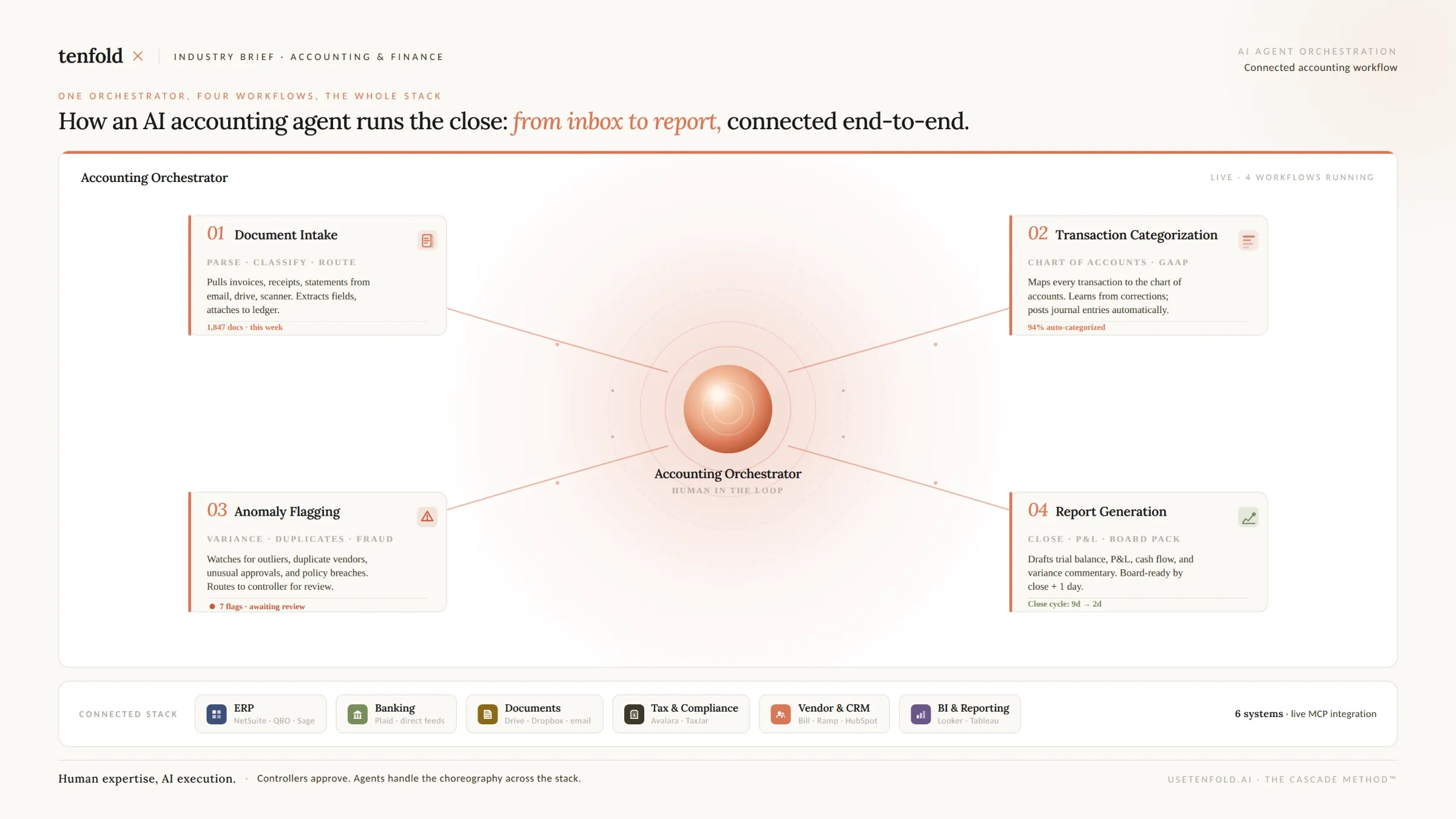
Wolters Kluwer breaks agentic roles into four tiers:
Taskers — automate low-value, repetitive tasks like document classification.
Automators — run entire processes end-to-end, such as flowing categorised transactions into trial balances.
Collaborators — provide intelligent guidance during complex workflows, such as routing or posting.
Orchestrators — coordinate multiple agents to deliver an outcome, such as moving a tax return workstream from intake to a first-pass, return-ready draft, with professional review at key judgment points.
The most mature deployment category today is document intake and categorisation — collecting financial documents, extracting data, and categorising against a chart of accounts without manual prompting on each item. Accounts payable agents automating W-9 collection, bill payment, and collections workflows are close behind.
Where the ROI Lives: Real Numbers From the Field
The case for AI agents in accounting is not theoretical. It is measurable.
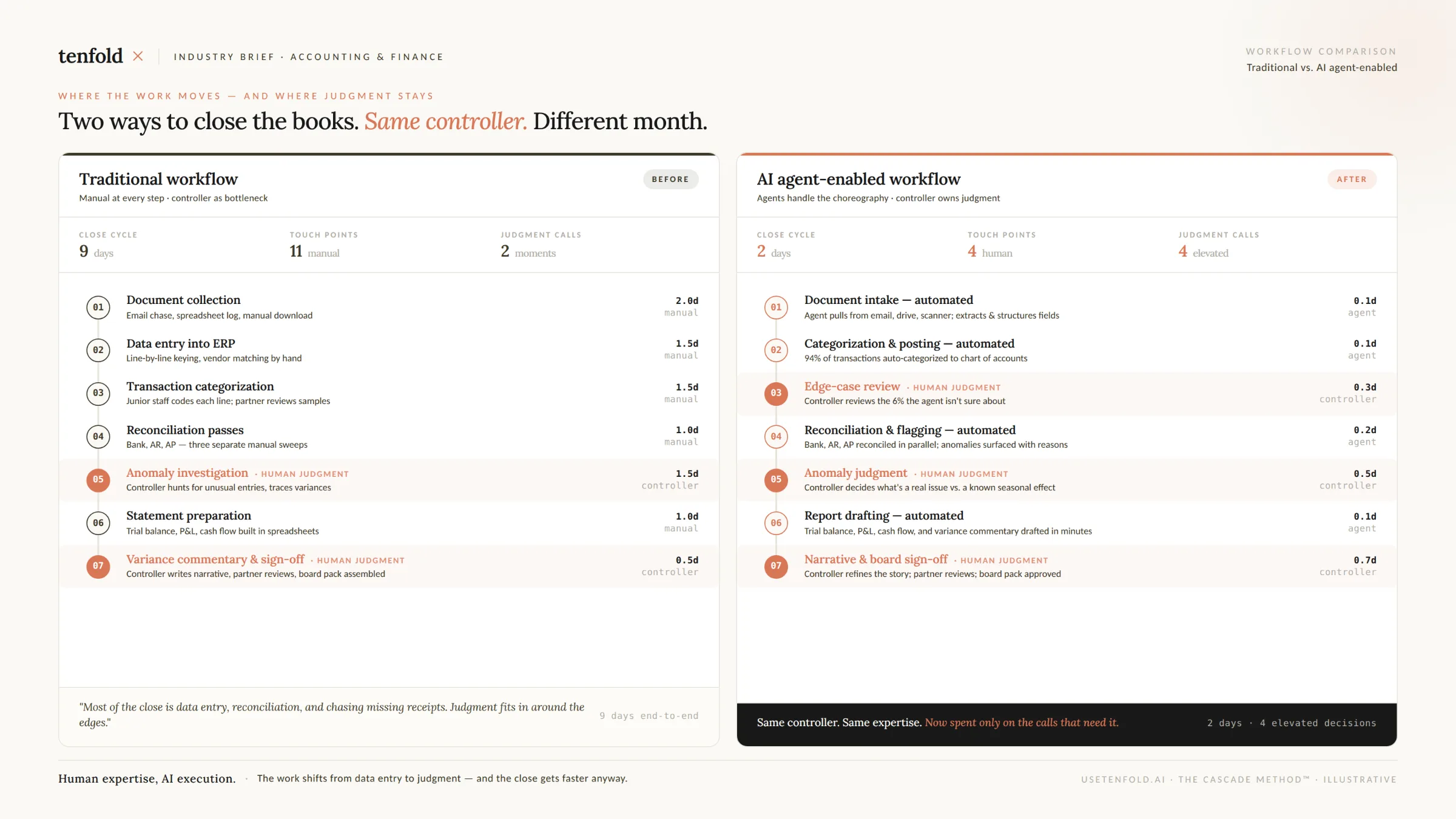
A Stanford Graduate School of Business study found that accountants who use AI support more clients per week and finalise monthly statements 7.5 days faster than those using traditional methods. They also spend 8.5% less time on routine back-office processing — redirecting that capacity toward client-facing advisory work.
The same study found that AI adoption led to a 12% rise in reporting granularity, meaning firms kept more detailed, more actionable records. Quality went up alongside speed.
At the firm level, the Wolters Kluwer 2025 report is unambiguous: 87% of professionals with highly integrated technology experienced revenue growth. High-growth firms are 53% more likely to have highly integrated systems and 38% more likely to be fully cloud-based.
According to Karbon's 2025 State of AI in Accounting Report, firms that invest in AI training unlock an additional seven weeks of capacity per employee per year. Only 37% of firms are currently making that investment — which means the majority are leaving that capacity on the table.
The Gap That Creates the Opportunity
Here is the tension that defines the current moment: 98% of accounting professionals now use AI in some form. Only 11% of enterprises across industries have achieved full-scale agentic AI deployment.
Most firms are using AI for research, drafting, and answering questions. Autonomous, multi-step execution across connected systems remains rare. The constraint is not what the technology can do — the agents exist and are proven. The constraint is governance: knowing which tasks are safe to automate fully, which require human review, and how to design oversight into workflows before something important slips through.
This is also where most implementation efforts stall. Firms deploy a tool, see early gains, then hit the integration wall. According to the 2025 Intuit QuickBooks Survey, firms are running an average of eight different apps for core operations — leading to integration difficulties (41%), time-consuming data entry (41%), and high subscription costs (44%). Agentic AI does not thrive in a fragmented stack. Orchestrators need clean data flows, reliable permissioning, and connected systems to deliver outcomes rather than demos.
At Tenfold, we have seen this pattern repeatedly: the organisations that move fastest are not those that bought the most tools. They are the ones that connected their stack before deploying agents into it.
What the Shift Toward Advisory Means for Firm Strategy
AI agents do not replace accountants. They change what accountants do.
The Wolters Kluwer 2025 report found that advisory services have become nearly universal among accounting firms, with 93% now offering them — up from 83% the year prior. The emphasis has moved from simply expanding service offerings to using AI and data to personalise and scale client advisory.
The 2025 Intuit QuickBooks Survey reinforces this: 93% of respondents said technology has significantly reduced time spent on compliance tasks and amplified their focus on strategic advice and client relationships. 79% expect a surge in strategic advisory work as a result.
This is not a soft, directional prediction. It is an operational restructuring. Firms that automate the volume work and free their CPAs for judgment-intensive advisory will outperform those that treat AI as a productivity tool bolted onto existing workflows.
Summary
AI agents in accounting are past the proof-of-concept stage. The data is clear: firms with integrated AI see measurable gains in speed, capacity, and revenue growth. The gap between those firms and those still experimenting is widening every quarter. The challenge is not finding an AI tool — it is building the connected, governed infrastructure that lets agents operate reliably at scale. That is where implementation expertise makes the difference, and it is exactly what Tenfold is built to deliver.
Frequently Asked Questions
Q: What is the difference between AI agents and regular AI tools in accounting?
A: AI agents take autonomous, multi-step actions across systems without requiring a human prompt at each stage. Regular AI tools — often called copilots — guide users inside a single application. Agents are distinguished by their ability to execute end-to-end workflows: collecting documents, categorising transactions, flagging anomalies, generating reports, and communicating with clients as part of a single automated sequence.
Q: Which accounting tasks are AI agents best suited to automate?
A: The most mature category is document intake and categorisation — collecting financial documents, extracting data, and mapping it against a chart of accounts. Accounts payable workflows (W-9 collection, bill payment, collections), reconciliation, payroll processing, and client communication tasks are also well-established use cases. Tax preparation automation is scaling rapidly, with some firms reporting over 80% automation of individual return preparation.
Q: Will AI agents replace accountants?
A: No — and the data supports this. A Stanford GSB study found that accountants using AI support more clients, close books faster, and produce higher-quality reports. The US Bureau of Labor Statistics projects 5% employment growth for accountants and auditors through 2034. The role is shifting from transaction processing toward advisory and judgment-intensive work, not disappearing.
Q: What is the biggest barrier to deploying AI agents in an accounting firm?
A: Governance and integration. Most firms operate fragmented tech stacks, which prevent agents from executing reliably across systems. Building the connected infrastructure — clean data flows, permissioning, defined review loops — is what separates firms running agents in production from those stuck in pilots.
Q: How do I know if my firm is ready for agentic AI?
A: Start with your workflow architecture. If your core systems are integrated and your data is clean, you are ready to begin with high-volume, rules-based tasks like document intake and reconciliation. If your stack is fragmented, address integration first. The firms seeing the strongest returns are those that treated agentic AI as an architecture programme before deploying agents into live workflows.
