
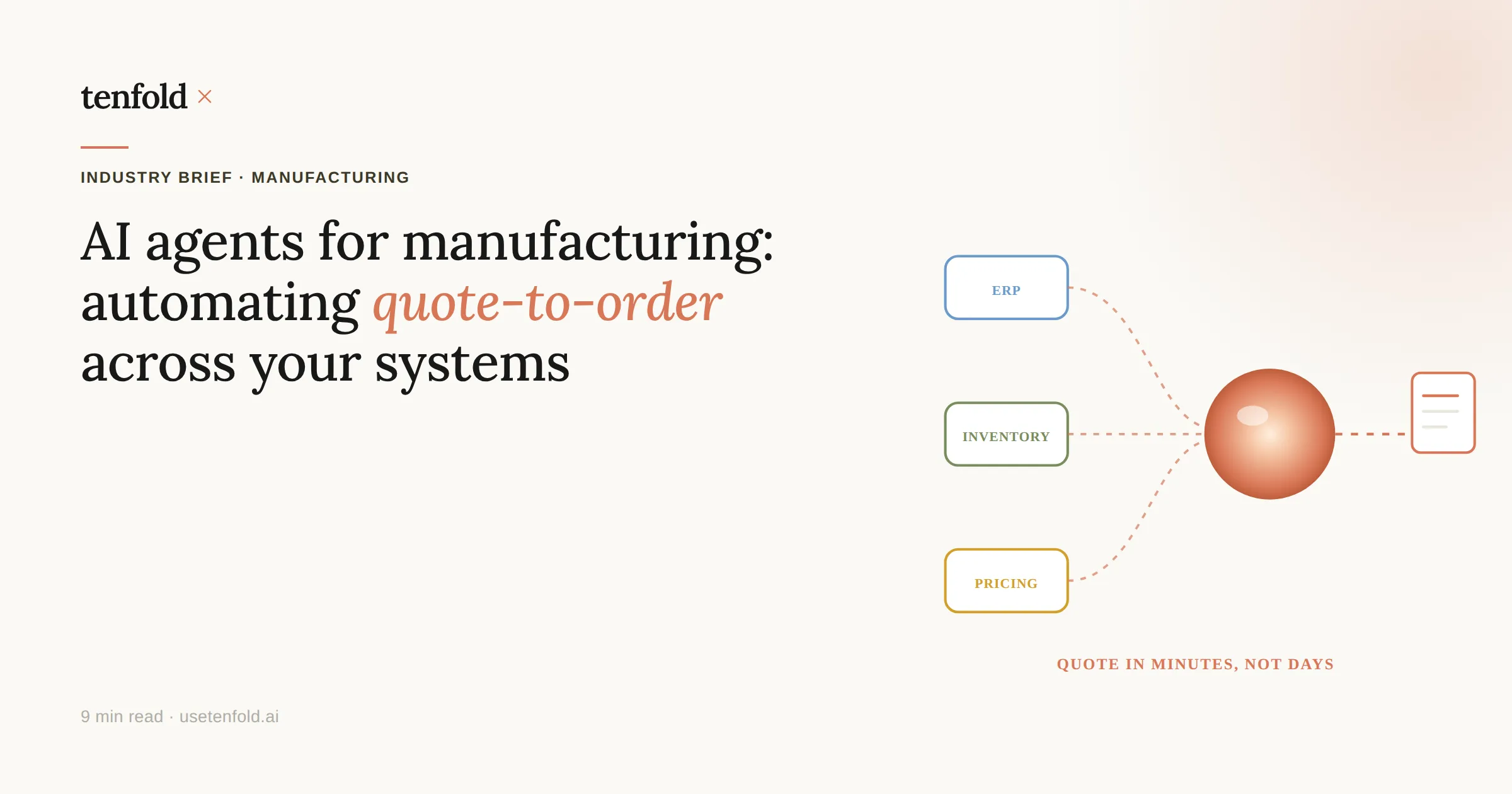
AI Agents for Manufacturing: Streamlining Quotes, Orders, and Support
Manufacturing has a quiet operational crisis: the work of quoting, order processing, and customer support is buried in manual, repetitive steps, while a demographic "retirement cliff" drains decades of senior expertise from the floor. The pressure is structural, and manufacturers know it — 89 percent of executives aim to implement AI in production, 69 percent have already started, and 72 percent of those report reduced costs and better operational efficiency.
What's changed in 2026 is the shift from rule-based automation to agentic AI: systems that understand a complex goal, build a multi-step plan, and execute across multiple software environments with human oversight but without constant human intervention. On the commercial side of manufacturing — quotes, orders, support — that shift is already producing measurable results.
Quick Answer: AI agents streamline manufacturing's transactional workflows by autonomously handling the repetitive, multi-system work of generating quotes, processing orders, and resolving support inquiries — freeing skilled staff to become strategic orchestrators rather than manual task-performers. The clearest early wins are in transactional order processing and materials-query handling.
Key Takeaways:
Early adopters report 80 percent automation of transactional order-processing decisions (Danfoss) and a 95 percent reduction in query time for materials data (Suzano).
Around 70 percent of agentic AI use cases are concentrated in BFSI, retail, and manufacturing — manufacturing is a primary adoption sector, not a laggard.
Manufacturing AI agents cut downtime by 15 to 20 percent through predictive maintenance and reduce maintenance costs by roughly 25 percent.
Smart factories using agentic systems can save about $300 million a year by reducing downtime and eliminating material waste.
Automated document management has avoided up to $1.3 million in productivity impact per site (Elanco).
Quotes: From Days of Back-and-Forth to Automated Responses
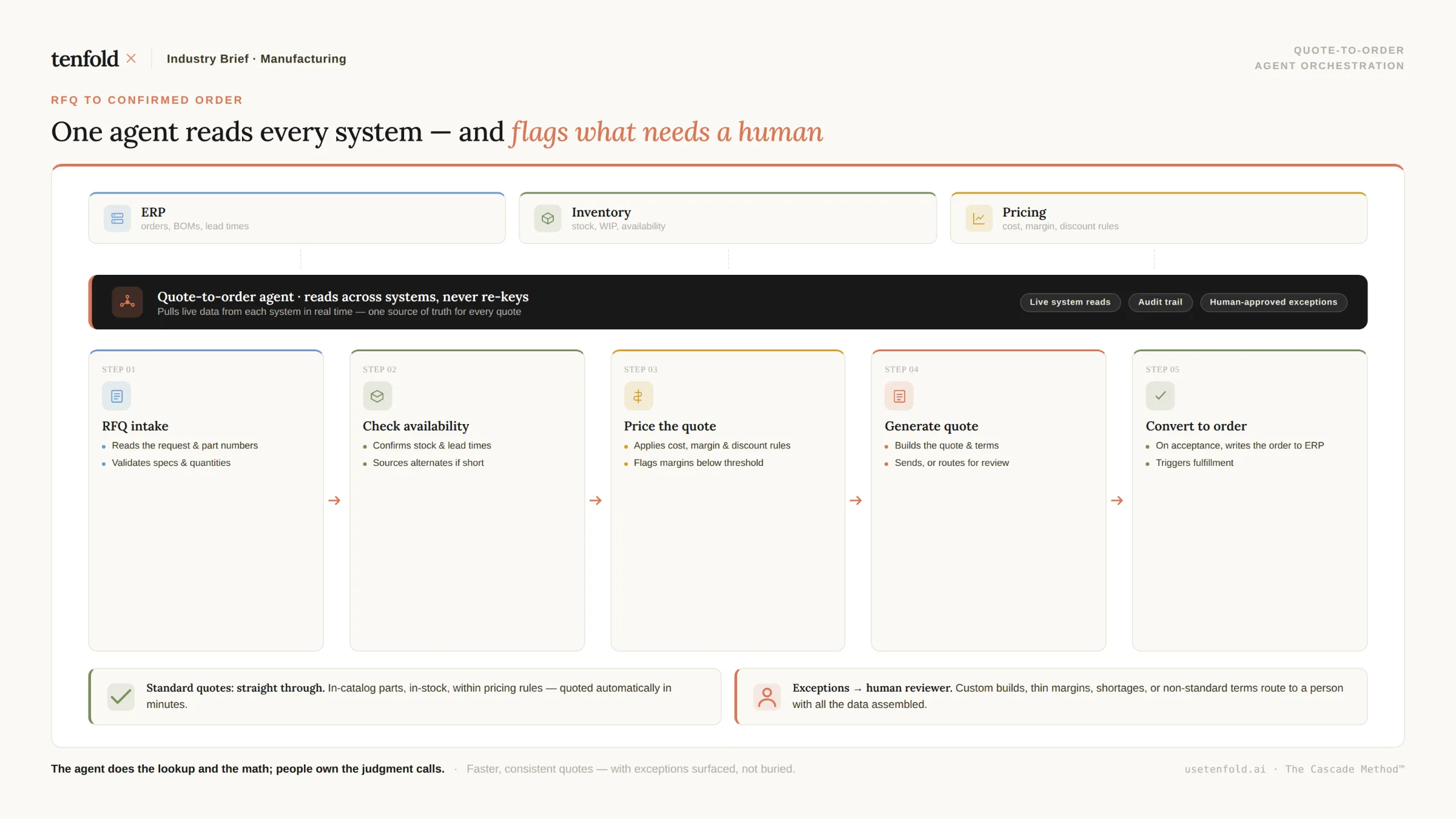
Quoting in manufacturing is notoriously slow — it requires pulling product specs, checking inventory and lead times, applying pricing rules, and accounting for configuration variables. Agentic systems compress this. One transportation company's buyers initiate agentic workflows that request quotes from approved suppliers and rank the responses autonomously. On the sell side, agents assemble quotes by reasoning across pricing logic, availability, and customer-specific terms, surfacing a draft for human approval instead of building each one from scratch.
Orders: Transactional Processing on Autopilot
Order processing is the clearest manufacturing win. The agent reads incoming requests from any channel — phone transcription, email, web form, or ERP API — and extracts the relevant details in seconds. It validates against inventory and policy, processes the routine transactional decisions autonomously, and escalates only the exceptions. Danfoss reports 80 percent automation of transactional order-processing decisions. Every action produces a log entry explaining the reasoning, which is what allows the system to improve and the business to diagnose failures.
This is genuinely agentic, not scripted. Traditional automation follows fixed if-then rules; agentic AI is goal-oriented — it understands an objective like "process this order accounting for a material delay," builds a plan, and executes across systems while keeping a human in the loop for oversight.
Support: 24/7 Resolution Across Systems
Manufacturing support spans product questions, order status, materials specifications, and technical troubleshooting — often requiring information scattered across siloed systems. Agents unify that. Suzano, the world's largest pulp manufacturer, built an AI agent that reduced query-handling time by 95 percent for 50,000 employees. By retrieving from product documentation, order systems, and technical knowledge bases, support agents resolve routine inquiries instantly and hand off complex cases to specialists with full context.
The Bigger Picture: The Digital Assembly Line
The most useful way to think about manufacturing AI in 2026 is the "digital assembly line" — the end-to-end orchestration of business and production processes by AI agents, just as physical assembly lines automated hardware in the 20th century. Agents provide tailored advice to plant managers, identify why specific shifts underperform, recommend optimal machine set-points, and coordinate across quoting, ordering, inventory, and support. The worker's role shifts from performing manual tasks to becoming a strategic orchestrator — delegating to agents, setting goals, providing nuanced judgment, and verifying quality as the final checkpoint.
What It Takes to Succeed
Manufacturing AI deployments often fail when all intelligence sits in a single layer — pushed entirely to the cloud or entirely to the edge. They also fail without the organizational discipline to define intent and verify agent output. The successful pattern: start with a high-volume transactional workflow (order processing or materials queries), build the audit trail in from the start, keep humans in the oversight loop, and expand to adjacent workflows once the first proves reliable.
Summary
For manufacturers, AI agents turn the slow, manual machinery of quoting, ordering, and support into autonomous workflows that run 24/7 and free skilled people for higher-value work — exactly as the retirement cliff makes that expertise scarcer. The early-adopter results are concrete: 80 percent order-processing automation, 95 percent faster materials queries, millions in avoided productivity loss. If you want to scope quote, order, or support automation for your operation, the Tenfold team can help.
Frequently Asked Questions
Q: What manufacturing workflow should we automate first? A: Transactional order processing or materials-query handling — these show the clearest early ROI, with adopters reporting 80 percent automation of order decisions and 95 percent faster query handling.
Q: How is agentic AI different from the automation we already have? A: Traditional automation follows fixed if-then scripts. Agentic AI is goal-oriented — it understands a complex objective, builds a multi-step plan, and executes across multiple systems while keeping a human in the loop, adapting to conditions like material delays.
Q: Will AI agents replace our floor and operations staff? A: The 2026 pattern is role shift, not replacement. Workers become "strategic orchestrators" who delegate repetitive tasks to agents, set goals, provide judgment on nuanced decisions, and verify quality.
Q: What's the most common reason manufacturing AI projects fail? A: Architecture and discipline — putting all intelligence in a single layer (all cloud or all edge), and deploying without the organizational process to define intent and verify agent output. Starting narrow with a built-in audit trail avoids both.
