

AI Agents for Insurance Claims Processing: How Automation Cuts Cycle Time in 2026
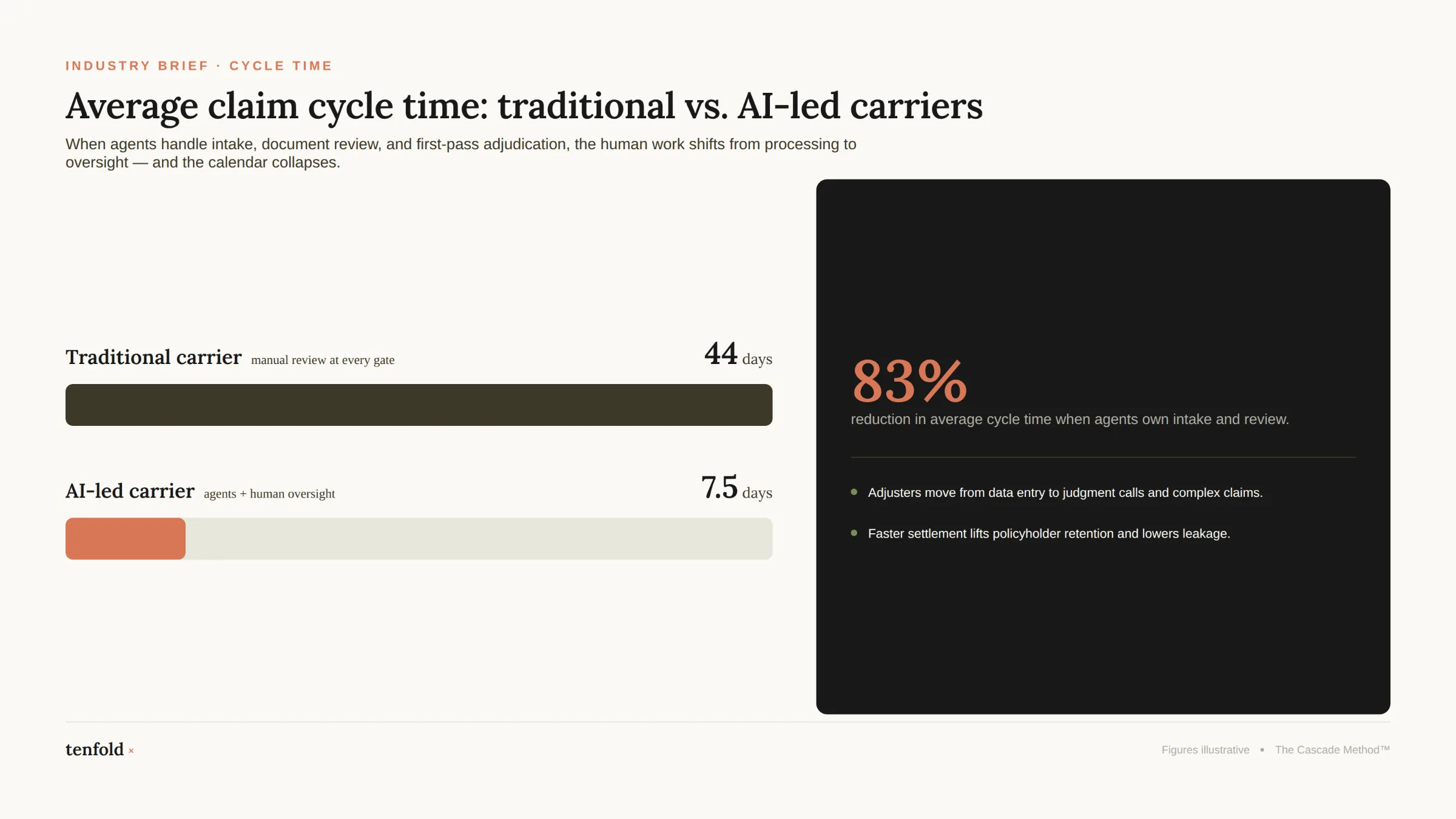
Insurance claims processing averages 44 days from first notice of loss to final payment — the longest on record, according to J.D. Power's 2025 U.S. Property Claims Satisfaction Study. Carriers deploying AI agents are resolving the same claims in under 8 days. That gap is not a technology problem. It's an organizational decision.
Quick Answer: AI agents cut insurance claims cycle time by automating the highest-friction stages of the workflow — FNOL intake, document extraction, fraud scoring, and adjudication routing — without replacing core claims systems. Carriers in production report 50–75% reductions in cycle time and 30–40% reductions in cost per claim.
Key Takeaways:
The J.D. Power 2025 study found average claim cycle time has reached 44 days — the longest on record. AI-led carriers are settling in 7.5 days.
Straight-through processing (STP) rates have jumped from 10–15% to 70–90% on leading agentic platforms.
FNOL-to-triage time drops from 4–8 hours to under 5 minutes with agentic workflows.
McKinsey's 2025 insurance AI analysis found full AI adoption jumped from 8% to 34% in a single year — the inflection is real.
The bottleneck in 2026 is not AI capability. It is organizational readiness to delegate decisions to a system.
At Tenfold, we work with operations leaders who are past the pilot phase. The question we hear most often is not "does this work" — it's "where do we start to get the fastest ROI." This post gives you the operational map.
Why Claims Cycle Time Is Still Broken in 2026
The average insurance carrier in 2026 operates across 4 to 7 disconnected systems — policy administration, claims management, billing, underwriting, fraud detection, and third-party vendor applications. Adjusters context-switch constantly. Policyholders repeat themselves at every touchpoint.
According to McKinsey's insurance modernization research, upgrading this fragmented infrastructure can deliver a 41% reduction in per-policy IT costs and a 40% increase in operational productivity. But most carriers haven't gotten there yet.
According to McKinsey's 2025 analysis, full AI adoption across the insurance industry stands at just 34% — up from 8% the year prior — while digital leaders like Aviva have already saved over £60 million by deploying more than 80 AI models across their claims domain. Two-thirds of U.S. insurers are watching a transformation unfold rather than leading it.
The structural problems creating this cycle-time crisis are consistent across carriers:
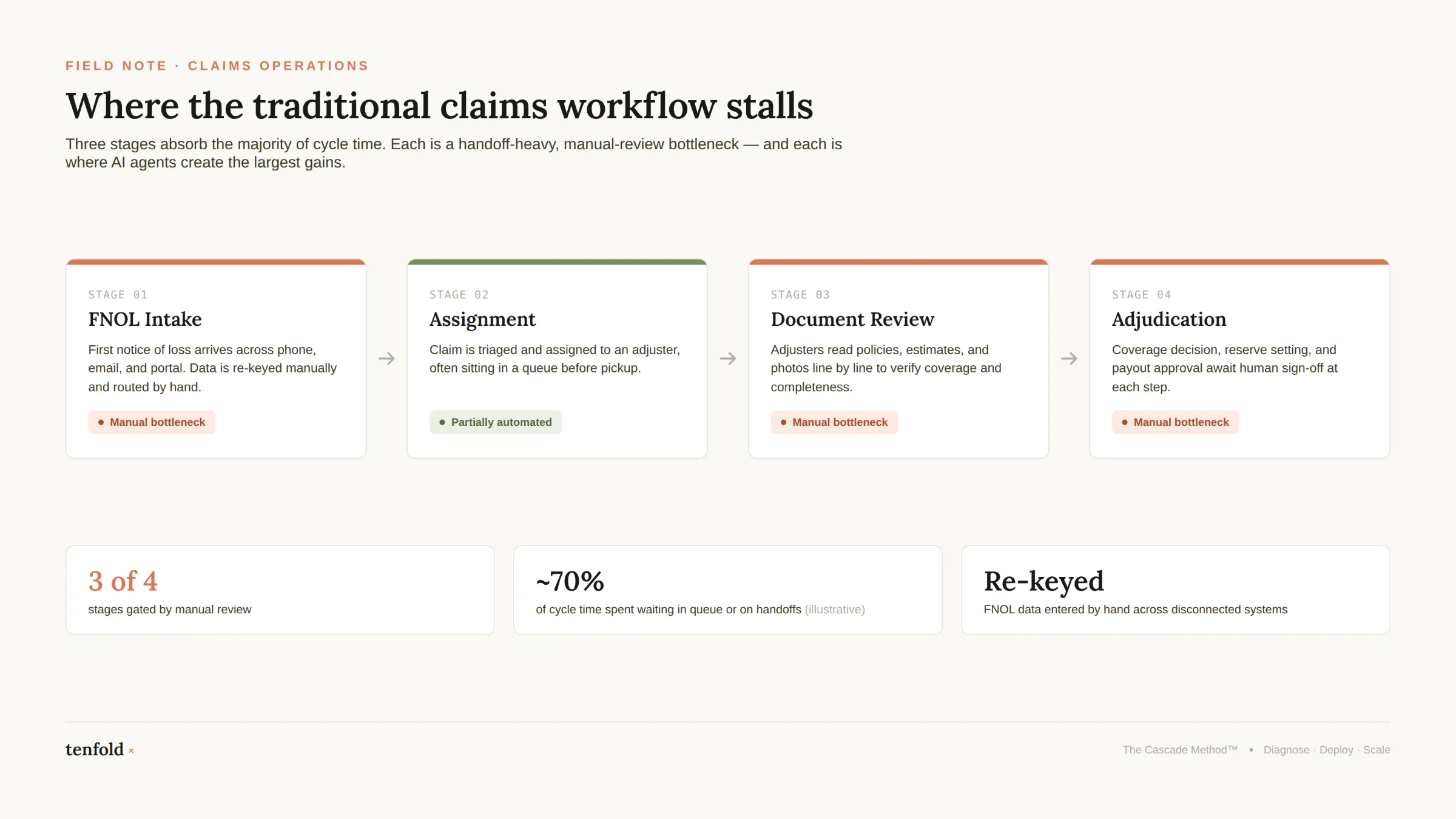
Manual FNOL intake creates a delay between notice and action that can stretch hours or days depending on staffing and workload. During that window, no triage occurs, reserves sit uncalculated, and customers get silence at the moment they need clarity most.
Disconnected document handling forces adjusters to manually extract data from medical reports, repair estimates, police reports, and photos — a task AI can complete in seconds.
Sequential review queues mean complex claims wait behind routine ones, dragging average cycle time up for every policy type.
What AI Agents Actually Do in a Claims Workflow
AI agents in claims processing are not chatbots with a claims FAQ. They are autonomous workflow executors that maintain context, interpret unstructured documents, and take coordinated actions across multiple systems — without a human in the loop for each step.
The architectural model gaining the most traction in 2026 is the compound AI architecture: a primary orchestrating model that simultaneously directs specialized sub-models for document classification, damage assessment, fraud detection, and reserve calculation. This is not a single model doing everything — it is an orchestrated agent team.
Here is what that looks like across the claims lifecycle:
Stage 1 — FNOL Intake and Triage
AI agents transform FNOL from a data-entry task into full orchestration. According to Five Sigma Labs, AI agents complete 30–40% of intake work before an adjuster opens the file. They capture structured data from voice, email, web portal, and mobile submissions simultaneously — with real-time validation against policy data and immediate fraud screening.
Carriers deploying agentic FNOL workflows report triage times dropping from 4–8 hours to under 5 minutes. That single compression has downstream effects on every subsequent stage of the claim.
For FNOL automation to work at scale, AI must accurately extract key claim data — insured name, loss date, jurisdiction, policy number, and claim type — from unstructured inputs including handwritten forms, scanned PDFs, photos, and free-text incident descriptions. Modern document AI handles this reliably.
Stage 2 — Document Extraction and Validation
Claims involve a high volume of unstructured documents: medical reports, contractor estimates, police reports, and damage photos. According to industry data cited by Prosper AI, 64% of insurers have made processing unstructured documents a top priority for AI investment — because it is the single most time-consuming manual task in the workflow.
AI using optical character recognition (OCR) and natural language processing (NLP) reads and extracts critical information from hundreds of pages in seconds. In auto insurance, computer vision AI analyzes damage photos and generates precise repair estimates almost instantly — enabling near-instant settlements on minor claims.
Stage 3 — Fraud Scoring
AI fraud scoring addresses one of the costliest problems in the industry. According to the Coalition Against Insurance Fraud (CAIF), insurance fraud in the US costs an estimated $308.6 billion annually.
Agentic AI fraud detection systems demonstrate a 78% improvement in fraud detection capabilities, with behavioral analytics achieving 92.3% accuracy in identifying fraudulent claims within the first 24 hours, according to Datagrid's 2025 analysis. When a fraud flag is triggered, the agent does not just alert a human — it documents the evidence, notifies the investigator, updates the case file, and pauses the settlement workflow in a single pass.
AI fraud scoring models also reduce false positives from 30–50% to under 10%, helping carriers cut manual investigation costs while improving customer experience for legitimate claimants.
Stage 4 — Adjudication and Straight-Through Processing
Straight-through processing (STP) — end-to-end claim resolution without human intervention — is the primary ROI metric in 2026. Industry data shows STP rates have jumped from 10–15% to 70–90% on leading agentic platforms. For US-based P&C carriers, STP rates for high-volume motor vehicle claims at defined severity thresholds have exceeded 60% at leading carriers.
In health insurance, approximately 80–85% of claims already process automatically. Advanced AI is now targeting the remaining complex cases — reducing the one to two weeks of extra processing time they typically require.
The Numbers in Production: What Carriers Are Actually Seeing
The results being published by carriers in production in 2026 are not projections. They are audited operational outcomes.
According to SG Analytics' June 2026 analysis of AI in insurance, carriers using AI automation in their claims resolution processes are resolving claims 75% faster, with an average cost reduction of 30–40%. What once took 30 days now takes 7.5 days on average, with simple claims moving through straight-through processing in as little as 24–48 hours.
According to ClaimRelay's 2026 Insurance Automation Trends report, agencies and carriers that adopted AI-powered claims processing reported 50–70% reductions in cycle time and significant improvements in policyholder satisfaction — and the gap between digitally advanced agencies and traditional operations is widening.
Zurich Insurance, using natural language AI technology, achieved a 58x reduction in claims review processing time — from 8 hours to just 8 minutes per claim, according to NextMSC's 2025 analysis. That is not an outlier result from a multi-year transformation project. That is a focused deployment producing immediate, measurable compression.
According to Deloitte's 2025 AI Outlook, focused pilots in FNOL automation or fraud scoring deliver 20–35% operational cost reduction and 50% faster claims cycles within 12 to 18 months — with ROI visible within the first quarter.
The global AI-in-insurance market is on a path from $15 billion today to $246 billion by 2035. But the carriers capturing that value are not waiting for the market to mature. They built governance guardrails, brought their operations teams along, and deployed into production.
The Transition Happening Right Now: AI-Assisted to AI-Orchestrated
The 2026–2027 period represents a structural shift — from AI-assisted claims workflows, where an adjuster uses AI tools, to AI-orchestrated workflows, where AI manages the claim end-to-end and the adjuster reviews outcomes.
This distinction matters for operations leaders making implementation decisions today. The ceiling on straight-through processing in 2026 is no longer technical. According to SG Analytics, the STP ceiling is no longer a function of AI capability — it is a function of organizational readiness to hand control to a system.
That requires three things most carriers have not fully built:
1. Clear escalation protocols — defining precisely which decisions can be fully automated, which require human review before execution, and which should receive AI recommendations only.
2. Audit trail infrastructure — capturing not just what decision was made, but what data informed it, what rules were applied, and what alternatives were considered. The NAIC Model Bulletin on AI use in insurance has been adopted by 23 states and Washington, D.C. as of Q1 2026. Compliance documentation is not optional.
3. Integration without core system replacement — modern AI agent modules connect via APIs without requiring carriers to replace their core claims management systems. This is the most common misconception that delays deployment.
At Tenfold, we've found that the fastest path to production is not the most ambitious AI deployment. It is the most precisely scoped one — starting with the highest-volume, lowest-complexity workflow stage and proving ROI before expanding scope.
Summary
AI agents are compressing insurance claims cycle time by 50–75% in production deployments — not through a single breakthrough, but through a compound effect across FNOL intake, document processing, fraud scoring, and adjudication routing. The data from 2025–2026 carrier deployments is unambiguous. The question for every operations leader reading this is whether their organization is building the governance and integration infrastructure to close the gap with carriers already in production.
Tenfold specializes in AI agent implementation for complex operational workflows. If your claims operation is ready to move from pilot to production, we can show you how.
Frequently Asked Questions
Q: How much does AI claims automation actually reduce cycle time?
A: In production deployments, AI agents reduce average claims cycle time by 50–75%. What once averaged 30 days now takes 7.5 days at AI-led carriers, with simple claims resolving in as little as 24–48 hours through straight-through processing.
Q: Do AI agents replace claims adjusters?
A: No. Agentic AI handles the high-volume, low-complexity stages of the workflow — FNOL intake, document extraction, fraud scoring, and routine adjudication — freeing adjusters to focus on complex, high-value claims that require judgment. The 2026 model is AI-orchestrated workflows with human review of outcomes, not replacement of human expertise.
Q: What is straight-through processing (STP) and why does it matter?
A: STP is a claim resolved end-to-end without human intervention. It is the primary efficiency metric in AI claims deployments. Leading carriers have pushed STP rates from 10–15% to 70–90% on agentic platforms, which directly reduces cost per claim, staffing overhead, and customer wait time.
Q: Where should a carrier start with AI claims automation?
A: The highest-ROI entry points are FNOL automation and fraud scoring — both are high-volume, well-structured workflows with measurable outcomes. According to Deloitte's 2025 AI Outlook, focused pilots in these areas deliver visible ROI within the first quarter and build the data foundation for expanding to full workflow orchestration.
Q: Do AI agents work with existing claims management systems like Guidewire or Duck Creek?
A: Yes. Modern AI agent platforms are designed to integrate via API alongside existing core systems — not replace them. Many carriers still rely on legacy claims platforms for record-keeping and regulatory reporting, with AI automation layers deployed on top to handle the operational workflows those systems do not automate.
