
AI Agents for Healthcare Operations: Compliance-Safe Automation Use Cases
Healthcare operations have a staffing problem, a margin problem, and a compliance problem — and they are all the same problem. Administrative burden consumes clinical bandwidth, inflates costs, and creates the exact documentation gaps that trigger audits and claim denials. AI agents can absorb that burden. The catch: in healthcare, how you deploy them matters as much as whether you deploy them.
The compliance-safe answer is this: AI agents work best in healthcare operations when they are deployed on high-volume, rules-heavy, administrative workflows — with clear human escalation paths and a signed Business Associate Agreement (BAA) with every vendor in the stack. Done right, they are not a risk. Done carelessly, they are a liability.
Key Takeaways:
Administrative tasks now absorb nearly a quarter of the U.S. healthcare system's $4 trillion annual spend — over $1 trillion per year.
The strongest AI agent ROI in healthcare comes from prior authorization, revenue cycle management, eligibility verification, and claims pre-validation — all compliance-manageable workflows.
Shadow AI is the leading governance failure: 20% of organizations suffered a breach tied to unsanctioned AI use in 2025, averaging $7.4 million per incident.
A signed BAA, role-based access controls, PHI de-identification, and human oversight at exception points are the non-negotiable architecture for any HIPAA-compliant AI agent deployment.
McKinsey projects AI in the revenue cycle could reduce cost to collect by 30–60% — but only organizations that govern their deployments will capture it.
Why Healthcare Operations Are Uniquely Suited to AI Agents
AI agents are not chatbots. They are goal-driven systems that can interpret context, plan multi-step actions, check outcomes, and iterate — without waiting for a human to direct each step. In healthcare operations, that capability maps directly onto the work that kills productivity.
According to McKinsey, health systems collectively spend more than $140 billion annually on revenue cycle operations — and nearly 20% of claims are denied on average, with as many as 60% of those denials never appealed. That is not a people problem. That is a workflow architecture problem.
The administrative workflows most suited to agentic AI share three characteristics: they are repetitive, rules-heavy, and data-intensive. According to a February 2026 HFMA survey of 95 healthcare finance professionals, 27% of organizations are actively deploying AI at scale across multiple revenue cycle functions, and 53% are running pilots. The shift from experimentation to production is happening now.
The bottleneck is not AI capability. It is that most healthcare organizations are deploying agents without the governance infrastructure to keep them compliant. That gap — between what agents can do and what organizations are set up to govern — is where implementations fail.
The Compliance Architecture Every Deployment Needs First
Before any use case, the legal and technical foundation must be in place. Skipping this is how $7.4 million breaches happen.
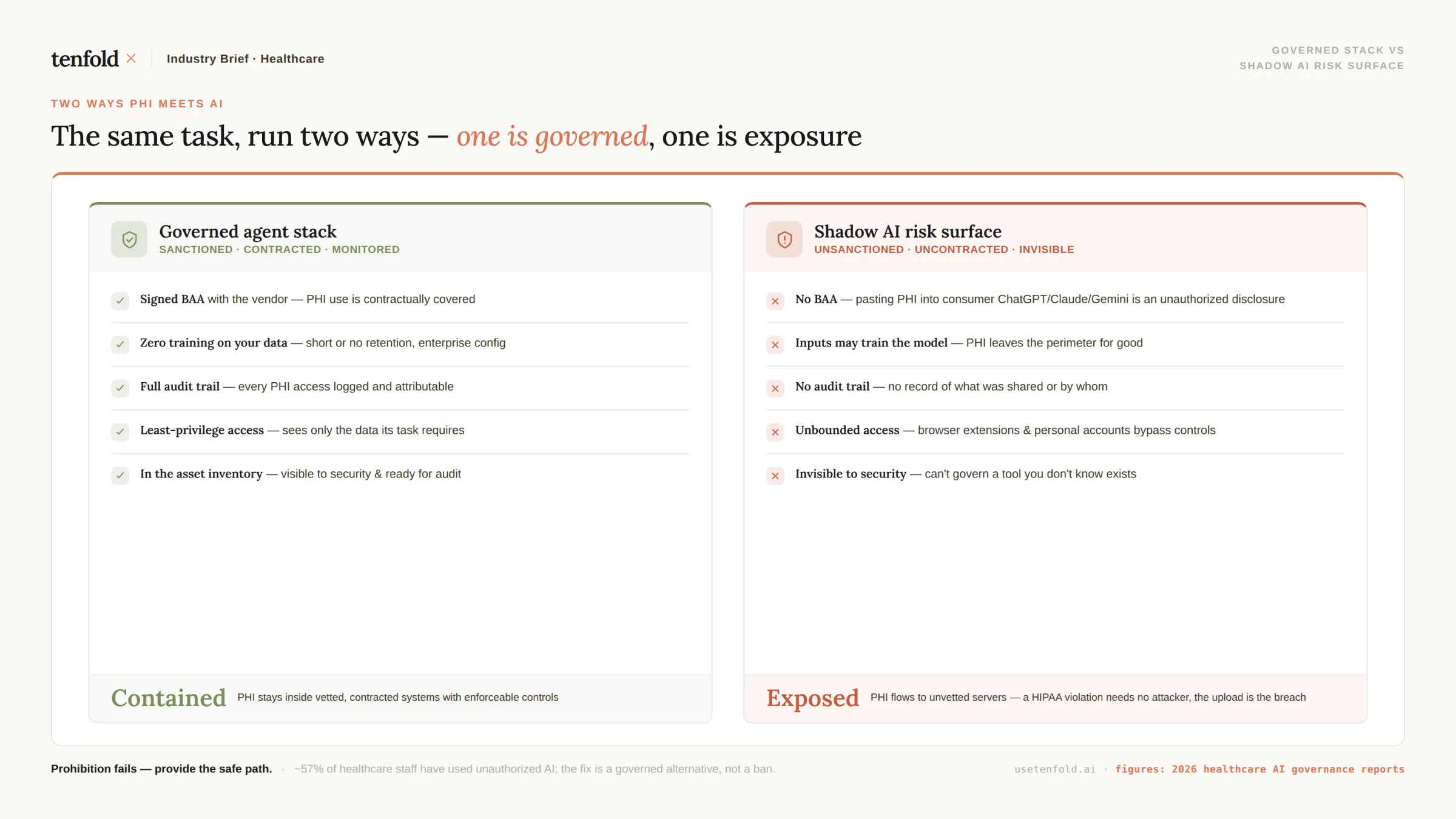
Business Associate Agreements (BAAs). Using AI for Treatment, Payment, or Healthcare Operations (TPO) is permitted under HIPAA without specific patient authorization — but only when a BAA is in place with the AI vendor. According to AISera, if a vendor refuses to sign a BAA, the evaluation ends. The BAA must explicitly prohibit the vendor from using your patient data to train public models, and must specify breach notification timelines.
PHI de-identification before processing. Good AI tools apply automatic PII scrubbing before routing data to models. HIPAA Safe Harbor requires removing 18 specific identifiers. Any agent touching clinical records must operate within these boundaries by design, not as an afterthought.
Role-based access control and audit logging. New 2025 HIPAA updates mandate continuous monitoring, mandatory encryption for all ePHI at rest and in transit, and breach notification timelines shortened from 60 to 30 days. Penalties now exceed $100,000 per violation annually. The architecture has to match the regulatory environment — which means immutable audit logs, least-privilege access, and automated evidence collection for audit readiness.
Human escalation paths. The most credible evidence from production deployments supports task automation and decision support — not fully autonomous, end-to-end clinical decision-making. Every agent workflow needs defined exception handling that routes complex or ambiguous cases to a human operator.
With that foundation in place, these are the use cases with the strongest evidence for compliance-safe ROI.
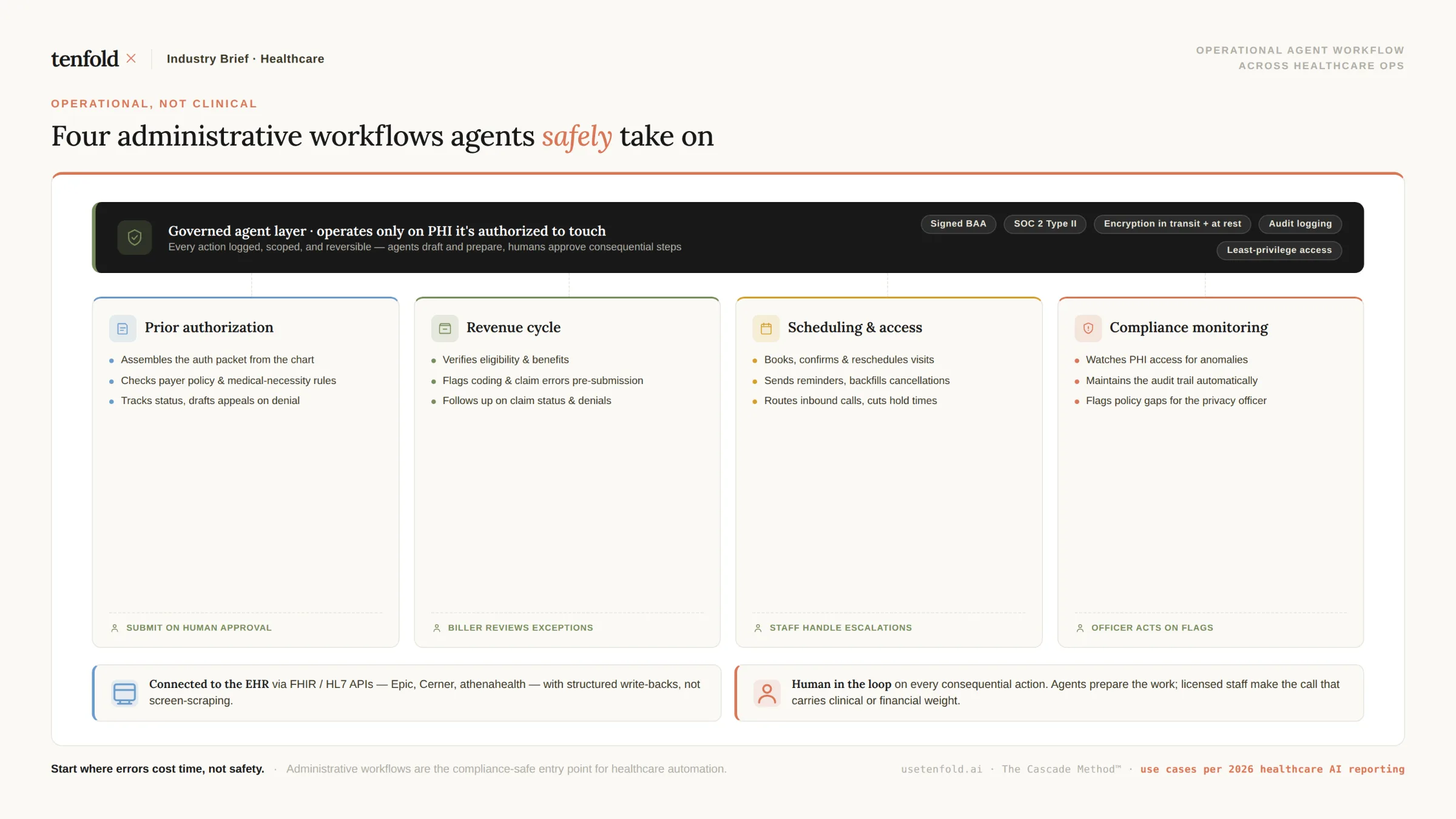
Use Case 1: Prior Authorization Automation
Prior authorization is the most operationally expensive administrative bottleneck in healthcare. It sits at the intersection of clinical operations, payer policy, and administrative capacity — three functions that rarely move in alignment. AI agents are changing that.
According to a 2025 national survey by the PAN Foundation, 27% of patients waited over a week for an insurance decision, and 34% experienced a reversal on an initially approved authorization. The burden falls on physicians and billing teams simultaneously, and it is fully automatable at the administrative layer.
Here is what a compliant agent workflow looks like in practice:
What the Agent Does
At the point of scheduling, the agent pulls real-time payer coverage data and maps payer-specific requirements for the exact service being requested.
It assembles the clinical documentation packet — pulling from EHR records, lab results, and physician notes — and validates completeness before submission.
It submits to the payer portal, monitors authorization status continuously, and pushes updates to patients, physicians, and scheduling staff in real time.
On denial, the agent drafts an appeal packet with guideline-concordant alternatives and routes it for clinician sign-off before resubmission.
Where Human Oversight Stays
Clinician sign-off remains on all appeal submissions. Complex cases with ambiguous clinical criteria route to a specialist queue. The agent handles the retrieval, assembly, and tracking — not the clinical judgment.
According to AWS, multi-agent AI frameworks have transformed prior authorization from a process that consumes hours of physician time each week into an automated workflow completed in minutes. A California Healthcare Network reported a 22% decrease in prior authorization denials following AI-powered implementation.
Use Case 2: Revenue Cycle Management and Claims Pre-Validation
Revenue cycle management is where agentic AI has the deepest evidence base in production healthcare environments. The workflows are rules-heavy, follow clear patterns, and produce measurable financial outcomes.
According to EY, providers reporting that 10% or more of their claims were denied increased from 30% in 2022 to 41% in 2025. The problem is getting worse. According to McKinsey, AI in the revenue cycle could lead to a 30–60% reduction in cost to collect — but only for organizations that deploy it at scale with proper governance.
Claims Pre-Validation
AI agents validate claims in real time against payer-specific edit libraries before submission — flagging coding errors, documentation gaps, bundling violations, and authorization mismatches. According to industry data, clean claim rates reach 95%+ with mature AI scrubbing versus an 85–90% industry average. Each percentage-point improvement in clean claim rate reduces denial rework cost by approximately $25 per claim.
Denial Management and Appeals
AI agents can review denied claims, identify the root cause, rebuild the documentation, and draft appeals — with human review before submission. According to McKinsey, functions like accounts receivable follow-up, underpayment management, and cash posting follow clear patterns that AI can learn and replicate, allowing human operators to manage exceptions. Inova Health System reduced annual coding costs by $500,000, decreased weekly discharged-not-final-billed cases by 50%, and increased average charge capture by 10% following autonomous coding implementation.
Eligibility Verification
Poor patient data at intake is the leading driver of denials. According to Experian Health's 2025 State of Claims survey, 54% of providers said claim errors were increasing, and 32% attributed them to inaccurate or incomplete patient data at intake. AI agents verify demographics, benefits, and secondary coverage before services are rendered — eliminating the downstream compounding effect.
Use Case 3: Compliance Monitoring and Audit Readiness
Compliance monitoring is the use case that most directly reduces regulatory risk — and it is one of the most underutilized. Manual compliance processes are structurally incapable of scaling with the volume of data, workflows, and third-party vendors healthcare organizations now manage.
According to Mindbowser, AI agents for healthcare compliance monitor operational workflows, evaluate activities against compliance policies, detect anomalies, and escalate issues when irregular behavior appears — continuously, not periodically. That is a fundamentally different capability than a quarterly audit.
Concrete applications include:
Continuous policy adherence tracking: Agents monitor whether updated guidance is consistently embedded into daily workflows, flagging deviations before they become audit findings.
Automated evidence collection: Instead of staff spending time collecting evidence during audit prep, agents maintain real-time audit-ready documentation across all relevant workflows.
Vendor risk monitoring: With accountability often split among CIO, CISO, compliance leaders, and third-party vendors, agents provide a single layer of continuous oversight across the vendor chain.
Shadow AI detection: Given that 20% of organizations suffered a breach tied to shadow AI in 2025 and that 63% lack formal AI governance policies, deploying an approved agent stack — with governance controls baked in — directly reduces the risk that staff seek out unsanctioned tools.
According to a 2025 IBM study, 97% of organizations that experienced an AI-related security incident had lacked proper AI access controls. The answer is not to slow down adoption — it is to govern it formally.
Use Case 4: Patient Scheduling and Contact Center Automation
Scheduling and patient communications are high-volume, low-clinical-risk workflows — which makes them ideal for agentic automation with minimal compliance exposure.
AI contact center agents handle patient inquiries across phone, chat, email, and portal simultaneously. They access complete patient histories, schedule appointments, verify benefits, answer billing questions, and provide medication information — escalating to clinical staff when medical judgment is required. According to Skan AI, hospital systems using these agents reduce average handle time while improving first-call resolution rates, with measurable improvements in patient satisfaction and reduced staffing requirements in contact centers.
According to a 2025 Salesforce survey, U.S. healthcare workers estimated that AI agents could reduce administrative burdens by up to 30%, with many reporting they would regain the equivalent of one full day per week if routine tasks were handled by intelligent agents.
The compliance posture here is relatively straightforward: agents must operate under a BAA, must not retain PHI beyond session scope, and must have clear escalation triggers to licensed clinical staff for anything that crosses into care guidance.
The Shadow AI Problem: The Risk Most Operations Leaders Are Ignoring
The biggest compliance risk in healthcare AI is not the agents you deploy. It is the ones you do not know about.
Shadow AI — clinicians and staff using consumer AI tools like public ChatGPT without organizational oversight — is now a primary driver of healthcare data breaches. In 2025, 20% of organizations suffered a breach specifically tied to shadow AI, making it one of the top three costliest breach factors. Healthcare breach costs averaged $7.4 million per incident in 2025.
According to Gartner's November 2025 analysis, by 2030, more than 40% of enterprises will experience security or compliance incidents linked to unauthorized shadow AI. The same research found that 69% of organizations already suspect or have confirmed that employees use prohibited public generative AI tools.
The governance implication is direct: the argument for deploying a governed, compliant AI agent stack is not just ROI. It is that governed agents crowd out ungoverned ones. A healthcare system that provided approved AI tools saw an 89% reduction in unauthorized use and 32 minutes of daily time savings per clinician — proving that the right governance model protects both compliance and productivity.
Organizations that delay formal AI agent deployment — waiting for a perfect framework before starting — are not avoiding risk. They are accumulating it.
How to Sequence Your AI Agent Deployment
Healthcare operations leaders do not need to automate everything at once. The right sequence maximizes ROI while containing compliance exposure at each stage.
Start at the back end of revenue cycle. Back-end RCM — accounts receivable follow-up, denial management, cash posting — is where AI agents have the strongest production evidence and the clearest compliance boundaries. Executives do not need to overhaul the entire system at once. This is where momentum builds.
Expand to prior authorization and eligibility. Once governance infrastructure is established and BAAs are in place, prior authorization automation delivers rapid, measurable impact on both operational efficiency and patient access.
Layer in compliance monitoring. Continuous compliance monitoring becomes a force multiplier as you add more agents — it provides the audit trail and anomaly detection that governance requires as the scope of automation expands.
Address scheduling and communications last. Not because they are less valuable, but because starting here without back-end governance in place creates a compliance surface without the foundation to manage it.
At every stage, the test is the same: Is there a BAA in place? Is PHI de-identified before processing? Are audit logs immutable? Are human escalation paths defined? If yes, the deployment is defensible. If no, it is not.
Summary
AI agents can absorb the administrative burden that is crushing healthcare operations — prior authorization delays, denial backlogs, compliance documentation, and patient communications — without crossing compliance lines. The organizations capturing this value share a common profile: they govern first, deploy second, and expand from there. The compliance infrastructure is not the obstacle to AI adoption in healthcare. It is the precondition for doing it safely at scale. At Tenfold, we help operations leaders build that foundation and execute AI agent deployments that are production-ready, not just pilot-worthy.
Frequently Asked Questions
Q: What does "HIPAA-compliant AI agent" actually mean in practice?
A: A HIPAA-compliant AI agent operates under a signed Business Associate Agreement with the vendor, applies automatic PHI de-identification before processing, enforces role-based access controls, and maintains immutable audit logs. Compliance is an architectural property, not a certification — it is built into how the system handles data, not claimed on a marketing page.
Q: Which healthcare AI automation use cases have the fastest ROI?
A: Revenue cycle management — specifically claims pre-validation, denial prevention, and eligibility verification — delivers the fastest measurable ROI because the outcomes are directly financial. Prior authorization automation is close behind, given the direct impact on claim approval rates and physician time.
Q: Can AI agents make clinical decisions under HIPAA?
A: The strongest production evidence supports administrative automation and clinical decision support — not fully autonomous clinical decision-making. AI agents in healthcare operations should handle retrieval, assembly, routing, and monitoring, with licensed clinicians retaining sign-off on all clinical judgments.
Q: What is shadow AI, and why does it matter for healthcare compliance?
A: Shadow AI refers to staff using consumer AI tools — public ChatGPT, consumer Gemini, and similar platforms — without organizational oversight, BAAs, or security controls. Entering Protected Health Information into these tools is a HIPAA violation. In 2025, shadow AI was linked to 20% of all organizational data breaches, with healthcare incidents averaging $7.4 million. The answer is governed AI deployment that gives staff approved tools, eliminating the incentive to seek out unsanctioned ones.
Q: How do we start an AI agent deployment without overwhelming our compliance team?
A: Start with back-end revenue cycle workflows — accounts receivable follow-up, denial management, cash posting. These have the clearest compliance boundaries, strong production evidence, and do not require broad clinical-data access to begin. Establish BAAs, audit logging, and escalation paths at this stage. Then expand to prior authorization and eligibility once the governance infrastructure is proven.
