
AI Agent Implementation Mistakes That Kill ROI (And How to Avoid Them)
Most companies implementing AI agents aren't failing because the technology doesn't work. They're failing because of avoidable decisions made before a single agent goes live. The result: wasted budget, stalled pilots, and a growing credibility gap between what leadership promised and what operations delivered.
Quick Answer: The most common AI agent implementation mistakes are deploying without a defined business outcome, ignoring data quality, skipping governance, building in isolation, and treating launch as the finish line. Each one is preventable — but only if you catch it before production.
Key Takeaways:
According to MIT research, 95% of companies investing in AI are not yet seeing meaningful ROI — not because AI fails, but because implementations do.
Gartner predicts over 40% of agentic AI projects will be canceled by end of 2027, citing poor value definition and weak governance as primary drivers.
The enterprises that see first-year returns define what to measure *before* they deploy — not after.
Data preparation can consume 60–80% of a project's effort before agents even begin delivering value.
The fix for nearly every mistake shares the same shape: define the outcome, name the owner, set the boundary, measure the result.
At Tenfold, we've built our entire delivery model on AI agents — not as a pilot, but as the operating core of how we work. That vantage point makes the industry's most common mistakes impossible to miss. Here's what we see, and what to do about it.
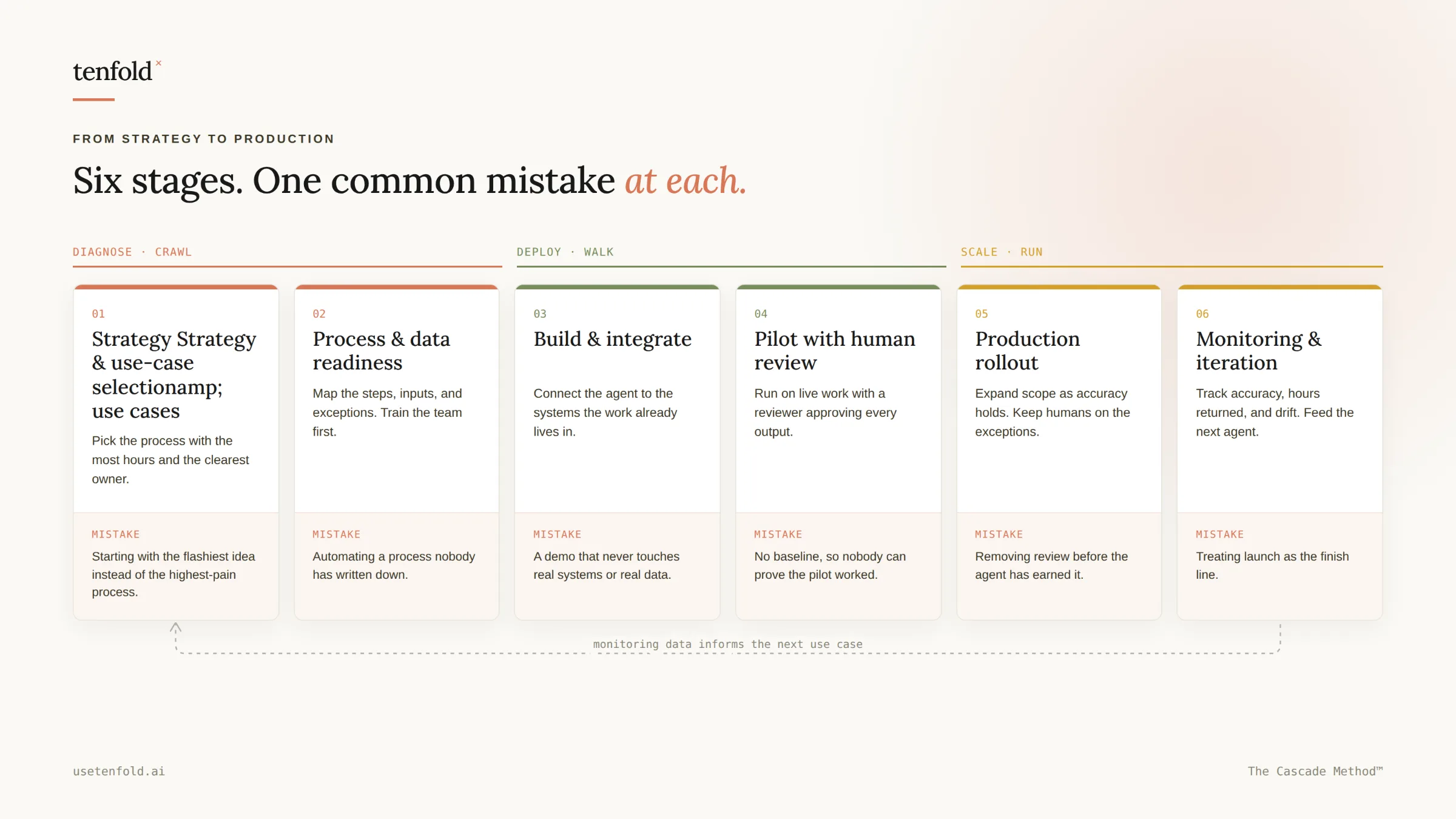
Mistake 1: Deploying Agents Without a Defined Business Outcome
This is the root cause behind most AI agent failures. Organizations launch agents because a demo impressed someone in a boardroom — not because a specific operational problem demanded it.
According to Inbenta's 2025 enterprise AI research, the most common strategic mistake is treating AI agents as technical prototypes rather than enterprise products. When agents are built without a product owner, roadmap, measurable KPIs, or governance, they become difficult to maintain, even harder to scale, and disconnected from the business outcomes they were meant to drive.
The symptom is familiar: a pilot that works in isolation, generates internal enthusiasm, and then quietly dies when it meets the real org.
How to avoid it: Before you name a tool, name the problem. Define the metric that proves success — not "agents deployed" or "tasks automated," but the operational outcome that changes. Cycle time reduced by X%. Escalation rate dropped by Y%. Cost per interaction from $Z to $Z-minus. If you can't name the number, you're not ready to build the agent.
Mistake 2: Underestimating Data Quality as an ROI Killer
Data problems don't announce themselves during demos. They surface three weeks after go-live, when agents start returning unreliable outputs — and nobody can explain why.
According to Informatica's 2025 CDO Insights Report, 43% of AI leaders cite data quality and readiness as their top obstacle to successful AI deployment. The mechanics are predictable: agents depend on trusted business data and business context to operate reliably. Feed them fragmented, outdated, or inconsistent inputs and the agent doesn't fail gracefully — it fails at scale.
The compounding cost is significant. Data preparation can consume 60–80% of a project's total effort before agents deliver a single unit of value. Organizations that skip the readiness assessment consistently underestimate this drag on ROI realization.
As the SAP Business Technology Platform president Michael Ameling put it: "One of the biggest challenges organizations face with agentic AI is scaling too soon before establishing a unified business data foundation."
How to avoid it: Run a data readiness audit before agent design begins. Map where your data lives, how it's structured, who owns it, and how stale it gets. Clean data isn't a prerequisite you can defer — it's the foundation every agent decision will be built on. Get it wrong here and you'll spend more fixing downstream outputs than you ever saved on automation.
Mistake 3: Skipping Governance Until It's Too Late
Governance feels like a brake on momentum. So teams defer it. According to Gartner, weak governance is one of the top named cancellation drivers for agentic AI projects — and it rarely gets added after the fact.
The data behind this is striking. Only 14.4% of teams go live with full security and IT approval, and just 47.1% of deployed agents are actively monitored. That's not a governance model — that's organizational exposure masquerading as a deployment.
The access problem compounds this. AI agents are often granted the same data permissions as the subject-matter experts they're meant to assist. As Shad Malloy, senior managing consultant at Bishop Fox, notes: "You wouldn't hand a new intern unrestricted access to your email, file share, and accounting platform, so there's no reason to grant an agent broad permissions either."
How to avoid it: Build governance before the agent becomes business-critical — not after. Assign named ownership. Set permission boundaries based on task risk, not convenience. Drafting a summary is low risk. Moving funds or altering regulated records is not. Match autonomy to blast radius, and build the oversight structure before you need it.
Mistake 4: Measuring Activity Instead of Outcomes
This mistake is quiet and expensive. Organizations count the number of agents deployed, tasks executed, and hours theoretically saved — and call it ROI. It isn't.
According to IBM's 2025 C-suite study, only 25% of AI initiatives have delivered expected ROI, and just 16% have scaled enterprise-wide. The companies stuck in that majority are almost always measuring the wrong things. They have dashboards full of activity metrics and no line connecting them to the business.
The problem runs deeper than reporting. Organizations not seeing returns either started with the wrong use cases, set no baseline to compare against, or built their business case around technology capabilities rather than operational results.
CFOs need hard-dollar outcomes: cost per interaction before and after, payback period, and a clear projection of what the investment returns over three years. Percentages don't close budgets — dollars do.
How to avoid it: Define your baseline before Day 1. What does the process cost today, in time and dollars? How often does it fail or require rework? Set that number before deployment, and make it the benchmark your agent is measured against. Every reporting cycle should answer one question: is the process performing better than it did before the agent?
Mistake 5: Scope Creep Before the First Agent Ships
The ambition that drives AI agent investment is the same force that kills it. Teams start with one well-defined use case and expand it — before launch — until the agent is supposed to handle fifteen things at once and nothing well.
Analysis of enterprise AI agent deployments across 2024 and 2025 reveals that fewer than 1 in 8 agent initiatives successfully reach production. Scope creep and data quality issues account for 61% of all failures combined — and scope creep, specifically, kills more AI agent projects than any other single factor.
It starts before a line of code is written. A customer support agent becomes a sales agent becomes an onboarding agent becomes a general-purpose assistant. By the time development starts, no one can define what "done" looks like — because done keeps moving.
McKinsey, Deloitte, and others point to over-customization as the biggest structural barrier to enterprise-wide agent deployment. Each highly customized one-off agent succeeds in isolation but collapses when you try to scale it.
How to avoid it: Lock scope before development begins. Define the agent's one job — not ten jobs, one job. Build, test, and prove that one job works. Then expand. Organizations new to AI agent implementation should start simple by targeting use cases where tasks are clearly defined and outcomes are easy to measure. The discipline of the first deployment is what earns the mandate for the next ten.
Mistake 6: Treating Launch as the Finish Line
The most operationally dangerous mistake isn't the first five. It's this one — because it happens *after* you've invested.
According to Salesforce, the biggest mistake organizations make is treating new agents like a one-and-done project, ignoring the need for rigorous testing and post-launch management. Without a continuous feedback loop, performance degrades. Business workflows evolve. The agent stays static. The gap between what the agent does and what the business needs widens — invisibly — until the failure is obvious.
Minor updates can introduce major regressions. Agents are non-deterministic and stateful, meaning the same request doesn't always produce the same result. Testing an agent before deployment and signing off doesn't make it safe in production. It makes it untested in production.
How to avoid it: Launch is Day 1, not the finish line. Establish a formal operational process from the start: regular performance reviews, regression testing on every major release, and a feedback loop from user interaction data back into agent improvement. The organizations that see sustained ROI treat agents the same way they treat any live product — with ownership, iteration cycles, and a roadmap.
What Separates the Companies That Get ROI From the Ones That Don't
The gap between organizations that see first-year returns and those still struggling to prove value comes down to one discipline: they define what to measure before they deploy, not after.
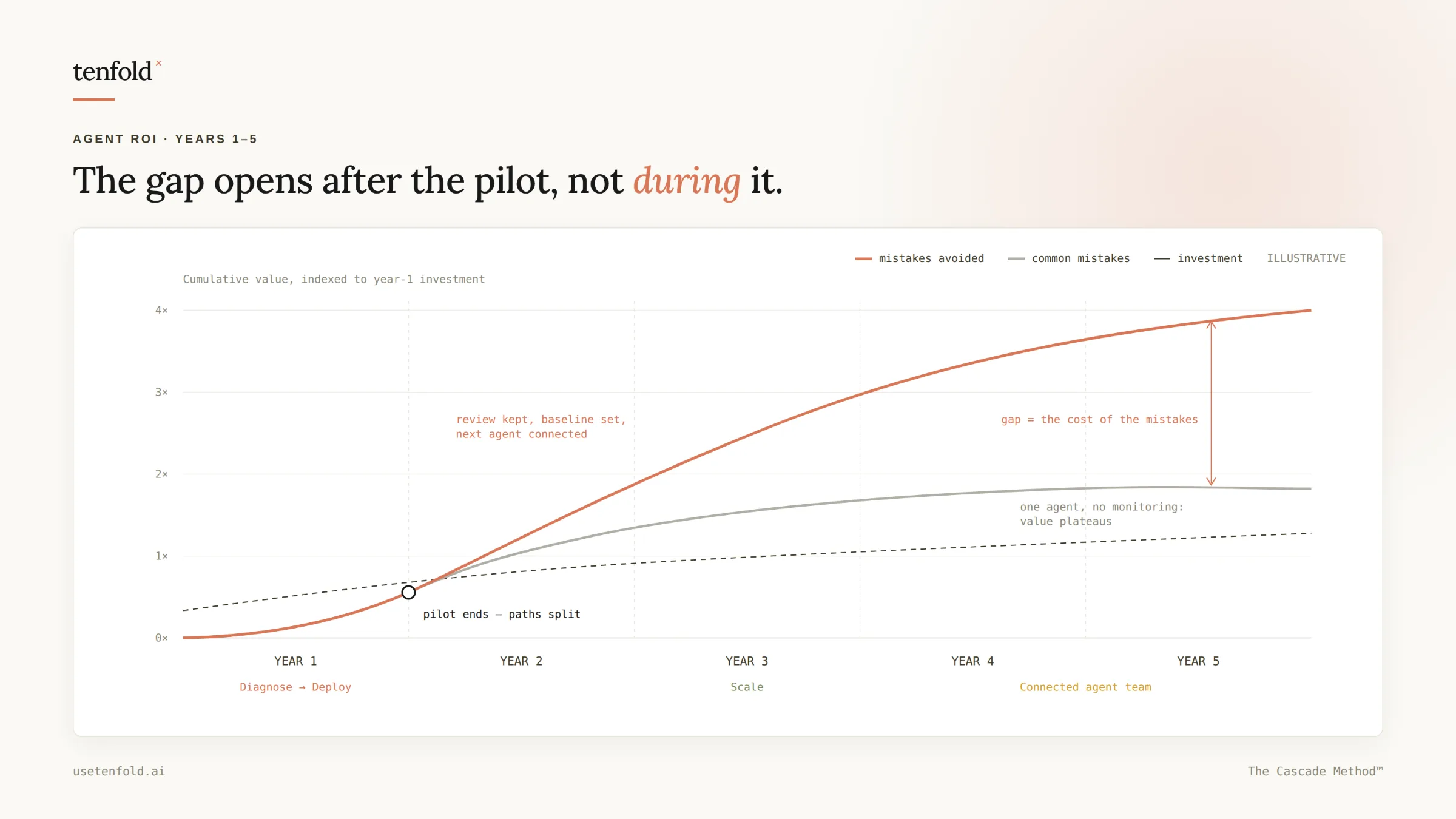
According to ABI Research, most enterprises can expect to see ROI from agentic AI by Year 2. Single-agent deployments yield a 29% ROI after two years, driven by efficiency gains. By Year 5, that compounds to 174%. But those timelines assume a clean implementation — defined outcomes, quality data, named ownership, and continuous iteration.
Shorten that timeline by eliminating the mistakes above before you build. Every one of them is preventable with discipline applied earlier in the process.
The bottleneck isn't AI capability. It's that most organizations aren't yet set up to delegate to it.
Summary
AI agent implementations fail for predictable, preventable reasons: no defined outcome, poor data quality, absent governance, vanity metrics, scope creep, and a launch-and-leave mentality. Each one is solvable — but only if you address it before production, not after. At Tenfold, we've operationalized AI agents as the core of how we deliver — and we help enterprise teams do the same, without the trial-and-error cost of learning these lessons the hard way.
Ready to implement AI agents without the common failure modes? [Talk to the Tenfold team.]
Frequently Asked Questions
Q: Why do most AI agent implementations fail to deliver ROI?
A: The technology rarely fails — the implementation does. Most failures trace back to three root causes: no defined business outcome before deployment, poor data quality, and weak governance. Organizations that see returns define success metrics, baseline performance, and ownership structures before writing a single line of agent code.
Q: How long does it take to see ROI from AI agents?
A: According to ABI Research, most enterprises see ROI from agentic AI by Year 2. Single-agent deployments yield approximately 29% ROI after two years, scaling to 174% by Year 5. However, Deloitte's 2025 research notes that most companies achieve satisfactory ROI within two to four years — significantly longer than the 7–12-month payback expected for traditional technology investments. Disciplined implementation shortens that timeline.
Q: What's the first thing a company should do before deploying AI agents?
A: Define the specific business problem the agent is solving and the metric that proves it's working. Before selecting a platform or building anything, name the outcome, establish the baseline, and assign ownership. Every implementation decision that follows should serve those three things.
Q: How much data preparation is actually needed before deploying an AI agent?
A: More than most teams anticipate. Data preparation can consume 60–80% of a project's total effort before agents begin delivering value. Run a data readiness audit early — mapping where data lives, how it's structured, and how current it is — to avoid the compounding cost of cleaning data after the agent is already in production.
Q: How do you prevent AI agent scope creep?
A: Lock scope before development begins. Define the agent's single job — not a cluster of related jobs — and build to that definition. Once that agent is live, tested, and proving its metric, expand. The discipline of the first scoped deployment is what earns organizational trust and budget for everything that follows.
