

AI Agent Deployment vs. Chatbots: What Professional Services Firms Need to Know Before Investing
If your firm deployed a chatbot in the last two years and called it an AI strategy, you are not alone — and you are not done. AI agents and chatbots are not incremental upgrades of the same technology. They are architecturally different systems built for different jobs. Confusing the two is costing professional services firms real money: wasted pilots, stalled ROI, and competitive ground surrendered to firms that got the distinction right earlier.
At Tenfold, we work with operations and C-suite leaders who are making this investment decision right now. The clearest thing we can tell you: the technology is ready, but most evaluation frameworks are not.
Quick Answer: Chatbots respond to inputs. AI agents pursue goals, reason across systems, and take autonomous action. For professional services firms with complex, multi-step workflows — proposal generation, client onboarding, compliance monitoring, contract review — AI agents deliver the category of ROI that chatbots structurally cannot. The investment decision hinges on workflow complexity, data readiness, and governance maturity, not on which product has the better demo.
Key Takeaways:
Chatbots are reactive and script-bound. AI agents are goal-directed and execute multi-step work autonomously.
According to Gartner, 40% of enterprise applications will include task-specific AI agents by end of 2026 — up from less than 5% in 2024.
Google Cloud's 2025 ROI of AI Report found that 74% of executives deploying AI agents achieved ROI within the first year.
The governance gap is the #1 deployment risk: only 21% of organizations have a mature governance model for agentic AI, per Deloitte.
"Agent washing" — rebranding existing chatbots and RPA tools as agents — is widespread. Industry analysts estimate only ~130 of thousands of claimed AI agent vendors are building genuinely agentic systems.
Professional services firms that treat chatbot deployment as step one of an agent roadmap will outperform firms that build one-off solutions.
The Actual Difference Between Chatbots and AI Agents
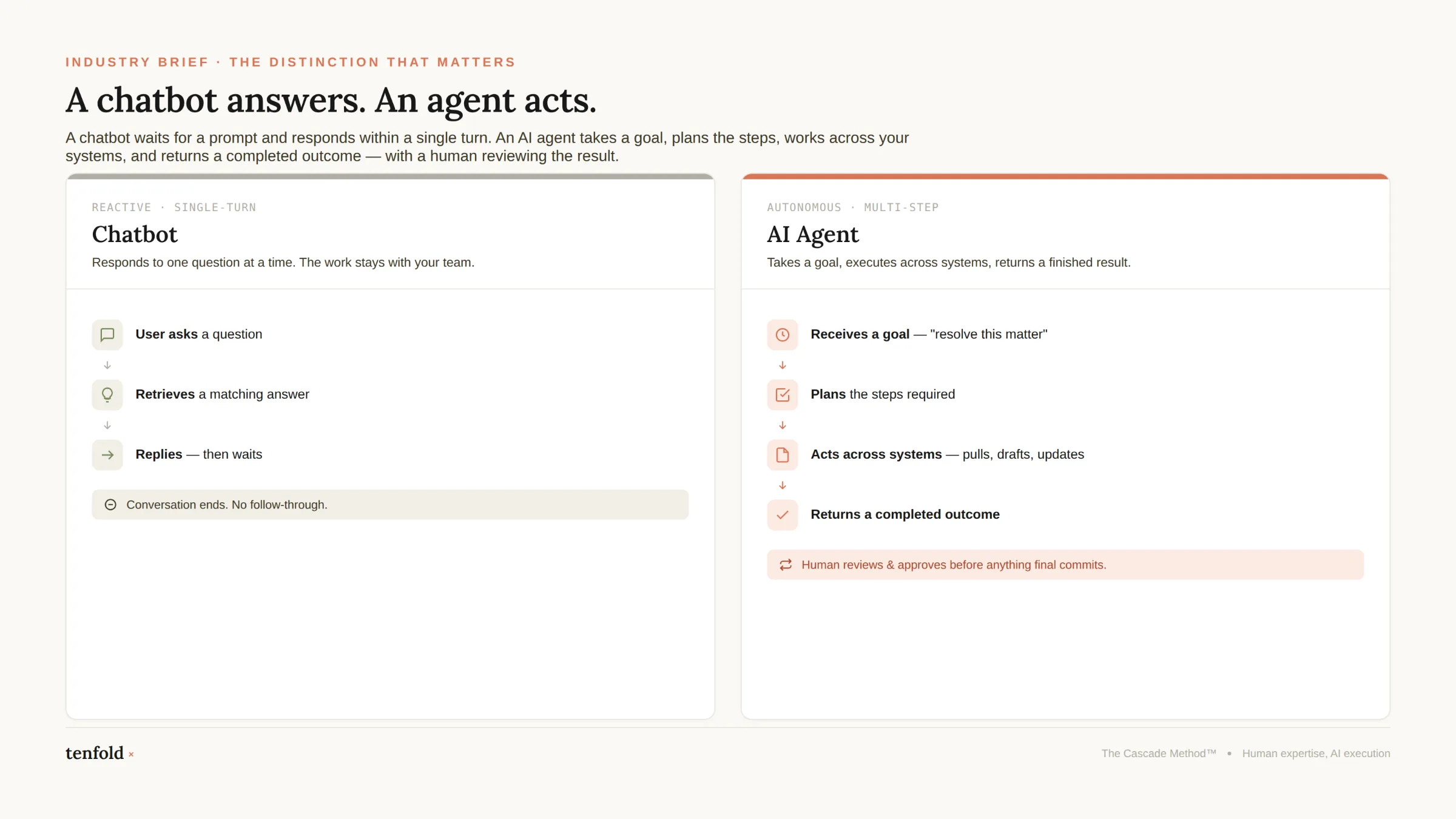
Chatbots respond to inputs. AI agents pursue goals. That sentence sounds simple, but it describes a fundamental architectural split with direct consequences for what each system can deliver in a professional services context.
A chatbot operates within predefined patterns and fixed logic. Even an LLM-powered chatbot depends on scripted responses and explicit user input to move a conversation forward. It handles well-defined tasks efficiently — FAQ resolution, basic data collection, routing inquiries — but it stops at the conversation layer. It cannot write to systems, trigger downstream workflows, or adapt when a step fails.
An AI agent is a goal-directed system. It can break a complex objective into sub-tasks, call external APIs and databases, make decisions without human intervention at each step, and adapt its strategy when a step fails. A chatbot tells a client how to schedule a review meeting. An agent checks calendars, identifies optimal times, sends invitations, books the room, prepares a briefing document, and follows up with non-respondents — all from a single instruction.
The performance difference is not marginal. According to Google Cloud's 2025 ROI of AI Report, among executives reporting productivity gains from AI agents, 39% saw productivity at least double. A chatbot plateau is a well-documented pattern: initial momentum in deflecting routine queries, followed by a leveling off once the bottleneck shifts from answering questions to carrying work through the process itself.
The core distinction for professional services leaders: chatbots improve conversations. AI agents complete work. If your highest-value bottlenecks involve multi-step processes — proposal generation, matter intake, client onboarding, compliance monitoring — chatbots address none of them.
Why Professional Services Is the Sector That Should Move First
Professional services firms face three structural pressures that make agent deployment more urgent than in most other sectors.
Capacity constraints. According to MindStudio's 2026 Professional Services AI Report, firms typically capture only 10–20% of their potential pipeline due to staffing limits. Agent-enabled delivery could expand that capture to 70–90%. The math is decisive: if an agent handles the repeatable, multi-step work of a junior associate, senior practitioners focus on judgment-intensive client work. That is not displacement — it is leverage.
Margin pressure. Traditional cost reduction methods — offshore staffing, process standardization — are near their limits. AI agents offer a path to efficiency without the quality tradeoff. Management consulting firms using internal AI agents are already reporting 30–40% reductions in analytical task time, according to the same report.
Client expectations. Clients now expect faster turnaround, 24/7 availability, and outcome-based pricing. Firms still operating on headcount-based billing models are under direct competitive pressure from the small number of firms that have already restructured delivery around agents.
The adoption data confirms urgency. McKinsey research cited by MindStudio shows AI implementation rates in professional services jumped from 33% in 2023 to 71% in 2024. That is not experimentation — that is structural adoption. The firms not moving in 2025–2026 will face a competitive gap that compounds.
According to the KPMG Q1 2025 AI Pulse Survey, 65% of C-suite respondents at organizations with over $1 billion in revenue reported progression from early experimentation into fully-fledged AI agent pilot programs — a jump from 37% just one quarter prior. Capital is moving. The question for your firm is not whether agents belong in professional services. It is whether you are building toward them or hoping the window stays open.
The ROI Case: What the Data Actually Shows
ROI from AI agents in professional services is not a projection — it is an observed pattern across multiple sectors, with numbers your board can evaluate.
According to Google Cloud's 2025 ROI of AI Report, 74% of executives deploying AI agents in production reported achieving ROI within the first year. Among those reporting productivity gains, 39% saw at least a doubling. These are not projections from vendors — they are executive surveys of live deployments.
Enterprise case studies confirm the scale. According to AI Monk's 2025–2026 enterprise case study analysis, organizations report an average ROI of 171% from agentic AI deployments, exceeding traditional automation ROI by 3x. U.S. enterprises specifically forecast 192% returns. Klarna's customer service AI agent saved $60 million, equivalent to 853 full-time agent roles by Q3 2025. JPMorgan runs 450+ agentic AI use cases in production daily. BakerHostetler, the American law firm, cut research-related hours by 60% using an AI-powered legal research tool, according to OneReach.ai's 2026 Agentic AI Statistics report.
The professional services-specific data is equally compelling. According to the same report, 87% of legal professionals predict AI will significantly impact the profession within five years. Global legal technology spending will reach $50 billion by 2027. The accounting and tax AI market hit $10.87 billion in 2026, with small and mid-size firms adopting at a 44.6% compound annual growth rate.
For operations leaders evaluating the investment decision: the ROI case for agents in professional services is no longer speculative. It is documented. The risk is not deploying too early. The risk is deploying without the governance foundation that separates productive agents from expensive incidents.
The Governance Reality Nobody Tells You Before the Pitch
Here is the number that should be on every leadership team's pre-investment checklist: only 21% of organizations have a mature governance model for agentic AI, according to Deloitte's 2026 State of AI in the Enterprise report — a survey of 3,235 IT and business leaders across 24 countries.
That means 79% of firms scaling agent deployments are doing so on governance infrastructure designed for a different era.
The gap is not theoretical. According to a 2026 EY/AIUC-1 Consortium survey, 64% of companies with revenue above $1 billion reported losses exceeding $1 million attributed to AI system failures during 2025. The Cloud Security Alliance's 2026 CISO AI Risk Report found that only 16% of organizations effectively govern AI access to core business systems. According to a Gravitee State of AI Agent Security survey of 750 executives, only 7.2% of organizations have a named individual with formal accountability for AI agent behavior.
For professional services firms, this is not just an operational risk. It is a compliance and client trust risk. Agents deployed in legal, financial advisory, or accounting workflows have access to sensitive client data. They write to systems, not just read from them. An ungoverned agent that makes a wrong decision in a matter intake workflow, a contract review process, or a compliance check does not just waste compute — it creates liability.
The EU AI Act's high-risk system requirements reached full enforcement in 2026, with penalties up to €35 million or 7% of global annual turnover. U.S. financial services face direct scrutiny: the SEC's 2026 examination priorities now list AI governance as a primary concern, having displaced cryptocurrency as the industry's dominant risk topic, per Corporate Compliance Insights' 2026 Operational Guide.
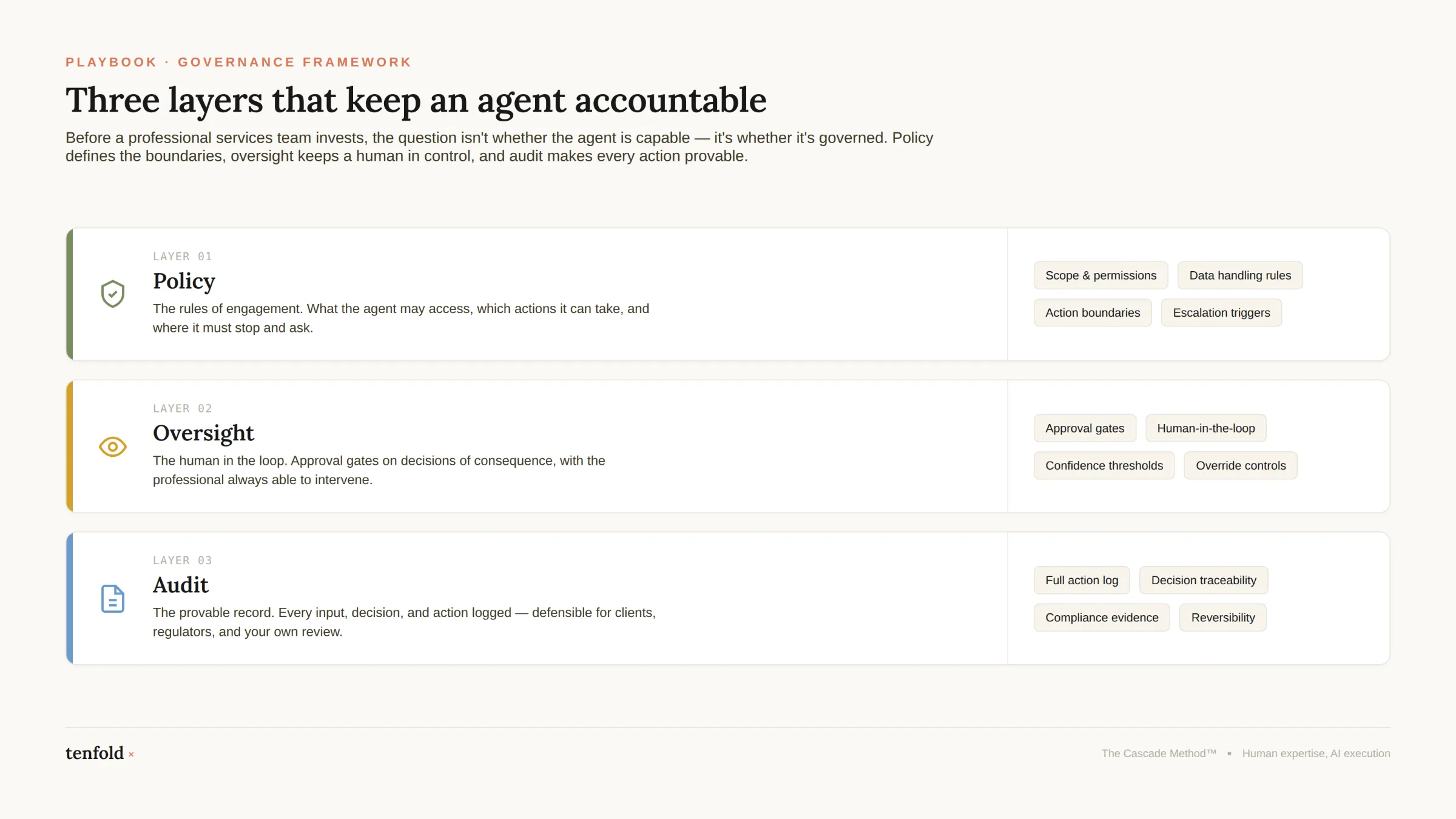
The practical implication: governance must be part of your agent deployment architecture, not a post-launch addition. In practice, the single largest source of failed AI pilots is not model quality — it is the absence of a governance layer that defines permissions, intervention points, and audit trails before agents go live.
The firms that succeed with agents are not those that deploy the most. They are the ones that deploy with clear accountability structures, defined intervention points, and the operational discipline to treat agents as infrastructure — not a tool.
The "Agent Washing" Problem: How to Spot It in Vendor Pitches
Not everything pitched as an AI agent is one. This matters because you are making a capital allocation decision, not a feature comparison.
According to SDxCentral's analysis of the 2025 agent market, Gartner estimated that of the thousands of claimed agentic AI vendors, only around 130 are building genuinely agentic systems. The rest are what the industry calls "agent washing" — existing automation tools, RPA scripts, or chatbots relabeled with agentic branding.
The test is not in the demo. It is in three questions:
1. Can the system write to your production systems without human approval of every step? If the vendor hedges, it is a chatbot with an agent badge.
2. What happens when a step fails mid-workflow? A real agent adapts. A script fails and surfaces an error.
3. How does the system maintain context across multi-session workflows? Chatbots typically reset between sessions. AI agents maintain multi-session memory and pursue long-term goals across environments and timeframes.
For professional services firms evaluating vendors: the distinction between a demonstration and a deployable system is not intelligence — it is control. Ask any vendor to walk you through their permissions model, their intervention points, and their audit trail architecture. If the answer is vague, the "agent" is not production-ready.
A related pattern to watch: firms that claim their chatbot deployment represents "AI transformation." According to McKinsey, while 88% of companies use AI in at least one function, fewer than 10% have deployed agentic AI at functional scale. Treating FAQ deflection as digital transformation is a positioning decision that will look costly in 24 months.
A Decision Framework: Chatbot, Agent, or Neither
The right tool depends on the problem, not the trend. Here is a direct framework for professional services leaders:
Deploy a chatbot when:
The task is conversational and bounded (FAQ, intake routing, basic data collection)
You need a fast, low-cost deployment to learn interaction patterns before committing to deeper integration
Risk tolerance for autonomous action is low and the process has no downstream system writes
Volume is high, variance is low, and the definition of "resolved" is simple
Deploy an AI agent when:
Work involves outcomes, not just responses — the system needs to *complete* something, not explain how to complete it
The process spans multiple systems that do not natively integrate
The task requires decision logic, not just retrieval (lead qualification, compliance checking, contract review, onboarding coordination)
You can define clear success metrics — cycle time, error rate, escalation rate — *before* deployment
Your data infrastructure is clean, structured, and accessible
Deploy neither when:
Your underlying data is messy, siloed, or undocumented — agents amplify data quality problems, they do not solve them
You have no governance framework in place — ungoverned agents in client-facing workflows are a liability, not an asset
The ROI case depends on replacing senior judgment rather than automating repeatable sub-tasks
The most common mistake we see: firms deploy an agent before defining what "the agent did its job" looks like. Measurable success metrics must be established before deployment, not inferred from dashboards afterward.
Summary
Chatbots and AI agents are not the same technology at different price points. They solve different problems, carry different governance requirements, and deliver different categories of ROI. For professional services firms, the distinction is material: chatbots handle conversations, agents complete work. The evidence from Google Cloud, Deloitte, KPMG, and sector-specific reports is consistent — agents deployed with proper governance and scoped to high-complexity workflows are delivering measurable, first-year ROI across legal, financial advisory, consulting, and accounting sectors.
At Tenfold, we help operations leaders move from evaluation to deployment with agent systems built to run in production — governance layer included from day one. That is how Inforge, our sister company, delivers full Salesforce implementations through prompts, not headcount. We are not describing a future state. We are describing how we operate today.
Frequently Asked Questions
Q: What is the main difference between an AI agent and a chatbot?
A: A chatbot responds to inputs within predefined logic and cannot take action outside the conversation. An AI agent pursues goals, reasons across multiple systems, and executes multi-step workflows autonomously. In professional services terms: a chatbot answers a client's question about a process; an agent runs the process.
Q: Is deploying an AI agent significantly more expensive than a chatbot?
A: Initial deployment cost is higher, but so is the ROI ceiling. Google Cloud's 2025 data shows 74% of organizations deploying agents achieved ROI within the first year, with some reporting productivity doubling. Chatbots deliver cost savings on repetitive queries but plateau quickly in complex workflow environments.
Q: What governance do we need before deploying AI agents?
A: At minimum: defined permissions for each agent (what systems it can read from and write to), human intervention checkpoints for high-risk decisions, a complete audit trail, and a named owner for agent behavior. Only 21% of organizations have mature agentic governance in place, per Deloitte. Governance should be architected before deployment, not retrofitted after an incident.
Q: How do we identify "agent washing" in vendor pitches?
A: Ask three questions: Can the system write to production systems without per-step human approval? What happens when a mid-workflow step fails? How does it maintain context across multi-session workflows? If the vendor cannot answer with specifics, the product is a rebranded chatbot or RPA tool.
Q: Where should our firm start if we have neither chatbots nor agents deployed?
A: Start with one high-volume, multi-step internal workflow where the bottleneck is repeatable coordination rather than expert judgment. Define the success metric before deployment. Build the governance layer in parallel. Prove value on one process before scaling. Firms that treat the first deployment as step one of a roadmap consistently outperform firms that build isolated tools.
